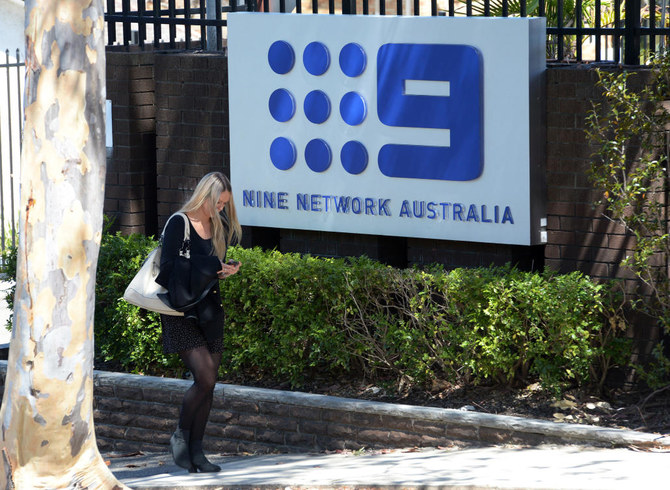
SYDNEY: Australian broadcaster and publisher Nine Entertainment Co. Holdings Ltd. said it signed multi-year content-supply deals with Google and Facebook Inc, harnessing tough new licencing laws to bolster profit.
The step means that all of Australia’s three largest media firms now have deals with US tech giants that had until this year fiercely opposed laws making them negotiate over the fees they pay for the links driving clicks to their platforms.
The owner of the Australian Financial Review and Sydney Morning Herald newspapers and the Nine free-to-air channel said it would provide articles and clips for Google’s News Showcase platform for five years, and to a similar Facebook product for three.
“These deals will contribute to supporting the world-class journalism on which our business thrives,” Nine Chief Executive Mike Sneesby told staff in an email, reviewed by Reuters, adding they would also help the firm pursue growth to underpin its strength in the long term.
A Google spokesman declined to comment, while Facebook was not immediately available for comment.
Rivals Seven West Media Ltd. and Rupert Murdoch’s News Corp, which dominate Australia’s traditional media market, along with Nine, have signed similar deals in recent months.
Like the others, Nine did not disclose financial details of the deals.
But it said it expected them to help grow pre-tax profit at its publishing unit by up to A$40 million ($31 million) in the year to June 2022, making it the first company to put a dollar value on the new arrangements.
The unit’s pre-tax profit was A$68.1 million in the six months to end-December.
In a client note, Morningstar analyst Brian Han called Nine’s deals “juicy high-margin arrangements which finally shift the image of the much-maligned and structurally-challenged division to one that can now much better monetise its (albeit still dwindling) journalistic resources.”
Nine shares rose as much as 5 percent to stand up 1 percent in late afternoon trade, in a flat overall market.
Since a bitter dispute with the government over the laws that briefly led Facebook to block all third-party content on its platform in Australia, the so-called “Big Tech” firms have signed up to pay for content from dozens of smaller regional and specialist providers.
Last month the managing director of Australian Broadcasting Corp. told a parliamentary hearing the state broadcaster was among the media companies to have signed letters of intent for deals with Facebook and Google, but has yet to finalize the arrangements.

Australia’s Nine signs Facebook, Google deals under new licensing regime
https://arab.news/bzjq6
Australia’s Nine signs Facebook, Google deals under new licensing regime
- “These deals will contribute to supporting the world-class journalism on which our business thrives,” Nine Chief Executive Mike Sneesby told staff
- The so-called “Big Tech” firms have signed up to pay for content from dozens of smaller regional and specialist providers
MenaML hosts 2026 Winter School in Saudi Arabia to boost AI education, collaboration in region
- Second edition of Winter School will be hosted in partnership with KAUST
DUBAI: The Middle East and North Africa Machine Learning Winter School will host its second edition in Saudi Arabia this year, in partnership with the King Abdullah University of Science and Technology.
The non-profit held its inaugural edition in Doha last year in partnership with the Qatar Computing Research Institute.
The initiative began when like-minded individuals from Google DeepMind and QCRI came together to launch a platform connecting a “community of top-tier AI practitioners with a shared interest in shaping the future of the MENA region,” Sami Alabed, a research scientist at Google DeepMind and one of the co-founders of MenaML, told Arab News.
Along with Alabed, the core team includes Maria Abi Raad and Amal Rannen-Triki from Google DeepMind, as well as Safa Messaoud and Yazan Boshmaf from QCRI.
Messaoud said that the school has three goals: building local talent in artificial intelligence, enhancing employability and connection, and reversing brain drain while fostering regional opportunity.
AI has dominated boardrooms and courtrooms alike globally, but “AI research and education in MENA are currently in a nascent, yet booming, stage,” she added.
Launched at a pivotal moment for the region, the initiative was timed to ensure “regional representation in the global AI story while cultivating AI models that are culturally aligned,” said Rannen-Triki.
The school’s vision is to cultivate researchers capable of developing “sophisticated, culturally aligned AI models” that reflect the region’s values and linguistic and cultural diversity, said Messaoud.
This approach, she added, enables the region to contribute meaningfully to the global AI ecosystem while ensuring that AI technologies remain locally relevant and ethically grounded.
MenaML aims to host its annual program in a different city each year, partnering with reputable institutions in each host location.
“Innovation does not happen in silos; breakthroughs are born from collaboration that extends beyond borders and lab lines,” said Alabed.
“Bringing together frontier labs to share their knowledge echoes this message, where each partner brings a unique viewpoint,” he added.
This year, MenaML has partnered with KAUST, which “offers deep dives into specialized areas critical to the region, blending collaborative spaces with self-learning and placement programs,” said Abi Raad.
The program, developed in partnership with KAUST, brings together speakers from 16 institutions and focuses on four key areas: AI and society, AI and sciences, AI development, and regional initiatives.
“These themes align with the scientific priorities and research excellence pillars of KAUST as well as the needs of regional industries seeking to deploy AI safely and effectively,” said Bernard Ghanem, professor of electrical and computer engineering and computer science at KAUST and director of the Center of Excellence in Generative AI.
The program will also highlight efficiency in AI systems, with the overall goal of equipping “participants with the conceptual and practical understanding needed to contribute meaningfully to next-generation AI research and development,” he told Arab News.
For KAUST, hosting the MenaML Winter School aligns with Saudi Arabia’s ambition to become a global hub for AI research under Vision 2030.
By attracting top researchers, industry partners, and young talent to the Kingdom, it helps cement the Kingdom’s position as a center for AI excellence, Ghanem said.
It also aligns closely with Vision 2030’s “goals of building human capital, fostering innovation, and developing a knowledge-based economy” and “contributes to the long-term development of a world-leading AI ecosystem in Saudi Arabia,” he added.

Although the program accepts students from around the world, participants must demonstrate a connection to the MENA region, Abi Raad said.
The goal is to build bridges between those who may have left the region and those who remain, enabling them to start conversations and collaborate, she added.
A certain percentage of spots is reserved for participants from the host country, while a small percentage is allocated to fully international students with no regional ties, with the objective of offering them a glimpse into the regional AI ecosystem.
Looking ahead, MenaML envisions growing from an annual event into a sustainable, central pillar of the regional AI ecosystem, inspired by the growth trajectory of global movements like TED or the Deep Learning Indaba, a sister organization supporting AI research and education in Africa.
Boshmaf said MenaML’s long-term ambition is to evolve beyond its flagship event into a broader movement, anchored by local MenaMLx chapters across the region.
Over time, the initiative aims to play a central role in strengthening the regional AI ecosystem by working with governments and the private sector to support workforce development, AI governance and safety education, and collaborative research, while raising the region’s global visibility through its talent network and international partnerships.
He added: “If TED is the global stage for ‘ideas worth spreading,’ MenaML is to be the regional stage for ‘AI ideas worth building.’”
The MenaML Winter School will run from Jan. 24 to 29 at KAUST in Saudi Arabia.