BEIRUT: French investigating judges questioned fugitive former car executive Carlos Ghosn in Beirut on Monday, in hearings that one of his lawyers described as a first for justice since his arrest in Japan.
The architect of the Renault-Nissan auto alliance has been fighting multiple probes since fleeing to Lebanon from Japan in late 2019 and has said he hopes to clear his name in financial misconduct cases against him.
The French allegations concern financial misconduct in France. Monday’s hearing started at 10:00 am local time (0700 GMT) and ended at 6:00 pm.
The sessions are expected to continue until June 4.
“It is the very first time that our client can explain himself in front of the judges with his lawyers sitting next to him and after preparing his defense,” Jean Tamalet, one of Ghosn’s lawyers, told reporters at the end of the hearing.
“It is the very first time of justice for Carlos Ghosn since he was arbitrarily arrested in Japan,” he said.
Ghosn, who has denied wrongdoing in all cases against him, was chairman of both Nissan and Mitsubishi and chief executive of Renault when he was arrested in Japan in 2018 on charges of under-reporting his salary and using company funds for personal purposes.
He fled to Lebanon in December 2019 hidden in carry-on luggage on a private jet that flew out of Japan’s Kansai Airport and has remained there since.
In France, Ghosn is at loggerheads with his former employer Renault over pension and severance payments he argues are due, and tax authorities have looked into his fiscal arrangements.
The French magistrates in Lebanon are pursuing questions about events thrown by Ghosn at the sumptuous Palace of Versailles, including whether in one case he knowingly used company resources to host a party that was for private purposes.
The French prosecutor’s office is also looking into financial flows between Renault, its Dutch affiliate and a car dealership in Oman.
Ghosn’s defense team had earlier said it had identified procedural irregularities in the French case that undermine the legal proceedings being organized by Lebanese judicial authorities.
The lawyers said in a statement that Ghosn — who had previously lived and worked in France and has French, Lebanese and Brazilian citizenship — would be heard as a witness and so cannot dispute the legality of the procedure.
The statement said the team was calling for Ghosn “to be afforded the status of ‘indicted’, as only this would allow him to challenge the legal flaws surrounding the case.”
Ghosn suffered a setback in one of his legal cases last week, when a Dutch court ordered him to repay 5 million euros ($6.1 million) in wages to Nissan and Mitsubishi in a case he had brought.


![]()

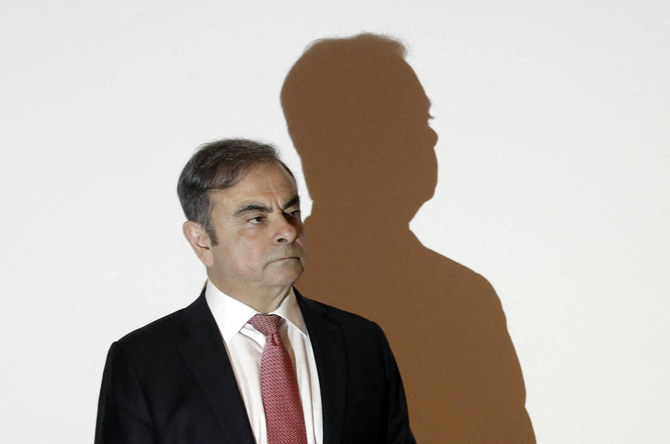
French judges question fugitive former Nissan exec Carlos Ghosn in Beirut
Short Url
https://arab.news/jajhj
French judges question fugitive former Nissan exec Carlos Ghosn in Beirut
- Monday's session started at 10:00 am local time and ended at 6:00 pm, as sessions are expected to continue until June 4
- "It is the very first time of justice for Carlos Ghosn since he was arbitrarily arrested in Japan," said his lawyer


Latest updates


© 2026 SAUDI RESEARCH & PUBLISHING COMPANY, All Rights Reserved And subject to Terms of Use Agreement.