

Jordan ramps up refugee vaccination drive

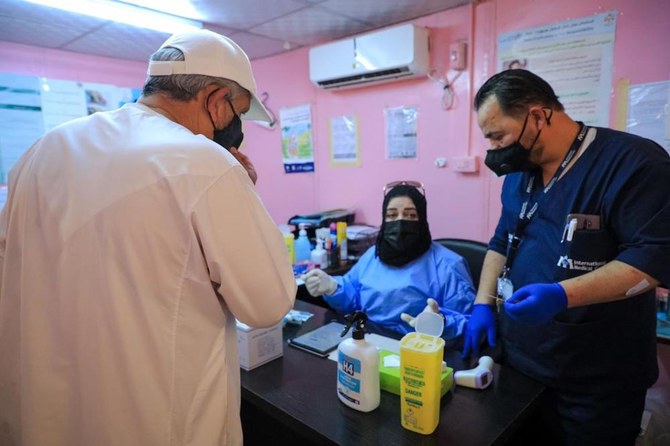
UNHCR said that 13,455 of the 47,000 people living in Jordan’s camps who were eligible for the jabs had now received at least one dose. (Raed Omari)
Short Url
Updated 30 May 2021
Follow

Jordan ramps up refugee vaccination drive

  • More than 1,500 jabbed at Zaatari camp in one day
  • Thirty percent of registered refugees receive first dose

AMMAN: Almost a third of the refugees eligible for the COVID-19 vaccine in Jordan have received their first dose, according to the UN refugee agency.

The UNHCR said that 13,455 of the 47,000 people living in Jordan’s camps who were eligible for the jabs had now received at least one dose.

UNHCR Jordan said in a statement to Arab News that, by excluding children under 18 and pregnant women from the inoculation campaign, 47,000 out of the 120,000 living in the Zaatari, Azraq and Emirati-Jordanian camps were eligible to register and receive the jabs.

It said 1,558 refugees were vaccinated on May 25 in the sprawling Zaatari camp on Jordan’s border with Syria. Two vaccination centers operate in the camp, which is home to around 80,000 Syrian refugees.


UNHCR said that 13,455 of the 47,000 people living in Jordan’s camps who were eligible for the jabs had now received at least one dose. (Raed Omari)

It added that another vaccination center was operating at the Azraq refugee camp, which is home to around 37,000 Syrian refugees. 

Located some 100 kilometers east of Amman, Azraq was set up in 2014 as the Zaatari camp started to run out of space.

According to the UNHCR, more than 20,000 refugees are currently registered on the government platform and are awaiting their vaccination appointment.

“UNHCR Jordan and partners are currently focusing on raising awareness among the remaining population about the benefits of taking the vaccine and encouraging them to register,” the agency said.

The vaccination of Syrian refugees in the two UNHCR-operated camps is part of a wider inoculation drive for refugees that began a few days after the start of Jordan’s nationwide campaign on Jan. 13.

Mohammad Hawari, the UNHCR spokesman in Jordan, told Arab News in early February that Jordan was the first country in the world to include refugees in its nationwide COVID-19 vaccination drive. “The vaccination center in Zaatari is also the first in the world at a UN-administered refugee camp,” he added.


UNHCR said that 13,455 of the 47,000 people living in Jordan’s camps who were eligible for the jabs had now received at least one dose. (Raed Omari)

The agency said that refugees living outside of camps in urban areas and cities in Jordan had been receiving their shots independent of the UNHCR by approaching their local vaccination centers when they received an appointment.

Hawari said on Saturday that all vaccines were administered through the Ministry of Health, which provided the agency with “fair and equal” access to the vaccines that the government brought into the country. He added that the jabs given to refugees were Pfizer-BioNTech, Oxford-AstraZeneca and Sinopharm vaccines.

“The success of the vaccination campaign is very much connected to the government’s decision to include all persons on Jordanian territory, nationals and refugees,” said UNHCR Jordan representative Dominik Bartsch. “But we cannot stop here. We need to carry forward the momentum generated thus far to ensure that all eligible refugees are vaccinated. Our aim is to leave no one behind - nobody is safe until everyone is safe.”

The government has said that everyone living on Jordanian soil, including refugees and asylum seekers, are entitled to receive the vaccine for free. It plans to immunize 20 percent of its 10 million population by the end of 2021.

“The inclusion of refugees within the national COVID-19 response plan and vaccination campaign has once again emphasized the generosity that Jordan has shown in hosting large numbers of refugees,” the agency said. “The UNHCR Jordan continues to work closely with the ministry of health to ensure that refugees receive the vaccine on par with the local population.”

Around 10 percent of Jordan’s population are refugees, according to the UNHCR.

Among them are 655,000 Syrians, 67,000 Iraqis, 15,000 Yemenis, 6,000 Sudanese and 2,500 refugees from 52 other nations. More than 80 percent of them live outside refugee camps, in cities and towns.

This year, UNHCR Jordan is appealing for $370 million to help refugees to cope with the additional challenges posed by the pandemic.

The government has previously announced that more COVID-19 vaccines are to arrive in the country under deals struck with manufacturers and the global COVAX initiative.

In its latest update on May 27, Jordan’s National Center for Security and Crisis Management said that 1.39 million people had received their first dose while 490,562 people had received their second. 

The total number of people registered on the government platform to be vaccinated is 2,305,248.


Retouched images of Israel’s first lady, distributed by the state, ignite a fiery ethics debate

Updated 11 January 2026
Follow

Retouched images of Israel’s first lady, distributed by the state, ignite a fiery ethics debate

  • Since the manipulation of images was revealed, the government has taken the unprecedented step of crediting Sara Netanyahu in its releases that include manipulated images

JERUSALEM: The photos seemed destined for posterity in Israel’s state archives.
In the snapshots, Prime Minister Benjamin Netanyahu is joined by his wife, Sara, as well as US Ambassador Mike Huckabee and a group of Israeli soldiers, as they light Hannukah candles at Western Wall, the holiest site where Jews pray. The leaders exchange triumphant looks.
But something is off.
Sara Netanyahu’s skin is poreless, her eyes overly defined and her hair perfectly coiffed — a look officials acknowledge is the result of heavy retouching.
Critics say the issue isn’t the use of photo-editing software, which is common on the social media accounts of celebrities and public figures. They say it’s the circulation of the images in official government announcements, which distorts reality, violates ethical codes and risks compromising official archiving and record-keeping efforts.
“All the pictures to this day in the archives in Israel are authentic pictures of reality as it was captured by the lenses of photographers’ cameras since the establishment of the state,” said Shabi Gatenio, the veteran political journalist who broke the story in The Seventh Eye, an Israeli site that covers local media. “These images, if entered into the database, will forever infect it with a virtual reality that never existed.”
Since the manipulation of images was revealed, the government has taken the unprecedented step of crediting Sara Netanyahu in its releases that include manipulated images. And it’s not clear if official archive will include images of her taken during the second half of last year, when Gatenio said the editing appears to have begun.
The first lady’s personal spokesperson did not respond to a request for comment.
Nitzan Chen, director of the Government Press Office, told The Associated Press that images of the prime minister are never manipulated and that his office would not upload any retouched photos to the official archive.
Personal Photoshop habit enters political realm
Sara Netanyahu, 67, has long used photo-editing software on her images. Her social media account is filled with images in which her face appears heavily retouched.
But the topic raised eyebrows since her Photoshop habit entered the public record.
Gatenio said he first noticed this last July, when the couple visited President Donald Trump in Washington, D.C., and again in September, as Sara Netanyahu joined her husband on the tarmac ahead of a trip to New York for the UN General Assembly.
At the time, the prime minister’s office released a video of the send-off along with a photo, credited to Avi Ohayon, an official government photographer.
Comparing the photo to the raw video, Hany Farid, a digital forensics expert at the University of California, Berkeley, said the image had been post-processed, bearing local manipulations to smooth the first lady’s skin and remove wrinkles.
Since then, photos showing the first lady meeting with Vice President JD Vance and his wife, Usha, in Washington also appear to have been retouched, Farid said.
“There’s been some Photoshop editing to — let’s call it — ‘beautify,’ lighten, smooth the face,” Farid said.
“Is it nefarious? No. Is it a problem? Yes. This is about something bigger than, ‘she Photoshopped her face to make herself look younger.’ This is about trust. Why should I trust any official photo coming out of that administration?”
Chen, the head of the Government Press Office, said office lawyers are trying to determine how to handle and properly identify photos “processed by people other than GPO photographers.”
He said the Justice Ministry is also examining the “criteria, limitations and possibilities” of the edited images, though he stressed there is nothing illegal about touching up photos. The issue, he said, is being transparent when such changes are made.
For now, his office has decided to add Sara Netanyahu’s name to press releases that include retouched images. Since November, press releases showing photos of her smiling next to Trump and the family of the last hostage in Gaza in Washington, visiting a Miami synagogue and attending a funeral for an Israeli mayor have included this label.
At least one outlet, the Times of Israel, has said it will no longer carry official state photos that appear to have been manipulated. The Associated Press does not publish images that appear to have been retouched or digitally manipulated.
A broader phenomenon
Chen said the prime minister is never edited: “No Photoshop, no corrections, no color. Nothing.”
While his face may not be retouched, the prime minister’s official Instagram account tells another story.
The page has posted a bevy of content that appears to be AI-edited or generated, including a picture of the couple with Trump and first lady Melania Trump celebrating the new year in Washington.
The photo raised suspicions in Israel because it shows Sara Netanyahu wearing a black dress absent from other photos of the event, where she wore a dark red frock. Appearing in the sky above the couples are brightly colored fireworks and American and Israeli flags that Farid said were “almost certainly” generated by AI.
It is now marked with a tag on Instagram indicating that it may have been altered or generated using AI. It is not clear when the tag was added nor by whom.
Netanyahu is not alone. Many world figures, including Trump, use AI-generated image manipulation frequently in their public output.
Tehilla Shwartz Altshuler, who runs the “Democracy in the Digital Age Program,” at the Israel Democracy Institute, a Jerusalem think tank, called it “part of the populist playbook” and said there was “no question” that Netanyahu was emulating how Trump uses the technology.
Netanyahu’s official Instagram has posted video of Trump and Netanyahu in a B-2 bomber that appears entirely AI-generated. It is captioned “on our victory lap,” referencing the joint Israel-US attacks on Iran last year.
“This is exactly what Netanyahu and his surrounding circle have tried to do for many years,” she said. “Presenting himself as a superhero, his wife as a supermodel, their family as a super loyal family. Even when it wasn’t the case, even at the expense of actual political work, administrative work and social work.”
She said Israel has reached a critical point in official government record-keeping and communications.
“The question of archiving the truth, archiving history, will be one of the questions of our time.”