LAHORE: Once prominently present in the architecture of the Indian subcontinent, the art of fresco painting may soon disappear in Pakistan, craftsmen say, as their skills are no longer sought after by contemporary patrons, except for preserving times long gone.
The origins of fresco painting are vague, but already in the ancient times it was a popular decorative form among the civilizations of the Mediterranean. In Europe, it flourished during the Italian Renaissance in the 14th through the 17th centuries, producing masterpieces such as Michelangelo's paintings in the Sistine Chapel and Raphael’s Stanza della Segnatura in Vatican.
In the Indian subcontinent, the art reached its zenith during the Mughal era from the 16th through the 19th century. Some of its most remarkable examples are surface decorations of the early 17th-century Maryam Zamani Mosque, the mid-17th-century Wazir Khan Mosque in the Walled City of Lahore, and the mausoleum of the Mughal Emperor Jahangir in Lahore's Shahdara Town area.
During the golden age of Mughal rule, fresco ornamentation would also adorn the interior and exterior walls of private residences, but with the passage of time, unfavorable subcontinental climate, and negligence, much of it has now discolored or decayed.
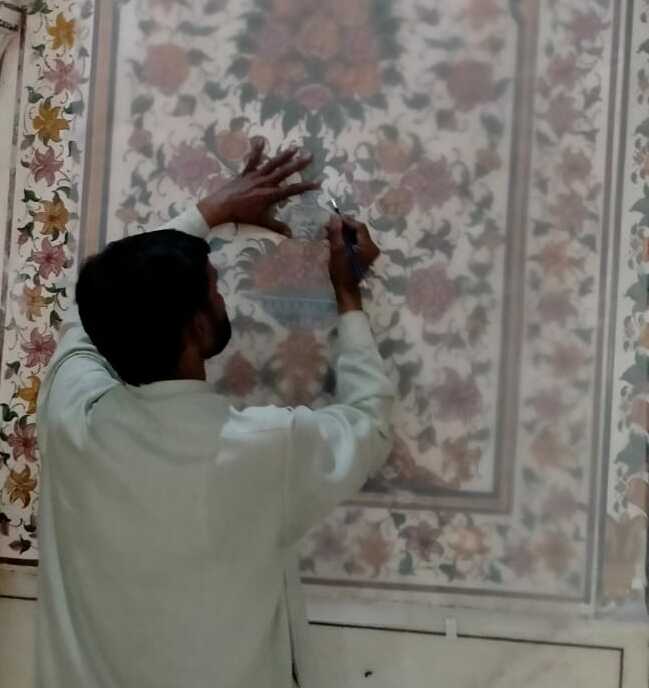
A conservator restores fresco paintings at the Sunehri Mosque in the Walled City of Lahore. (Photo courtesy: WCLA)
"This art is dying now as the trend has changed," said Abdur Rehman Naqqash, artisan from Multan whose family members have practiced the art for centuries.
"One of my elders, Ustad Elahi Baksh Naqqash, did this work at Taj Mahal. My great-grandfather, Ustad Allah Baksh Naqqash, did fresco work at Gurdwara Darbar Sahib," Naqqash told Arab News.
But the family's fame has waned with the art itself which, as Naqqash explained, is now too expensive as fresco painting not only takes time, but also requires costly natural materials.
The fresco method of painting uses natural, water-based pigments which are applied directly onto fresh, lime plaster. The dyes are set with the plaster to become a permanent part of the wall.
"Elders told us to how develop colors from stones, fruits, vegetables and trees. We make green color from sangsabz stone, blue from lajward stone, indigo from kaisar, brown from the rind of pomegranates," Naqqash said. "Now cement is used in construction instead of mud and lime. People are in hurry and can’t wait for long to complete the houses. It is expensive too."
The art is no longer oriented to the future. All the skills and laborious efforts of fresco painters belong to the past — both in the form of its remnants and attempts to preserve it.
Those who still pursue the craft in its original form find employment in art conservation projects such as those undertaken by the Walled City Lahore Authority (WCLA).
The restoration of old fresco paintings in the historic core of Lahore requires artists to use traditional materials and techniques.
"We are using the indigenous materials and natural pigments in the process. Skilled craftsmen are working on it. We have done work at Lahore Fort and it is continued at Sunehri Mosque," Najmussaqib, WCLA conservation director, told Arab News.
"The art is in danger as artisans nowadays don't find jobs. This art is time-consuming and costs more than other art forms," he said. "We have engaged the young fresco painters to bring it back to life."
Fresco painting is taught as a diploma course at the National College of Arts (NCA) in Lahore to promote and revive an endangered art form.
But students know it won't be their professional future.
"Some of the graduates have joined creative sections of different clothing brands and turned their skills in design," Tehmina Syed, a fresco painting graduate of the NCA, told Arab News.
"This art itself has little commercial value," she said. "We are learning it because of our passion."