

With 3,000 cups of imported tea downed every second, Pakistan experiments with local plantations

A vendor makes tea at his stall in Karachi on September 17, 2018. (AFP/ File)
Short Url
Updated 28 May 2021
Follow

With 3,000 cups of imported tea downed every second, Pakistan experiments with local plantations

  • Pakistan has identified 64,000 hectares of land in northwestern districts after evaluating soil and climatic data
  • Pakistan spent $533 million to import 221,319 tons of tea between July 2020 and April 2021

KARACHI: Tea-thirsty Pakistan is looking to reduce its dependency on the import of the country’s favorite drink, and successful research and experiments with tea plantations in the northwest have proven that it is possible to drastically increase local production, officials and tea traders told Arab News on Thursday.

Consumption per second of tea in Pakistan is estimated at 3,000 cups, according to Dr. Abdul Waheed, director National Tea and High Value Crops Research Institute. With an estimated annual per capita consumption of more than 1 kg, Pakistan remains among the largest importers of tea in the world.
Black tea is imported from 19 different countries, with the largest chunk-- 80 percent-- from Kenya. The country also imports a substantial chunk of green tea from China, Vietnam and Indonesia.
“We have done some research to increase local production of tea in the country and reduce its dependence on imports,” Dr.Waheed told Arab News. “Successful tea plantation was demonstrated at the institute along with a few fields in potential tea growing areas of Khyber Pakhtunkhwa and Azad Kashmir.”
“The results,” he continued, “are very encouraging. We have developed about 12 varieties of tea through local planation in Khyber Pakhtunkhwa’s Shinkiari town [in Mansehra district]. The yield potential and quality has been assessed to determine its economic viability. We have also identified the extent of the plantation area.”
Over the next 20 years, Pakistan hopes to substitute about 70 percent of imported tea with locally produced brands.
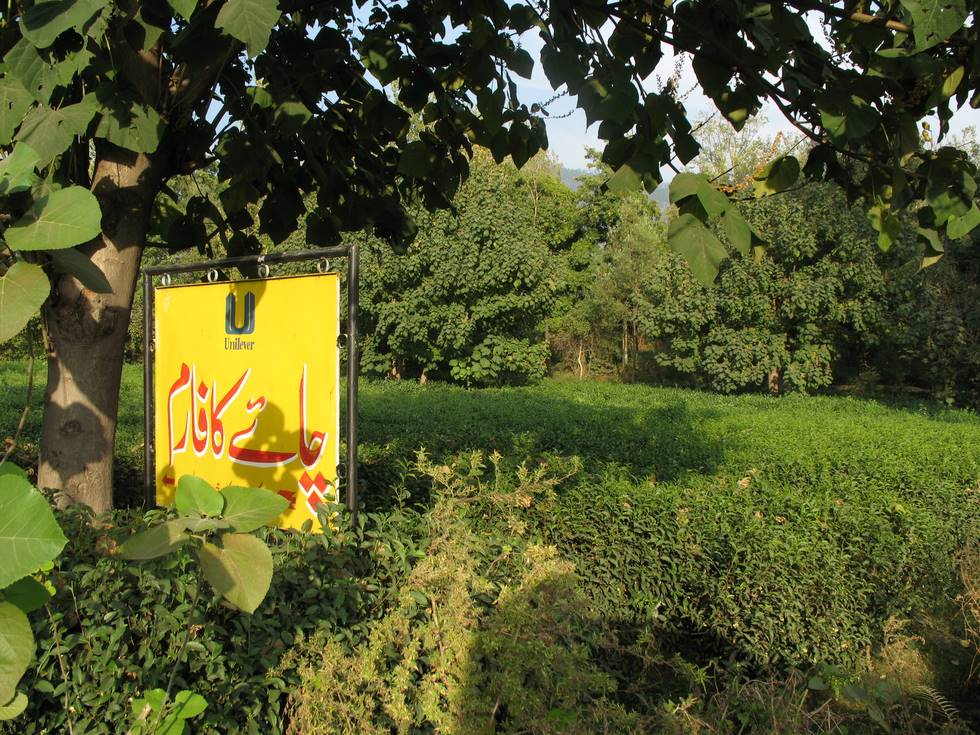


In this undated photo, a tea garden is shown in Mansehra Pakistan. (Photo courtesy: social Media)

The country imported 25,709 tons of tea in the last month which cost it $59.68 million.
According to the Pakistan Bureau of Statistics, the country spent $533 million to import 221,319 tons of tea during the current fiscal year between July 2020 and April 2021.
Pakistan has identified about 64,000 hectares of land in Mansehra and Swat to grow tea. It earmarked the area after a comprehensive evaluation of topological, soil and climate data.
Pakistani tea importers say local tea production is currently too low in the country to substitute imports in any major way.
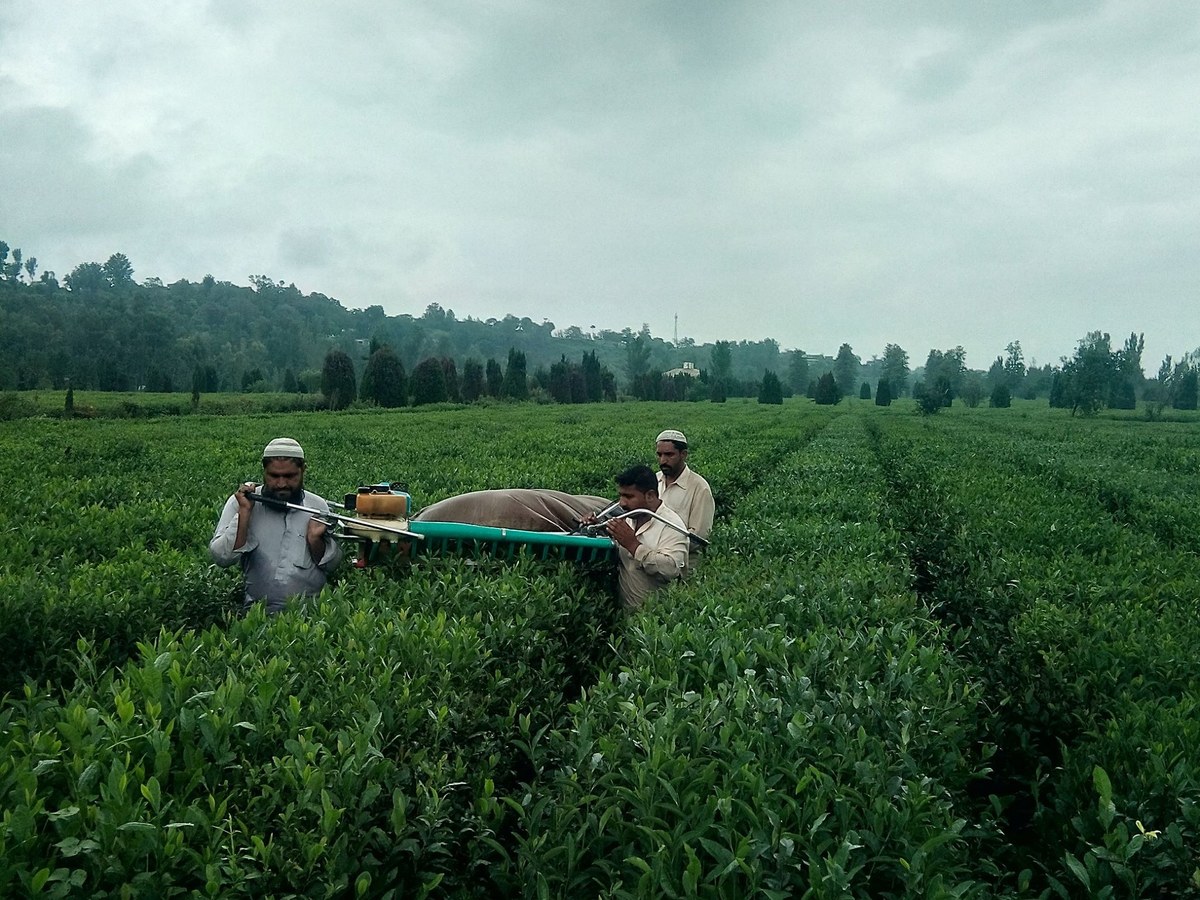


Harvesters pluck tea leaves through a machine in Shinkiari, Pakistan on July 23, 2018. (Photo courtesy: Social media)

“The local production is very low, and it can’t instantly substitute our imports,” Muhammad Aman Paracha, chairman Pakistan Tea Association, told Arab News.
“But its price will decline if the tea production area is increased. Local production will also help the country save foreign exchange. Apart from that, tea importers are currently paying about 53 percent taxes which will be reduced.”
Tea importers say the government needs to think long-term in order to attract investment for local production of the commodity.
“The government must resolve issues related to land acquisition, remove hurdles that are likely to be created by local residents in the identified areas, allow duty-free import of machinery and give required subsidies,” Zeeshan Maqsood, who deals with tea trade at the Federation of Pakistan Chambers of Commerce and Industry, told Arab News.
“This needs a long-term vision, at least until 2040, since tea plants can take up to 10 years to grow,” he continued. “If all things go well, the country may be in a position to replace about 70 percent of its imports in a 20-year period.”
Stakeholders said that ultimately, local production of tea could earn precious foreign exchange if the country managed to make enough to sell some of its indigenous brands abroad.


Pakistan opposition rallies in Khyber Pakhtunkhwa to demand release of Imran Khan

Updated 07 December 2025
Follow

Pakistan opposition rallies in Khyber Pakhtunkhwa to demand release of Imran Khan

  • PTI-led gathering calls the former PM a national hero and demands the release of all political prisoners
  • Government says the opposition failed to draw a large crowd and accuses PTI of damaging its own politics

ISLAMABAD: Pakistan’s opposition led by the Pakistan Tehreek-e-Insaf (PTI) party demanded the release of jailed former prime minister Imran Khan at a rally in the northwestern Khyber Pakhtunkhwa province on Sunday, describing him as a national hero who continues to command public support.

The gathering came days after a rare and strongly worded briefing by the military’s media chief, Lt. Gen. Ahmed Sharif Chaudhry, who dismissed Khan as “narcissistic” and “mentally ill” on Friday while responding to the former premier’s allegations that Pakistan’s chief of defense forces was responsible for undermining the constitution and rule of law.

He said that Khan was promoting an anti-state narrative which had become a national security threat.

The participants of the rally called for “civilian supremacy” and said elected representatives should be treated with respect.

“We, the people of Pakistan, regard Imran Khan as a national hero and the country’s genuinely elected prime minister, chosen by the public in the February 8, 2024 vote,” said a resolution presented at the rally in Peshawar. “We categorically reject and strongly condemn the notion that he or his colleagues pose any kind of threat to national security.”

“We demand immediate justice for Imran Khan, Bushra Bibi and all political prisoners, and call for their prompt release,” it added, referring to Khan’s wife who is also in prison. “No restrictions should be placed on Imran Khan’s meetings with his family, lawyers or political associates.”

Addressing the gathering, Sohail Afridi, the chief minister of Khyber Pakhtunkhwa, denied his administration was not serious about security issues amid increased militant activity. However, he maintained the people of his province had endured the worst of Pakistan’s conflict with militancy and urged a rethinking of long-running security policies.

The resolution asked the federal government to restore bilateral trade and diplomatic channels with Afghanistan, saying improved cross-border ties were essential for the economic stability of the region.

The trade between the two neighbors has suffered as Pakistan accuses the Taliban administration in Kabul of sheltering and facilitating armed groups that it says launch cross-border attacks to target its civilians and security forces. Afghan officials deny the claim.

The two countries have also had deadly border clashes in recent months that have killed dozens of people on both sides.

Some participants of the rally emphasized the restoration of democratic freedoms, judicial independence and space for political reconciliation, calling them necessary to stabilize the country after years of political confrontation.

Reacting to the opposition rally, Information Minister Attaullah Tarrar said the PTI and its allies could not gather enough people.

“In trying to build an anti-army narrative, they have ruined their own politics,” he said, adding that the rally’s reaction to the military’s media chief’s statement reflected “how deeply it had stung.”

“There was neither any argument nor any real response,” he added, referring to what was said by the participants of the rally.