Saudi FM discusses Gaza cease-fire in phone call with US Secretary of State

1 / 2
Saudi Arabia’s Foreign Minister Prince Faisal bin Farhan and US Secretary of State Antony Blinken discussed the cease-fire in Gaza. (File/AFP)
2 / 2
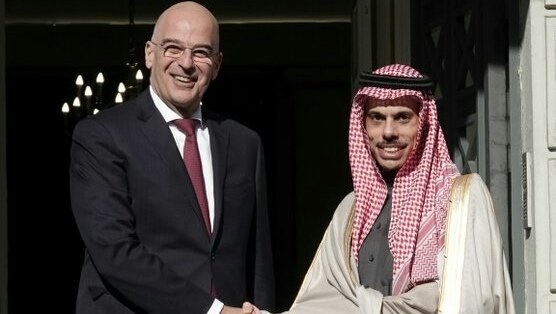
Saudi Arabia’s Foreign Minister Prince Faisal bin Farhan received a phone call from his Greek counterpart Nikos Dendias. (Twitter/@NikosDendias)
Short Url
Updated 27 May 2021
Follow

Saudi FM discusses Gaza cease-fire in phone call with US Secretary of State

  • Prince Faisal and Blinken expressed their support for the cease-fire between Israel, Hamas, and other parties in Gaza
  • The Saudi minister discussed the Middle East and developments in the wider region with Dendias

RIYADH: Saudi Arabia’s foreign minister and the US Secretary of State discussed on Thursday the cease-fire in Gaza.
During a phone call, Prince Faisal bin Farhan and Antony Blinken reviewed bilateral relations and the strategic partnership between their countries, along with cooperation on regional and international challenges.
The officials expressed their support for the cease-fire between Israel, Hamas, and other parties in Gaza, and discussed efforts to reduce risks of further conflict, the State Department said.  
Blinken also raised the importance of international support for humanitarian and development efforts in Gaza.
The call comes after the Secretary of State ended a Middle East tour on Thursday that aimed to consolidate the cease-fire that ended the worst fighting in years between Israel and Hamas.
He visited Jerusalem, Ramallah, Cairo and Amman during his tour.
Prince Faisal also received a call from his Greek counterpart Nikos Dendias to discuss relations between the two countries and means of developing and strengthening them in various fields.
They also exchanged views on a number of issues of common interest.
Following the call Dendias said in a tweet that they “discussed the Middle East and developments in the wider region.”


Ramadan the Hijazi way, a festive season of memories and togetherness

Updated 24 sec ago
Follow

Ramadan the Hijazi way, a festive season of memories and togetherness

  • Local customs, cherished recipes and family reunions define the holy month along the Red Sea coast
  • Abir Abusulayman: People like to prepare before its arrival. It’s part of the joy

JEDDAH: Across Saudi Arabia, the arrival of Ramadan is not simply marked on a calendar; it is felt in homes, streets, markets and hearts. 

Preparations begin well before the crescent moon is sighted, transforming daily life into a tapestry of devotion, generosity and celebration.

In the Hijaz region, many revive culturally rooted traditions that celebrate the moment wholeheartedly.

Abir Abusulayman, an expert in Hijazi traditions, a tour guide in Al-Balad, and the CEO of Aloula charitable organization, shared insights into these customs.

“People like to prepare before its arrival. It’s part of the joy,” she told Arab News.

The first signs of Ramadan appear in grocery baskets. Families stock up on essential ingredients and traditional beverages that define the month’s evenings.

“Families start to buy groceries, especially for Ramadan dishes,” she said. “Qamareddine and subia are very popular. They are local beverages linked to Ramadan, served cold during iftar or sahoor.”

Alongside these refreshing drinks, certain dishes hold almost ceremonial status. “Al-Hab soup is the queen of the Ramadan table,” she added. Made from hearty grains, it is often purchased in large quantities and stored for the entire month.

She added that preparing sambusa with different fillings and storing it in large quantities is a cherished tradition. Most households begin preparing it at least two weeks before the holy month, as these savory parcels are equally indispensable.

“These are not just foods,” she said. “These are rituals.”

Soups vary from lentil to vegetable to shish barak, offering nourishment after long fasting hours. Healthy, warm and comforting, they are staples of the iftar spread.

“Saudi Arabia has the best dates in the world, hundreds of types,” she said. “But in Ramadan, they are presented in very attractive ways.”

Rather than serving them plain, Hijazi families like to get creative by stuffing dates with walnuts, hazelnuts or almonds, sprinkling them with sesame or black seeds, and sometimes serving them with tahini on the side, along with Saudi coffee.

“We start to break our fast with dates, like the Prophet Muhammad, peace be upon him,” she explains. “And we drink water and buttermilk.”

Zamzam water in Hijaz is often prepared in advance and infused with aromatic mastika, giving it a distinctive flavor associated with the holy month.

Decoration is another essential expression of Ramadan’s joy. “It is a must,” she says. “It’s part of the happiness for citizens and expats alike.”

Whether installed by municipalities, illuminating streets and lamps, or lovingly arranged by families at home entrances and interiors, Ramadan lights glow across neighborhoods. The festive spirit extends to personal preparation as well.

“Ladies like to wear their thobes during Ramadan,” she said. Families dress in their finest, particularly when gathering for prayers or hosting guests.

Spiritual readiness is equally important. Prayer mats and women’s prayer garments are washed and perfumed, ensuring that worship spaces are fresh and inviting.

“In the worshipping space, everything should have a nice smell,” she said, adding it is “a sensory reflection of inner purification.”

“Usually, the first day for Hijazi families is marked by gatherings at the grandmother’s or grandfather’s house,” she explained. “It’s an opportunity to greet each other and wish one another a blissful Ramadan.”

Children and grandchildren fill the home, turning the first iftar into a celebration of kinship. “The first day is a feast by itself,” she said.

This year, as in the last, Ramadan falls in February and March, bringing gentle weather to the Hijaz region. In Jeddah and along the Red Sea coast, families take advantage of the pleasant climate.

“Jeddawis enjoy iftar and sahoor outside, sometimes as a picnic near the Red Sea,” she said. Invitations flow throughout the month, strengthening social bonds.

When speaking of Ramadan in Jeddah, one name inevitably arises: Al-Balad, the city’s historic heart.

“When we say Jeddah, we say Al-Balad,” Abusulayman said.

Visiting Al-Balad during Ramadan has become a cherished ritual. Last year, visitor numbers exceeded three million, excluding international tourists. Families return once, sometimes several times throughout the month.

“Grandfathers like to show their grandchildren where their houses used to be, where they played and gathered with siblings,” she says. “It’s not only nostalgia. It’s about sharing reality and memories.”

Throughout the Kingdom, Ramadan weaves together worship, cuisine, fashion, decoration, memory and family. It is a month where sensory details, such as the scent of incense, the sweetness of stuffed dates and the glow of streetlights, reflect spiritual devotion.

“These are not only customs,” she added. “They are part of who we are.”