A case of growing mangoes: New farming method promises to multiply Pakistan's yield

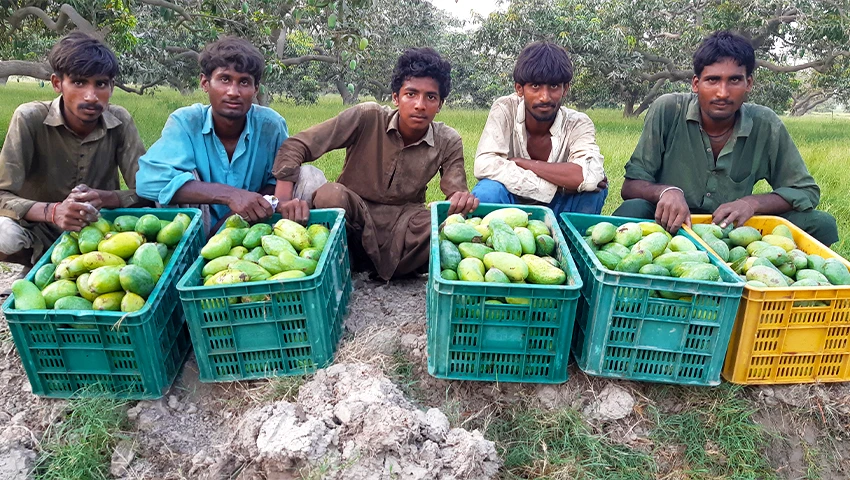
A group of young workers pose for a picture with freshly harvested mangoes at a farm in Tando Allahyar in Pakistan's Sindh province on May 24, 2021. (AN photo by Zulfiqar Kunbhar)
Short Url
Updated 27 May 2021
Follow

A case of growing mangoes: New farming method promises to multiply Pakistan's yield

  • A mango grower in Sindh has introduced the small tree system of cultivating orchards which allows more trees to grow on smaller area
  • Sindh, Pakistan’s second-largest mango-producing province, has seen a decline in production volume largely due to outdated farming techniques

TANDO ALLAHYAR: After a decade of declining harvest, mango growers in Pakistan’s southern Sindh province are pinning their hopes on a new farming technique that would allow them to increase their fruit yield up to six times, several growers and experts said. 
Pakistan is the world’s sixth largest mango producer, with annual production volume of about 1.7 million tons. While most of the harvest comes from Punjab, Sindh province has the second-largest yield and is known for the Sindhri variety of the mango, famous for its honey-like sweetness and deep, thin yellow peel.
But farmers are increasingly sounding the alarm on declining crop yield.
Sindh cultivated mangoes on 59,215 hectares of land and produced 381,269 metric tons in 2010. Provincial agricultural data shows this yield reduced to 329,300 metric tons by 2019.
Realizing that a major reason for the decline is outdated farming practices, one grower, Mahmood Nawaz Shah from Tando Allahyar district, decided to try something new at his Genuine Delight Farms. 

In 2019, he initiated a pilot project to cultivate new orchards under the small tree system (STS) on four acres, or 1.6 hectares, of land, using a pruning technique that keeps the height of the mango plants at nearly nine feet, making their management easier and helping to accommodate more trees in a smaller area.
“STS can revolutionize the quantum of our mango production,” Shah, who also represents a provincial farmers’ body, the Sindh Abadgar Board, told Arab News.
“We can increase our mango production some five times in this country,” he added, explaining that while average mango yield per acre was five metric tons from large trees, an average of 25 to 30 metric tons could be harvested from the same area using the small tree system.
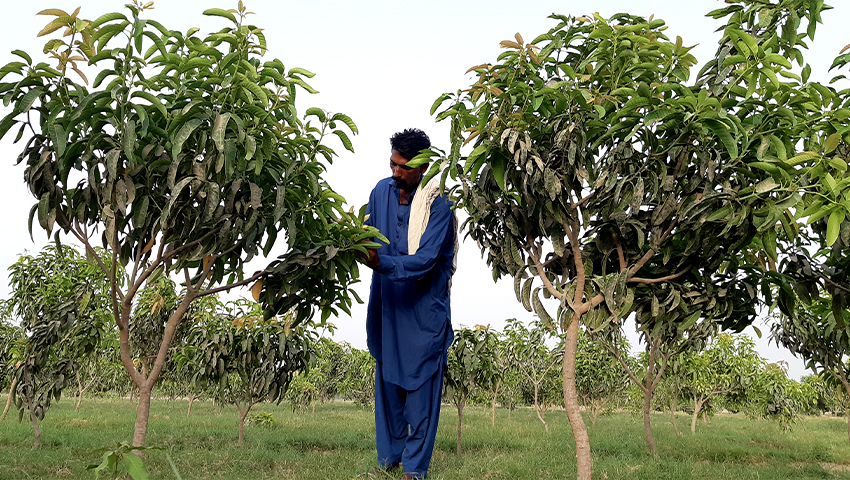


A worker is seen trimming a mango tree planted in Tando Allahyar in Pakistan's Sindh province on May 24, 2021. (AN photo by Zulfiqar Kunbhar)

 According to estimates by the Sindh Abadgar Board, the small tree system is currently being used on only 1,618 hectares (4,000 acres) of Pakistan’s total mango cultivation area of 167,000 hectares. In Sindh, only ten growers have so far adopted the method. 
“We are far behind when it comes to modernizing our farming structures and techniques,” Dr. Noor-un-Nisa Memon, a faculty member at the Sindh Agriculture University in Tando Jam, said.
It was high time, she said, that old mango orchards were replaced with new ones but farmers in Sindh were reluctant to prune their trees, thinking it would reduce their yield.
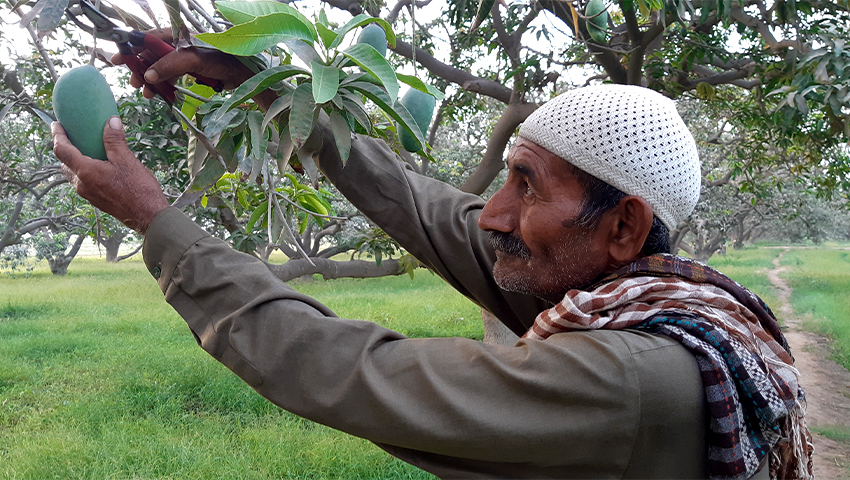


A laborer cuts a mango from an orchard at a farm in Tando Allahyar in Pakistan's Sindh province on May 24, 2021. (AN photo by Zulfiqar Kunbhar)

Farmers, however, say they are willing to adopt new techniques but cannot do it without government support as most are small-scale growers.
“It is extremely important to adopt the small tree system to deal with the situation,” Mir Zafarullah Talpur, a grower from Sindh’s largest mango growing Mirpurkhas district, told Arab News. “The government should arrange an extensive awareness program for farmers and provide them subsidies and installment facilities so they can import modern instruments.”
Hidayatullah ChHajjro, Director General Agriculture Extension, said the provincial administration had already arranged several training sessions to raise awareness among mango growers about new farming techniques but agreed that subsidies need to be given to farmers who wanted to import essential gadgets and machinery.
“By adopting a comprehensive approach, such as the small tree system, not only can we reclaim our previous production level but also enhance it further,” ChHajjro said.
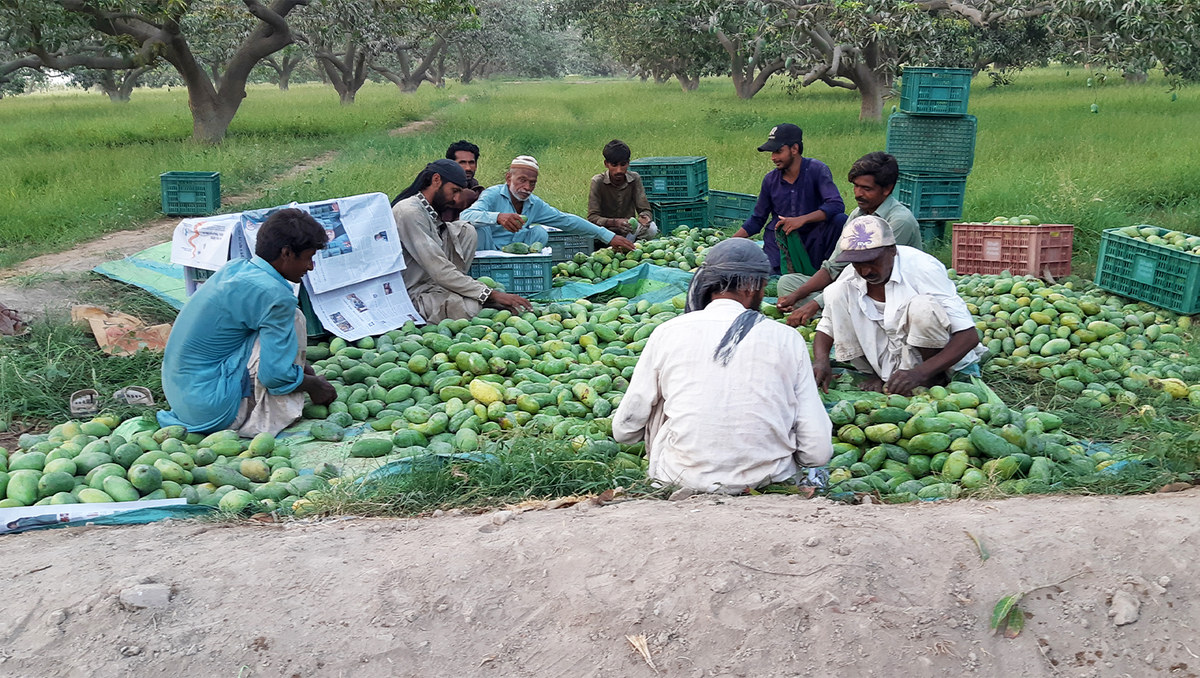


Laborers sort mangoes before packing them into boxes at a farm in Tando Allahyar in Pakistan's Sindh province on May 24, 2021. (AN photo by Zulfiqar Kunbhar)

Shah, who introduced the new farming method to Sindh, is hopeful the trend will gain momentum in the next few years.
“There are farmers who are waiting for the results,” he said. “Most of the farmers initiated the STS in 2019 and it requires at least five years for trees to develop fruit.”
“If the result comes out positively, as per our expectations,” he said, “there are chances that mango areas will see a sudden transformation, uprooting old practices and adopting new techniques.”
Pakistan remembers Benazir Bhutto, first woman PM in Muslim world, on death anniversary

Updated 5 sec ago
Follow

Pakistan remembers Benazir Bhutto, first woman PM in Muslim world, on death anniversary

  • Bhutto was daughter of ex-PM Zulfikar Ali Bhutto who was hanged during reign of former military ruler Gen. Zia-ul-Haq
  • Year before assassination in 2007, Bhutto signed landmark deal with rival Nawaz Sharif to prevent army interventions

ISLAMABAD: Prime Minister Shehbaz Sharif and other Pakistani leaders on Saturday paid tribute to Benazir Bhutto, the first woman prime minister in the Muslim world who was assassinated 18 years ago in a gun and bomb attack after a rally in the city of Rawalpindi.

Born on Jun. 21, 1953, Bhutto was elected premier for the first time in 1988 at the age of 35. She was deposed in 1990, re-elected in 1993, and ousted again in 1996, amid allegations of corruption and mismanagement which she denied as being politically motivated.

Bhutto only entered politics after her father was hanged in 1979 during military ruler Gen. Zia-ul-Haq’s reign. Throughout her political career, she had a complex and often adversarial relationship with the now ruling Sharif family, but despite the differences signed a ‘Charter of Democracy’ in 2006 with three-time former PM Nawaz Sharif, pledging to strengthen democratic institutions and prevent military interventions in Pakistan in the future.

She was assassinated a year and a half later.

“Mohtarma Benazir Bhutto took exemplary steps to strengthen the role of women, protect the rights of minorities, and make Pakistan a peaceful, progressive, and democratic state,” PM Shehbaz Sharif, younger brother of ex-PM Nawaz Sharif, said in a statement on Saturday.

“Her sacrifices and services are a beacon of light for the nation.”

President Asif Ali Zardari, Bhutto’s widower, said Bhutto believed in an inclusive Pakistan, rejected sectarianism, bigotry and intolerance, and consistently spoke for the protection of minorities.

“Her vision was of a federation where citizens of all faiths could live with dignity and equal rights,” he said. “For the youth of Pakistan, her life offers a clear lesson: speak up for justice, organize peacefully and do not surrender hope in the face of adversity.”

Powerful families like the Bhuttos and the Sharifs of Pakistan to the Gandhis of India and the Bandaranaike family of Sri Lanka have long dominated politics in this diverse region since independence from British colonial rule. But none have escaped tragedy at the hands of rebels, militants or ambitious military leaders.

It was Zulfikar Ali Bhutto, Bhutto’s father, who founded the troubled Bhutto dynasty, becoming the country’s first popularly elected prime minister before being toppled by the army in 1977 and later hanged. Both his sons died in mysterious circumstances.

Before her assassination on Dec. 27, 2007, Bhutto survived another suicide attack on her motorcade that killed nearly 150 people as she returned to Pakistan after eight years in exile in October 2007.

Bhutto’s Oxford-educated son, Bilawal Bhutto-Zardari, now leads her Pakistan Peoples Party, founded by her father, and was foreign minister in the last administration of PM Shehbaz Sharif.

Aseefa Bhutto Zardari, Bhutto’s daughter who is currently the first lady of Pakistan, said her mother lived with courage and led with compassion in life.

“Her strength lives on in every voice that refuses injustice,” she said on X.

Pakistan has been ruled by military regimes for almost half its history since independence from Britain in 1947. Both former premiers Imran Khan and the elder Sharif, Nawaz, have alleged that they were ousted by the military after they fell out with the generals. The army says it does not interfere in politics.