Turkey tracks down, detains members of terror groups in latest ops

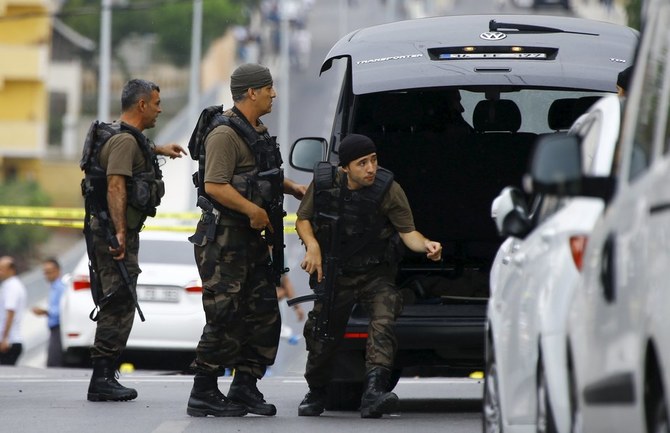
Turkish anti-terror teams have recently arrested several senior Daesh operatives in various cities across the country. (Reuters)
Short Url
Updated 26 May 2021
Follow

Turkey tracks down, detains members of terror groups in latest ops

  • Seven suspected members of the Jabhat Al-Nusra organization detained during a counter-terrorism operation in Ankara
  • Anti-terror teams were also hunting four other people still at large and thought to be linked to the movement that was originally established in Syria

ANKARA: Turkish police on Wednesday detained seven suspected members of the Jabhat Al-Nusra organization during a counter-terrorism operation in the capital Ankara.

Anti-terror teams were also hunting four other people still at large and thought to be linked to the movement that was originally established in Syria and has been classified by Turkey as a terror group since 2014.

Simultaneous operations have been taking place against Daesh in Turkey with police recently arresting several senior operatives in various cities.

On Tuesday, police caught 16 Daesh suspects in a countrywide operation in 11 provinces, one day after another suspected Daesh member of Syrian nationality was held in the central Anatolian province of Nigde. 

Meanwhile, on Monday, a Daesh suspect named Mustafa Abdulvahap Mahmut, was detained in Istanbul. An explosives specialist who is also being sought by the US, Mahmut was reportedly planning to carry out a terror attack in Turkey. The operation was held jointly between American and Turkish intelligence units.

Last week, a Daesh suspect was stopped by Turkish police 500 meters away from the US Consulate in Istanbul, while another one was detained on the top floor of a nearby building.

In early May, Basim, codenamed Afghan jihadist, one of the closest figures to Abu Bakr Al-Baghdadi, the former Daesh chief who was killed two years ago by the US, was detained in Istanbul with a fake passport.

Nihat Ali Ozcan, a senior foreign affairs expert at Ankara-based think tank TEPAV and a former Turkish military commander, told Arab News that Turkey had become the preferred location for Al-Nusra sleeper cells in the region.

“It is not surprising that they are still active in Turkey. They are establishing their link with the outside world through Turkish territories in terms of logistics, networks, and manpower,” he said. 

According to Ozcan, their expanded and hidden presence posed a threat not only to Turkish domestic security but also to the West, and Russia.

“The changing parameters in Syria’s rebel-held province of Idlib are also noteworthy because Al-Nusra recently got all small dissident groups under its hegemony and eliminated them. They are now trying to boost their leverage for preserving their authority in the region,” he added.

The dominant rebel group governing Idlib and its surrounding regions is still Hayat Tahrir Al-Sham (HTS), an offshoot of Al-Nusra Front.

Al-Nusra is amassing chemicals in Idlib to use against civilians and plot a false flag chemical attack in Syria, the Russian Foreign Ministry recently claimed.

On Tuesday, the Russian Defense Ministry’s Center for Reconciliation of Opposing Sides in Syria announced that Jabhat Al-Nusra carried out 46 shelling attacks against Idlib in one day from its positions in Syria.

Experts also noted that similar counter-terrorism operations and the revelations of some underground networks generally happen in spring and summer in Turkey and the frequency of the operations keeps increasing until September when the mobility of the terror groups gradually decreases in the region.

Ozcan did not anticipate a strategic and political collaboration of Al-Nusra and Daesh on Turkish soil at the present time despite members of both groups being caught simultaneously in a week.

“They have a common denominator by hitting Western targets. They can carry out tactical cooperation, but they do not have organic ties and their end targets are different,” he said.


Gaza ceasefire enters phase two despite unresolved issues

Updated 16 January 2026
Follow

Gaza ceasefire enters phase two despite unresolved issues

  • Under the second phase, Gaza is to be administered by a 15-member Palestinian technocratic committee operating under the supervision of a so-called “Board of Peace,” to be chaired by Trump

JERUSALEM: A US-backed plan to end the war in Gaza has entered its second phase despite unresolved disputes between Israel and Hamas over alleged ceasefire violations and issues unaddressed in the first stage.
The most contentious questions remain Hamas’s refusal to publicly commit to full disarmament, a non-negotiable demand from Israel, and Israel’s lack of clarity over whether it will fully withdraw its forces from Gaza.
The creation of a Palestinian technocratic committee, announced on Wednesday, is intended to manage day-to-day governance in post-war Gaza, but it leaves unresolved broader political and security questions.
Below is a breakdown of developments from phase one to the newly launched second stage.

Gains and gaps in phase one

The first phase of the plan, part of a 20-point proposal unveiled by US President Donald Trump, began on October 10 and aimed primarily to stop the fighting in the Gaza Strip, allow in aid and secure the return of all remaining living and deceased hostages held by Hamas and allied Palestinian militant groups.
All hostages have since been returned, except for the remains of one Israeli, Ran Gvili.
Israel has accused Hamas of delaying the handover of Gvili’s body, while Hamas has said widespread destruction in Gaza made locating the remains difficult.
Gvili’s family had urged mediators to delay the transition to phase two.
“Moving on breaks my heart. Have we given up? Ran did not give up on anyone,” his sister, Shira Gvili, said after mediators announced the move.
Israeli Prime Minister Benjamin Netanyahu said efforts to recover Gvili’s remains would continue but has not publicly commented on the launch of phase two.
Hamas has accused Israel of repeated ceasefire violations, including air strikes, firing on civilians and advancing the so-called “Yellow Line,” an informal boundary separating areas under Israeli military control from those under Hamas authority.
Gaza’s Hamas-run health ministry said Israeli forces had killed 451 people since the ceasefire took effect.
Israel’s military said it had targeted suspected militants who crossed into restricted zones near the Yellow Line, adding that three Israeli soldiers were also killed by militants during the same period.
Aid agencies say Israel has not allowed the volume of humanitarian assistance envisaged under phase one, a claim Israel rejects.
Gaza, whose borders and access points remain under Israeli control, continues to face severe shortages of food, clean water, medicine and fuel.
Israel and the United Nations have repeatedly disputed figures on the number of aid trucks permitted to enter the Palestinian territory.

Disarmament, governance in phase two

Under the second phase, Gaza is to be administered by a 15-member Palestinian technocratic committee operating under the supervision of a so-called “Board of Peace,” to be chaired by Trump.
“The ball is now in the court of the mediators, the American guarantor and the international community to empower the committee,” Bassem Naim, a senior Hamas leader, said in a statement on Thursday.
Trump on Thursday announced the board of peace had been formed and its members would be announced “shortly.”
Mediators Egypt, Turkiye and Qatar said Ali Shaath, a former deputy minister in the Ramallah-based Palestinian Authority, had been appointed to lead the committee.
Later on Thursday, Egyptian state television reported that all members of the committee had “arrived in Egypt and begun their meetings in preparation for entering the territory.”
Al-Qahera News, which is close to Egypt’s state intelligence services, said the members’ arrival followed US Middle East envoy Steve Witkoff’s announcement on Wednesday “of the start of the second phase and what was agreed upon at the meeting of Palestinian factions in Cairo yesterday.”
Shaath, in a recent interview, said the committee would rely on “brains rather than weapons” and would not coordinate with armed groups.
On Wednesday, Witkoff said phase two aims for the “full demilitarization and reconstruction of Gaza,” including the disarmament of all unauthorized armed factions.
Witkoff said Washington expected Hamas to fulfil its remaining obligations, including the return of Gvili’s body, warning that failure to do so would bring “serious consequences.”
The plan also calls for the deployment of an International Stabilization Force to help secure Gaza and train vetted Palestinian police units.
For Palestinians, the central issue remains Israel’s full military withdrawal from Gaza — a step included in the framework but for which no detailed timetable has been announced.
With fundamental disagreements persisting over disarmament, withdrawal and governance, diplomats say the success of phase two will depend on sustained pressure from mediators and whether both sides are willing — or able — to move beyond long-standing red lines.