UNGA president arrives in Islamabad amid Pakistan’s lobbying for Palestine

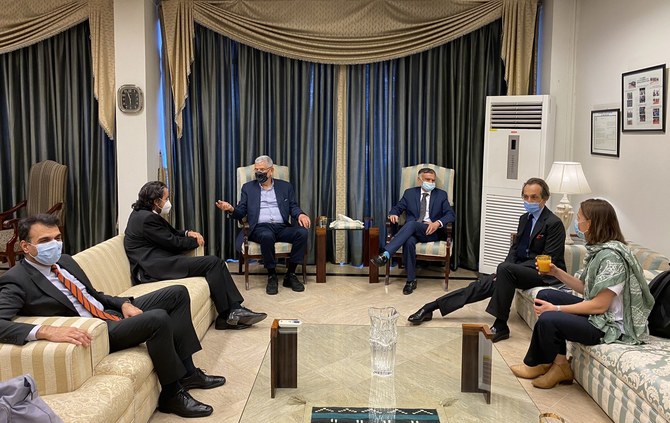
United Nations General Assembly President Volkan Bozkir arrives in Islamabad, Pakistan on an official three-day visit on May 26, 2021. (Photo courtesy: Volkan Bozkir)
Short Url
Updated 26 May 2021
Follow

UNGA president arrives in Islamabad amid Pakistan’s lobbying for Palestine

  • Volkan Bozkir’s Pakistan trip comes days after an emergency meeting of the UNGA on Palestine
  • Coming on the invitation of FM Qureshi, he is expected to also meet the Pakistani president and prime minister

ISLAMABAD: United Nations General Assembly (UNGA) President Volkan Bozkir arrived in Islamabad on Wednesday evening for an official three-day visit. 

Bozkir’s trip comes days after an emergency meeting of the UNGA on Palestine. Pakistani Foreign Minister Shah Mahmood Qureshi was present during the special session as part of Pakistan’s intensive diplomatic onslaught to mobilize international support to end Israeli airstrikes on the Gaza Strip. The attacks killed over 240 people in the Palestinian territory between May 10 and May 21 when a cease-fire was announced.

The UNGA president is in Pakistan on the invitation of Qureshi and is expected to meet the country’s top leaders.

“During his stay in Islamabad, Mr. Bozkir will have detailed talks with the Foreign Minister and call on the leadership. The interactions will cover a wide range of political and socio-economic issues on the UN agenda,” the Pakistani foreign office said in a statement on Wednesday.

“The visit of the PGA would lend an opportunity to showcase Pakistan’s active contributions to multilateralism and the central role of the United Nations in international affairs.”

Upon his arrival, Bozkir tweeted: “I look forward to my important meetings tomorrow in Islamabad.” 

Last week, also in a Twitter post, he announced he would be meeting with Pakistani President Arif Alvi and PM Imran Khan.

Bozkir arrived in Pakistan from a two-day official trip to Bangladesh.


Pakistan arrests four TTP suspects in connection with Islamabad suicide bombing

Updated 48 min 3 sec ago
Follow

Pakistan arrests four TTP suspects in connection with Islamabad suicide bombing

  • Twelve people were killed and 36 injured in the suicide blast outside a district court complex in Islamabad on Tuesday afternoon
  • Pakistan’s Interior Minister Mohsin Naqvi claimed an Afghan national carried out the blast, Kabul did not respond to the allegation

ISLAMABAD: Pakistani intelligence and counter-terrorism authorities have arrested four Tehreek-e-Taliban Pakistan (TTP) members in connection with this week’s suicide blast in the Pakistani capital of Islamabad, the government said on Friday.

Twelve people were killed and 36 injured in a suicide blast outside a district court’s complex in Islamabad’s G-11 sector on Tuesday afternoon. Pakistan’s Interior Minister Mohsin Naqvi claimed an Afghan national had carried out the blast. Kabul did not respond to the allegation.

Pakistan’s Intelligence Bureau Division and the Counter-Terrorism Department have busted a “terrorist cell” involved in the attack and arrested four suspects, including the alleged handler of the attack on the court complex, according to a Pakistani government statement on X.

“During interrogation, Sajidullah alias Sheena, the handler of the suicide bomber, confessed that TTP/FAK (Fitna Al-Khawarij) Commander Saeed-ur-Rehman alias Daadullah (resident of Charmang, Bajaur, currently in Afghanistan, and serving as TTP’s Intelligence Chief for Nawagai, Bajaur) contacted him through the Telegram application to carry out a suicide attack in Islamabad to cause maximum casualties of LEAs (law enforcement agencies),” the statement read.

“Daadullah sent pictures of the suicide bomber (SB) Usman alias Qari to Sajidullah alias Sheena for receiving him. SB Usman Qari belonged to the Shinwari tribe and was a resident of Achin, Nangarhar, Afghanistan. When he reached Pakistan from Afghanistan, Sajidullah alias Sheena arranged his stay in a residence near Islamabad.”

Sajidullah collected a suicide jacket from Akhun Baba graveyard in the northwestern city of Peshawar and brought it to Islamabad, according to the statement. On the day of the blast, he set the suicide jacket on the bomber.

“The network was handled and guided at every step by the Fitna Al-Khawarij/TTP high command based in Afghanistan,” the Pakistani government said.

“The entire cell involved in the incident, including its commander and three other members, has been arrested. Investigations are continuing, and more revelations and arrests are expected.”

There was no immediate response from Kabul to the statement.

The TTP has been behind some of the deadliest attacks in Pakistan since late 2000s. The group has stepped up its attacks against Pakistani security forces and law enforcement agencies since the Taliban’s return to power in Afghanistan.

Islamabad frequently accuses the Afghan Taliban of sheltering the TTP, or the Pakistani Taliban, and India of backing the group in launching cross-border attacks against Pakistan. Kabul and New Delhi deny this.

Clashes erupted between the neighbors on Oct. 11 after Pakistan conducted airstrikes in Afghanistan against what it said were TTP-linked targets. The two sides reached a ceasefire in Doha on Oct. 19, but tensions remain high between the neighbors despite two rounds of talks in Istanbul, with Pakistan seeking “verifiable” action against militant groups operating on Afghan soil.