KARACHI/ISLAMABAD: Islamabad police on Wednesday formed a special team to investigate an attack on Islamabad-based journalist Asad Ali Toor, a producer for a local news channel who makes outspoken YouTube videos that are often critical of the Pakistani government and the military.
The Tuesday night attack on Toor, 37, comes only days after a journalists’ protection bill was presented before Pakistani parliament.
“Islamabad Police formed a special investigation team headed by SP Saddar to investigate,” the force said on Twitter. “The investigation team will work under the direct supervision of SSP Investigation and will use all scientific and forensic methods to trace the culprits involved in the incident.”
تحقیقاتی ٹیم ایس ایس پی انوسٹی گیشن کی براہ راست نگرانی میں کام کرے گی اور وقوعہ میں ملوث ملزمان کا سراغ لگانے کے لئے تمام سائنسی اور فارنزک طریقے بروئے کار لائے گی۔ اس کے علاوہ سی سی ٹی وی فوٹیج ، سیف سٹی کیمروں اور دیگر ذرائع سے بھی مددلی جائے گی ۔#IslamabadPolice
— Islamabad Police (@ICT_Police) May 26, 2021
Photographs of Toor on social media showed him with bandages on his body after he was treated at the Pakistan Institute of Medical Sciences (PIMS).
In a video circulated on Twitter, Toor described being tied up and beaten at his apartment in Islamabad’s F-11 sector, saying he dragged himself out of the apartment after the attackers left.
“I came out and screamed and said, ‘save me, they will kill me’,” he said. “Some people from my building’s administration then came and started untying me.”
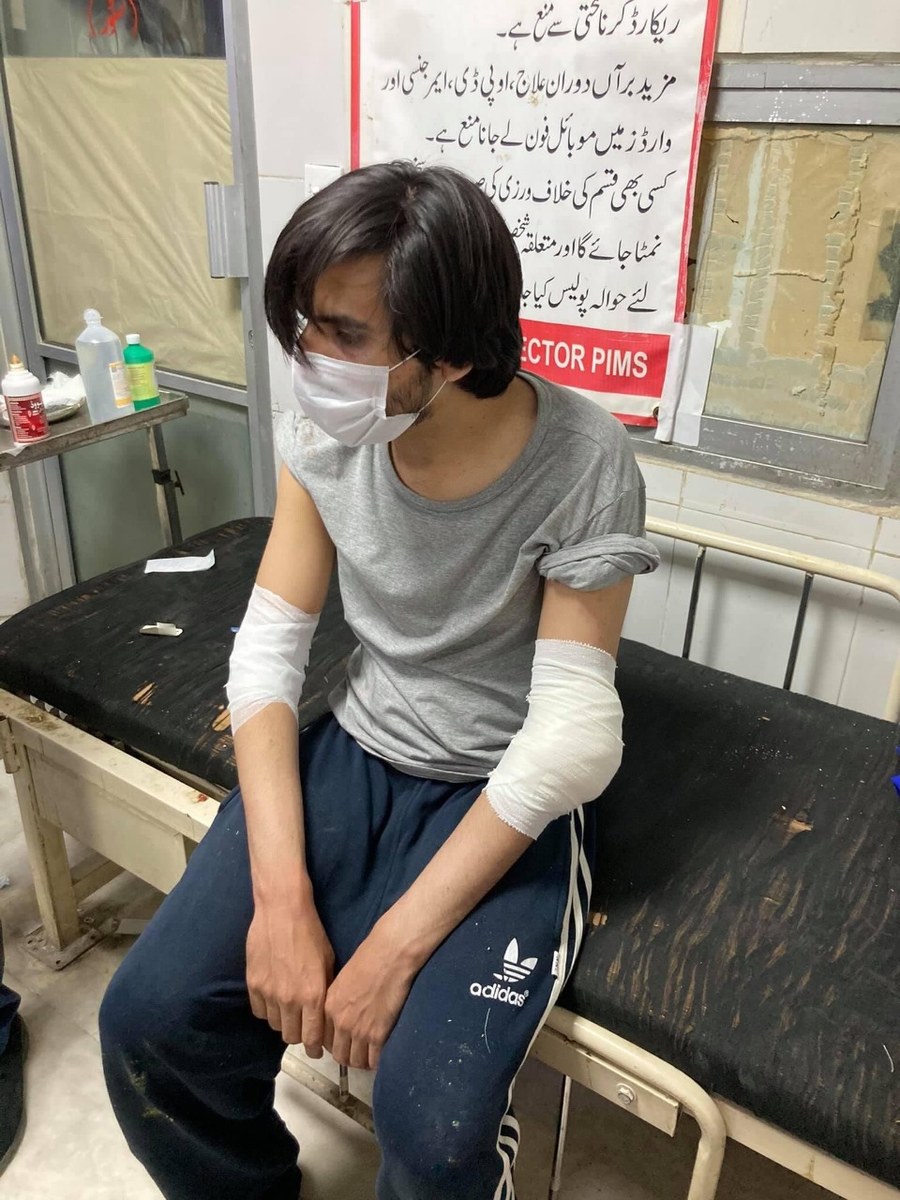
Asad Ali Toor after being treated at PIMS Hospital in Islamabad, Pakistan, on May 25, 2021. (Photo courtesy: Social Media)
The Associated Press reported that Toor told police in a statement the attackers claimed they were intelligence agents.
“He said they tied his hands and feet with cloth and one of them hit him with a pistol,” AP said. “Toor said the assailants asked about his source of income and forced him to chant slogans in favor of the army.”
No one has as yet claimed responsibility for the attack.
The Pakistan army and government vehemently deny they censor or attack journalists.
Federal minister for information Chaudhry Fawad Hussain condemned the assault and said police had been directed to launch an investigation and arrest the culprits:
Federal Minister for I&B @fawadchaudhry condemns the assault on journalist @AsadAToor. SSP Islamabad has been directed to probe the attack and bring the perpetrators to justice.
— Ministry of Information & Broadcasting (@MoIB_Official) May 25, 2021
Human rights minister Shireen Mazari said CCTV footage from Toor’s apartment showed the “perpetrators.”
Condemn attack on journalist Asad Toor. Perpetrators are on the CCTV cameras and Info Min @fawadchaudhry has already been in touch with the police to take necessary action.
— Shireen Mazari (@ShireenMazari1) May 26, 2021
The Committee to Protect Journalists (CPJ) estimates that between 1992 and 2019, at least 61 journalists were killed in Pakistan. Last year, it ranked Pakistan number nine on its annual Global Impunity Index, which spotlights countries where journalists are slain, and their killers go free. Nine of the 65 journalists and media workers killed worldwide while on duty in 2020 were in Pakistan, according to the International Federation of Journalists.
Last month, journalist and a former chairman of the Pakistan Electronic Media Regulatory Authority, Absar Alam, was shot and wounded while he was walking in a park near his residence in Islamabad. Last July, journalist Matiullah Jan was abducted from outside a government school in Islamabad. He was released after 12 hours. Perpetrators have not been arrested in either case.
In an interview with Arab News earlier this year, Toor said he had turned to making YouTube videos because it “provided an alternative platform to bring facts” to viewers after censorship increased on mainstream TV channels and newspapers. He was also charged under the Pakistan Electronic Crimes Act last September for his videos, which a police report described as “negative propaganda against the state, Pakistani institutions and the Pakistan Army.”
In November, the Lahore High Court quashed the case against Toor after the Federal Investigation Agency admitted the charges levelled against him were false.
Toor has also come under fire for a recent YouTube video about a local woman journalist who has since filed a defamation case against him.
Meanwhile, in Pakistan’s southern Sindh province, anti-terrorism cases have been filed against 50 journalists in the last one year.
This week, Fareed Khan, an Associated Press photographer, was arrested while he was taking pictures of a police crackdown against coronavirus rule violations by shops in Karachi’s Federal B. Area.
“I was taking pictures as police personnel were forcing people to close their shops,” Khan told Arab News. “While I was doing my work, a cop asked me to sit in the police van and threatened to break my camera.”
He said police misbehaved with him and kept him with the lockdown violators despite the fact that he had introduced himself and proved his identity.
Other journalists in the city also described being harassed by authorities while covering coronavirus rule violations.
Speaking to a delegation of journalists on Tuesday, Karachi police chief Imran Yaqoob Minhas said he had taken notice of such incidents and directed his officials to deal with the media “more respectfully.” Sindh information minister Syed Nasir Shah did not respond to repeated calls seek comment.
“Pakistani Journalists have been facing such situations for a long time, but these sudden attacks are quite alarming,” Mazhar Abbas, a former secretary general of the Pakistan Federal Union of Journalists (PFUJ) and Karachi Press Club, told Arab News on Wednesday, saying he hoped the journalists’ protection bill tabled in the National Assembly on Tuesday would help curb such incidents.
“It is the responsibility of media owners and journalists’ organizations to forcefully take up this issue [of violence against journalists],” Abbas added. “At the same time, journalists should be trained to tackle such incidents.”
The government has introduced the new legislation in the National Assembly following years of demands by media bodies, civil society organizations and the international community. It still has to be debated and voted into law.
Under the new proposed legislation, the government will set up an “independent commission” where a journalist or media professional threatened or abused by an individual or institution can file a complaint within 14 days. Upon receipt of the complaint, the commission is bound to “take all necessary actions” to investigate and prosecute within 14 days.
Journalists and media professionals have, however, raised questions over the autonomy and independence of the commission as the government will appoint its chairperson for a two-year term and allocate funds for its functions.
“We want this commission to be financially autonomous and fully independent from government intervention,” Shahzada Zulfiqar, president of the Pakistan Federal Union of Journalists (PFUJ), told Arab News last week, adding that PFUJ would share its suggestions and recommendations with the government to further strengthen the legislation. “We want some ambiguities ... and other loopholes in the legislation be addressed before its passage from the parliament.”
Information minister Hussain has called the bill a “great success” for working journalists.