

How Manchester City overcame pandemic on, off pitch to become Premier League champions again

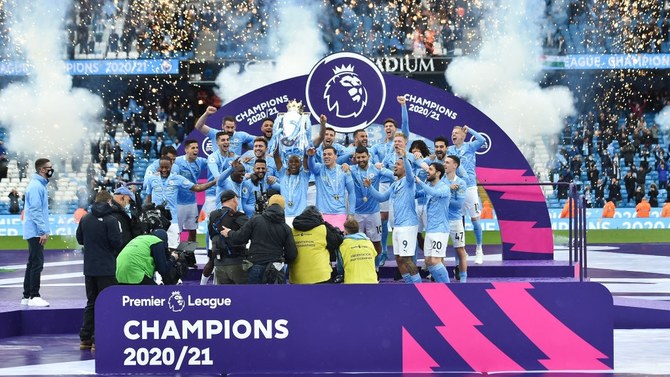
The 2020-21 Premier League title was Manchester City's fifth in the last 10 seasons. (Manchester City FC)
Short Url
Updated 25 May 2021
Follow

How Manchester City overcame pandemic on, off pitch to become Premier League champions again

  • Players, staff had to overcome unique challenges by adopting creative new methods

RIYADH: When Manchester City captain Fernandinho lifted the Premier League trophy on Sunday after the 5-0 thrashing of Everton, it marked the fifth time in 10 seasons that the club owned by Sheikh Mansour had been crowned champions of England.

Yet while the previous four titles had been played out against a traditional backdrop of home support, the unique context of the coronavirus disease (COVID-19) pandemic meant this was a victory unlike any other.

On the pitch, it was a campaign underpinned by manager Pep Guardiola’s reinvention, and the building of perhaps his second great team at the Etihad Stadium.

Having lost the title the previous year to Jurgen Klopp’s Liverpool, City’s coaching staff and players had to adapt to combine new and old methods of playing, as they demonstrated renewed physical and mental resilience to overcome the logistical challenges that emerged during the period.

City midfielder and captain, Kevin de Bruyne, said. “It’s been a unique experience playing in front of empty stadiums. We’ve missed our fans so much.

“All our usual routines and preparation have been impacted. We’re really proud that as a team we’ve worked together and been able to overcome all those challenges.

“We all hope that after this season we never have to play without our fans again – it just isn’t the same without them and we were so motivated to give them something to celebrate.”

The logistical challenges presented by the COVID-19 pandemic meant that nearly every aspect of the club’s operation had to be altered, with new approaches required to maintain connection with fans, drive value with commercial partners and above all, ensure that the team continued to conjure wins on the pitch.

“We are in such a fortunate position. We know how hard the past year has been for people all over the world. If we can deliver on the pitch and bring a smile to people’s faces then it makes it all worth the effort,” De Bruyne added.

With fans missing from the Etihad Stadium throughout the season, until the last match, Manchester City sought to maintain that connection with a consistent flow of content to keep supporters as close as possible.

The dedicated Cityzens at Home web portal provided fans of all ages with activities to stay engaged and active during lockdown, including exclusive exercise advice given by Guardiola’s first team backroom staff.

Fan-produced content was championed across club channels and images of supporters were displayed in the tunnel and on stadium screens to ensure they remained front-of-mind for City’s players, while investment in new camera technologies allowed the club to film players remotely and broadcast exclusive access.

Commercially, the absence of traditional assets such as tickets, hospitality, player appearances, and fan events meant the playbook for the club’s commercial partners needed to adapt overnight.

Together there was a pivot to new digital opportunities, including virtual player appearances in homes during lockdown, while City delivered more partner-branded content across its social media platforms than any other club, which delivered huge engagement and exposure for partners.

Cisco’s Webex solutions were integral to player training and fan content series, while Intel’s True View product provided an enhanced broadcast experience for fans at a time when it was needed more than ever. Official club partner Puma delivered virtual kit launches and fan competitions, while the Midea Home Challenge kept fans entertained at home during lockdown.


Morocco banish any doubts about ability to host World Cup 2030

Updated 19 January 2026
Follow

Morocco banish any doubts about ability to host World Cup 2030

  • Impressive stadiums, easy transportation links and a well-established tourism infrastructure ensured the 24-team tournament went off without any major hitch and will assuage any doubters about the World Cup in four years’ time

RABAT: Morocco’s successful staging of the Africa Cup of Nations means there should be no skepticism about its ability to co-host the World Cup with Portugal and Spain in 2030, even if Sunday’s final was clouded by a walk-off and defeat for the home team.

Impressive stadiums, easy transportation links and a well-established tourism infrastructure ensured the

24-team tournament went off without any major hitch and will assuage any doubters about the World Cup in four years’ time.

Morocco plans to use six venues in 2030 and five of them were used for the Cup of Nations, providing world-class playing surfaces and a spectacular backdrop.

The Grande Stade in Tangier with a 75,000 capacity is an impressive facility in the northern coastal city, less than an hour’s ferry ride from Spain.

Meanwhile, FIFA President Gianni Infantino condemned "some Senegal players" for the "unacceptable scenes" which overshadowed their victory in the final when they left the pitch in protest at a penalty awarded to Morocco.

African football's showpiece event was marred by most of the Senegal team walking off when, deep into injury time of normal play and with the match locked at 0-0, Morocco were awarded a spot-kick following a VAR check by referee Jean-Jacques Ndala for a challenge on Brahim Diaz.

security personnel at the other end of the stadium, Senegal's players eventually returned to the pitch to see Diaz shoot a soft penalty into the arms of their goalkeeper Edouard Mendy.

The match was played at the Stade Moulay Abdellah in the capital Rabat, which has a capacity of 69,500. The attendance for the final was 66,526.

Stadiums in Agadir, Fes and Marrakech were also more than adequate and will now be renovated over the next few years.

But the crowning glory is the proposed 115,000-capacity Stade Hassan II on ⁠the outskirts of Casablanca which Morocco hope will be chosen to host the final over Madrid’s Santiago Bernabeu Stadium.

In all, Morocco will spend $1.4 billion on the six stadiums. Also planned is extensive investment in airports, with some 10 Moroccan cities already running direct air links to Europe and many budget airlines offering flights to the country.

An extension of Africa’s only high-speed rail service, which already provides a comfortable three-hour ride from Tangier to Casablanca, further south to Agadir and Marrakech is also planned. Morocco hopes all of this will modernize its cities and boost the economy.

On the field, Morocco will hope to launch a credible challenge for a first African World Cup success, although on Sunday they continued their poor return in the Cup of Nations, where their only triumph came 50 years ago.

They surprised with a thrilling run to the last four at the Qatar 2022 World Cup as the first African nation to get that far and will hope for a similar impact at this year’s finals in North America. They are in Group C with Brazil, Scotland and Haiti.