

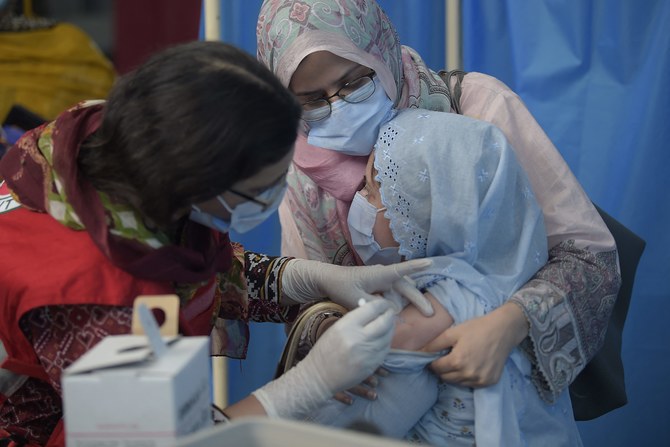

ISLAMABAD: The Pakistan government announced on Tuesday it had started producing China's single-dose CanSino vaccine to prevent the spread of COVID-19, adding that the National Institute of Health would roll out three million coronavirus jabs every month to reduce the country's dependence on imported shots.
Pakistan has started production of China’s single-dose Covid-19 vaccine CanSino at National Institute of Health (NIH) plant. This facility will produce 3 million doses/month and as a result, significantly reduce Pakistan’s dependence on importing vaccine from other countries. pic.twitter.com/ejXhq9QsUG
— Government of Pakistan (@GovtofPakistan) May 25, 2021
Earlier in the day, Pakistan’s health chief, Dr. Faisal Sultan, said the country had successfully processed, using Chinese raw materials, a local version of the coronavirus vaccine, as the national positivity ratio dropped below five percent for the first time in around two months.
Pakistan has so far vaccinated five million of its 220 million population, using mostly Chinese vaccines and a limited supply of AstraZeneca and Sputnik jabs.
In the last 24 hours, 2,253 people tested positive for the coronavirus in Pakistan, with 92 deaths. The national positivity rate was 4.82 percent, the lowest in months. In Islamabad, the district health officer said the positivity rate was 2.7 percent, “the lowest positivity in many months of [the] third wave of COVID19.”
BREAKING: We have 111 cases diagnosed and positivity remained 2.7%.
4114 tests were conducted in the federal capital. This is the lowest positivity in many months of third wave of COVID19.
— Zaeem Zia MD-MPH (@ZaeemZia) May 25, 2021
“Congratulations to the NIH [National Institute of Health] Pak team and its leadership for successful fill/finish (from concentrate) of the Cansino vaccine with the help of Cansino Bio Inc. China,” Sultan said on Twitter, posting a picture of the vaccine dose. “The product has passed the rigorous internal QA [quality assurance] testing,” he added, saying this was an important step in boosting Pakistan’s vaccine supply line.
Congratulations to the NIH Pak team and its leadership for successful fill/finish (from concentrate) of the Cansino vaccine with the help of Cansino Bio Inc. China. The product has passed the rigorous internal QA testing. An imp step to help in our vaccine supply line pic.twitter.com/hrkySTJxPX
— Faisal Sultan (@fslsltn) May 24, 2021
In March, Pakistan said it would import Chinese Cansino Biologics COVID-19 vaccines in bulk to package three million doses locally.
“We will be getting the bulk vaccine by mid-April from Cansino, from which 3 million doses can be made,” planning minister Asad Umar had said. “The bulk vaccine received will be formulated, sterilized and packed in Pakistan.”
In March, a representative of Pakistani private pharmaceutical company AGP Limited also said China’s CanSino vaccine would be brought in bulk in Pakistan and from April would be packed at a filling plant at the National Institute of Health, adding that the country would soon start manufacturing the vaccine itself through ‘technology transfer’ from China.
“It will reduce the price of the vaccine by up to 30pc (around Rs3,000),” technical Adviser to AGM Pharma, Dr. Hassan Abbas Zaheer, told Pakistan’s Dawn newspaper, referring to the vaccine being packed at the NIH in the future. “At a later stage, it will be manufactured in Pakistan through transfer of technology. This has been made possible because the clinical trial of Cansino was held in Pakistan.”
Zaheer said though Pakistan was a vaccine insecure country currently, “soon it would become a secure country as vaccine production would begin here and dependence on other nations would end.”
“The vaccine will be manufactured under a public-private partnership project,” Zaheer added. “Currently India’s vaccine manufacturing industry is worth $5 billion. Pakistan can also start producing a number of vaccines including Covid-19.”
The Ministry of National Health Services said on Monday the first batch of China’s single-dose CanSino COVID-19 vaccine would be available for administration to citizens by the end of this month after quality control checks, media reported.


