

Expo 2020’s Terra pavilion displays art by GCC creatives in Dubai

“Takween” by Zeinab Alhashemi at Terra — The Sustainability Pavilion. (Supplied)
Short Url
Updated 24 May 2021
Follow

Expo 2020’s Terra pavilion displays art by GCC creatives in Dubai

  • Artists from Saudi Arabia and UAE create works to reflect on pavilion’s theme of sustainability

DUBAI: One might initially doubt the connection between contemporary art and sustainability.

Can art be sustainable? Moreover, how does a work of art reflect the Middle Eastern response to issues of sustainability?

To this end, five thought-provoking art installations by four leading contemporary artists from the Gulf Cooperation Council (GCC) were commissioned by Expo 2020 in collaboration with Art Dubai.


“Hugs” by Mohammed Ahmed Ibrahim at Terra — The Sustainability Pavilion. (Supplied)

Those artists are Zeinab Al-Hashemi, Mohammed Ahmed Ibrahim and Mohammed Kazem from the UAE and Ayman Zedani from Saudi Arabia.

Through their visual imagery, structure and positioning, the works reinforce the importance of sustainability at Expo 2020.

“The five pieces help to articulate our sustainability messages in uniquely visual and inspiring ways, further empowering people to make changes towards a cleaner, safer, healthier future,” said Marjan Faraidooni, chief experience officer at Expo 2020, in a statement.

Located in the walk-through area of the Terra pavilion, Emirati artist Ibrahim’s “Hugs” installation reveals a large maze-like space covered in black symbols, akin perhaps to a contemporary rendition of cuneiform. The installation prompts visitors to re-evaluate how their values impact the decisions they make each day and how those choices affect the wellbeing of our planet.

“When we were constructing Terra and the stories within, we were conscious of the hugely diverse audiences that we would be receiving at Expo 2020 from nearly every country in the world, from every age and every background,” John Bull, director of Terra — The Sustainability Pavilion, Expo 2020, told Arab News.


“Directions,” Expo 2020 by Mohammed Kazem at Terra — The Sustainability Pavilion. (Supplied)

“It was very important to me and my colleagues, as we looked to building Terra for the now and for its legacy, that we considered multiple viewpoints on the same topics. Contemporary art is a fantastic way of reaching out to our diverse audiences. These artworks also bring a new viewpoint on the subject of sustainability for children and more casual visitors,” he added.

Emirati artist Kazem showcased two artworks at Terra.

One is “Directions,” a work embedded into the building’s inside wall and displaying the geographic coordinates of worldwide visitors to the Expo 2020 Dubai site with the aim of inspiring them to think about ways to live more sustainably in the future.
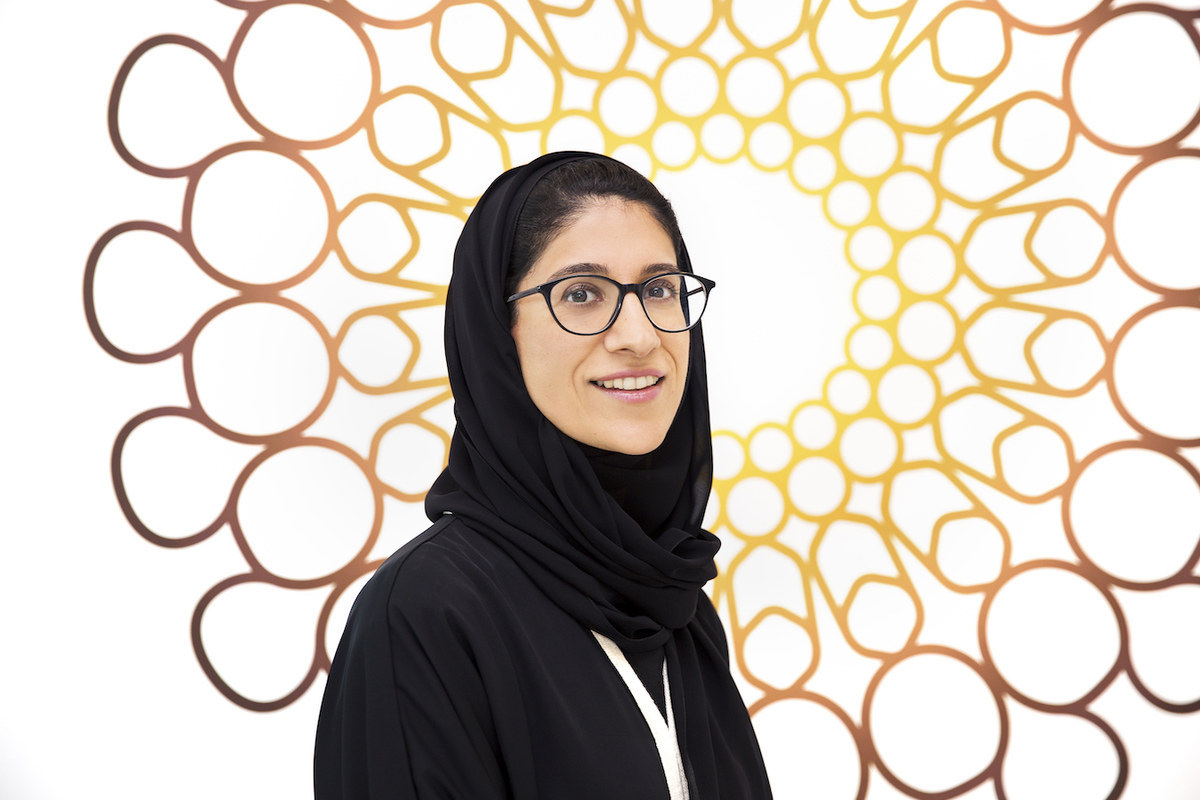


Marjan Faraidooni is the chief experience officer at Expo 2020. (Supplied)

His second work is “Measuring,” an installation that is also embedded into the building’s wall on the ground floor and that challenges the common understanding of an architectural space.

Kazem, through the incorporation of high-tech sensorial lights, shows how the perception of the space can be determined by both one’s memory and mood.

Meanwhile, artist Al-Hashemi’s stainless steel corten metal ball, featured in the piece “Takween,” examines the responsibility of human beings to work with their natural environment, showing that the two are not divergent forces, but one and the same. Al-Hashemi’s large sphere, inspired by kinetic movement, aims to show how humans and the environment can interact.


“Measuring” by Mohammed Kazemin at Terra — The Sustainability Pavilion. (Supplied)

Lastly, Saudi artist Zedani has created a digital artwork called “Terrapolis,” which uses a purpose-designed digital algorithm to transform the identities of all contributors to the Sustainability Pavilion into digital organic entities that live in a simulation reflecting life from a parallel reality.

His work, where myriad colorful abstract forms move around the screen, blurs the distinction between various forms of life.


“Terrapolis” by Ayman Zedani at Terra — The Sustainability Pavilion. (Supplied)

Even after Expo 2020 has concluded, the artworks will live on as permanent installations. They are part of the plan to establish Terra’s legacy, which will transform into a Children’s Science Centre within District 2020 — the model global community that will be built in the same location and will reimagine the cities of the future as well as repurpose more than 80 percent of Expo’s environment.

Dubai Expo 2020 will run from Oct. 1, 2021 until March 31, 2022.


Sheikha Al-Mayassa talks cultural patronage at Art Basel Qatar Conversations panel

Updated 04 February 2026
Follow

Sheikha Al-Mayassa talks cultural patronage at Art Basel Qatar Conversations panel

DOHA: Cultural leaders at the inaugural edition of Art Basel Qatar in Doha have discussed how patronage is reshaping art ecosystems, with Qatar’s own long-term cultural vision at the center.

The opening panel, “Leaders of Change: How is patronage shaping new art ecosystems?” brought together Sheikha Al-Mayassa bint Hamad bin Khalifa Al-Thani, chair of Qatar Museums, and Maja Hoffmann, founder and president of the Luma Foundation, in a discussion moderated by Hans Ulrich Obrist, artistic director of the Serpentine Galleries in London. The talk formed part of the Art Basel Conversations x Qatar Creates Talks program, coinciding with the debut of Art Basel Qatar which runs in Doha until Feb. 8.

Sheikha Al-Thani framed Qatar’s cultural project as a strategic, long-term endeavor anchored in national development. “Qatar has a national vision called 2030 where culture was one of the main pillars for socioeconomic development and human development,” she said. “We have always invested in culture as a means of human development.”

That vision, she explained, underpins the decision to welcome a major international fair like Art Basel to Doha after turning away many previous proposals.

“For the longest time, I can’t tell you how many art fairs came to us wanting to be here, and we never felt it was the right time,” she said. “However, this is an important year for us and we felt, with the surplus of talent and the growing gallery scene we had here, that it was time to bring industry to talent, because that’s how we will spur the economic diversification from hydrocarbon to a knowledge-based society.”

She was also keen to stress that Art Basel Qatar was not conceived as a conventional marketplace.

 “This is not your typical art fair … It’s a humane art fair where engagement is more important than transaction, discourse more important than division, and curiosity more important than conviction,” she added.

That ethos extends to the fair’s artistic leadership. Al-Thani described how the decision to have an artist — Wael Shawky — serve as artistic director emerged collaboratively with Art Basel’s team.

“He’s a global artist who’s now become a very local artist, very invested in our local art scene. And really, I think that’s the beauty of partnerships … There is a safe space for us to critique each other, support each other, and really brainstorm all the possibilities … and then come to a consensus of what would make sense for us,” she said.

Collecting art, she added, has long been embedded in Qatari society: “My grandmother is almost 100 years old. She was collecting in the 60s when Qatar was a very poor country. It’s in our DNA … always with this notion of investing in knowledge and human development.”

Today, that impulse translates into comprehensive, multi-disciplinary collections: “We are both collecting historical objects, contemporary objects, modern objects, architecture, archival material, anything that we feel is relevant to us and the evolution of this nation towards a knowledge-based economy.”

Looking ahead, Al-Thani outlined a new cultural triangle in Doha — the National Museum of Qatar, the Museum of Islamic Art and the forthcoming Art Mill Museum — as engines for both economic diversification and intellectual life.

 “That ecosystem will enhance the economic growth and diversification, but also the knowledge that’s available, because the diversity in the collections between these three institutions will no doubt inspire young people, amateurs, entrepreneurs to think outside the box and inform their next business,” she said.

The panel closed with a focus on the future of large-scale exhibitions with Rubaiya, Qatar’s new quadrennial, timed to coincide with the anniversary of the 2022 World Cup.

“Every four years in memory of the opening of the World Cup, we will open the quadrennial. This year, the theme is ‘Unruly Waters.’ At the center of the theme is Qatar’s trading route to the Silk Road,” explained Al-Thani.

“It’s important for us to trace our past and claim it and share it to the rest of the world, but also show the connectivity that Qatar had historically and the important role it has been playing in diplomacy.”