Pakistan says Saudi Arabia has not yet communicated final Hajj policy

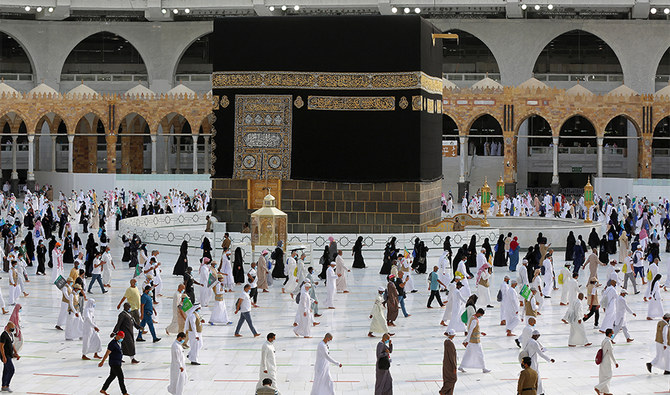
Muslim pilgrims circumambulate around the Kaaba, Islam's holiest shrine, at the centre of the Grand Mosque in the holy city of Makkah on August 2, 2020 (AFP)
Short Url
Updated 24 May 2021
Follow

Pakistan says Saudi Arabia has not yet communicated final Hajj policy

  • Religious affairs minister says kingdom has not finalized number of pilgrims and standard operating procedures for this year’s Hajj
  • Spokesperson says Pakistan to follow all health protocols based on guidelines issued by the kingdom once they are finalized

ISLAMABAD: Saudi Arabia has yet to issue a final policy for the Hajj pilgrimage this year, Pakistan’s religious affairs minister and a spokesman for the ministry have said, saying any final decision taken on number of international pilgrims allowed and standard operating procedures would be communicated to Pakistan in due time.
Saudi Arabia barred foreigners from the Hajj last year due to the pandemic for the first time in the kingdom’s modern history, allowing only a limited number of Saudi citizens and residents to perform the pilgrimage.
On Sunday, Religious Affairs Minister Noorul Haq Qadri said the kingdom’s Hajj ministry had not yet decided on the number of pilgrims and standard operating procedures for the upcoming Hajj, saying Pakistan would be “taken into confidence before making a final decision.”
“Pakistan’s religion ministry will be told about it, but until now ... they have made no final decision,” Qadri said in a video message to the nation.
“Saudi government has not yet issued a final policy on Hajj 2021,” religion ministry spokesman Imran Siddiqui told Arab News, saying Pakistan would follow all health protocols based on guidelines issued by the kingdom once they were finalized.
Last week, Pakistan had requested Saudi Arabia to include Chinese vaccines in its list of approved COVID-19 shots for visitors traveling to the kingdom to perform Hajj and Umrah.
“Pakistan has taken up with the Kingdom of Saudi Arabia, the issue of vaccines which are mandatory for travel to Saudi Arabia for visit, Umrah and Hajj,” foreign office spokesperson Zahid Hafeez Chaudhri had said in a statement. “We have proposed inclusion of some of the Chinese vaccines used in Pakistan in the list of vaccines approved by the Saudi authorities ...The Ministry [of Foreign Affairs] is actively pursuing this matter with the Saudi side.”
Except for a small number of AstraZeneca jabs, Pakistan has mostly administered Chinese vaccines to its citizens in a government-run immunization campaign that began last February. Around five million people have been inoculated so far.
Hundreds of thousands of Pakistanis visit Saudi Arabia annually, mostly for pilgrimage. The kingdom is also home to a sizeable Pakistani expatriate community that makes the largest contribution to incoming remittances every year.


Pakistan, ADB reaffirm commitment to ML-1 rail project amid economic reforms

Updated 6 sec ago
Follow

Pakistan, ADB reaffirm commitment to ML-1 rail project amid economic reforms

  • Flagship railway upgrade tied to IMF-backed stabilization, multilateral financing
  • ADB, World Bank working with Pakistan to address project delays, readiness gaps

ISLAMABAD: Pakistan and the Asian Development Bank (ADB) have reaffirmed their commitment to advancing the long-delayed Main Line-1 (ML-1) railway modernization project, a flagship infrastructure upgrade central to the country’s economic reform and connectivity agenda, the information ministry said on Thursday. 

The renewed focus on ML-1 follows meetings this week between senior Pakistani ministers and ADB officials in Islamabad, as the government seeks to revive large-scale infrastructure investment while maintaining fiscal discipline under an International Monetary Fund (IMF) program.

ML-1 is Pakistan Railways’ busiest north–south corridor, linking the southern port city of Karachi with major population and industrial centers in Punjab and Khyber Pakhtunkhwa. The project aims to modernize tracks, signaling and rolling stock to improve safety, cut travel times and lower transport costs. 

Originally envisioned as a flagship transport upgrade under the China-Pakistan Economic Corridor (CPEC), ML-1 has struggled to reach financial close amid cost concerns, debt sustainability debates and implementation challenges. Pakistan has since sought broader multilateral engagement, with institutions including the Asian Development Bank now playing a central role in project structuring, financing discussions and efforts to address execution bottlenecks.

During a meeting with Leah Gutierrez, Director General for Central and West Asia at the ADB, Federal Minister for Economic Affairs Ahad Cheema underscored the government’s reform priorities and the importance of the project’s timely execution.

“The Minister underscored the Government’s strong commitment to the timely implementation of the Main Line–1 (ML-1) railways project and emphasized that ADB’s continued support would be critical to achieving this milestone,” the information ministry said in a statement.

The ministry said Cheema also highlighted coordination with provincial governments and welcomed joint efforts by the ADB and the World Bank to identify implementation bottlenecks and improve project readiness to ensure timely disbursements.

Gutierrez commended Pakistan’s reform agenda and acknowledged the government’s focus on macroeconomic recovery and fiscal consolidation, reaffirming that ADB teams were working closely with Pakistani authorities on ML-1, according to the statement.

Separately, Federal Minister for Railways Muhammad Hanif Abbasi told Defense Secretary Lt. Gen. Muhammad Ali in a meeting that an agreement for the ML-1 project had been finalized with the ADB and that steps were being taken to move the project forward.

“Concrete steps are being taken to complete the project at the earliest,” the statement quoted Abbasi as telling Ali. “The ML-1 project will serve as a milestone in modernizing Pakistan Railways.”

Abbasi also briefed participants on parallel reform measures at Pakistan Railways, including the launch of an artificial intelligence-based monitoring system at Rawalpindi Railway Station, real-time tracking of trains and rolling stock through digital tagging, and the installation of a weigh bridge in Karachi to address overloading and improve safety.

Pakistan Railways has long struggled with aging infrastructure, safety challenges and financial losses, even as rail transport remains vital for passenger movement and freight. Multilateral lenders have repeatedly stressed the need for stronger execution capacity and governance reforms to translate infrastructure commitments into economic gains.