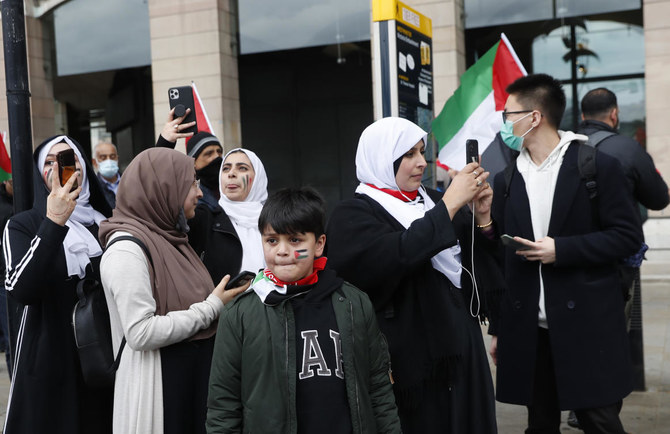
LONDON: Thousands of pro-Palestinian demonstrators marched through London and other British cities on Saturday to protest against Israeli air strikes on the Gaza Strip during fighting with the Islamist group Hamas.
Protesters called for sanctions on Israel during the march in London. Some were draped in Palestinian flags and set off green and red smoke flares. Others carried banners declaring “Free Palestine,” “Stop bombing Gaza” and “Sanctions on Israel.”
A cease-fire on Friday, mediated by Egypt, ended 11 days of hostilities, during which the Israeli military pounded Gaza with air strikes which it said were a response to rockets fired at Israel by Palestinians militants.
Gaza medical officials said 248 people were killed in the Palestinian enclave, and aid officials have expressed concern about the humanitarian situation there.
Health officials said 13 people were killed in Israel in the hostilities, during which the Israeli military said Hamas, Islamic Jihad and other militant groups fired around 4,350 rockets, many of which did not reach Israel or were intercepted.

Thousands of pro-Palestinian demonstrators march in Britain
https://arab.news/4scvz
Thousands of pro-Palestinian demonstrators march in Britain
- Protesters called for sanctions on Israel during the march in London
- They carried banners declaring “Free Palestine,” “Stop bombing Gaza” and “Sanctions on Israel”
Kremlin welcomes US sanctions waiver says US and Russia share interest in stable energy markets
DUBAI: Russia sees a U.S. sanctions waiver on its oil as an attempt by Washington to stabilise global energy markets, and the two countries have a shared interest in this, Kremlin spokesman Dmitry Peskov said on Friday.
"We see actions by the United States aimed at trying to stabilise energy markets. In this respect, our interests coincide," he said.
US Treasury Secretary Scott Bessent announced a temporary authorisation allowing countries around the world to purchase Russian oil currently stranded at sea on Thursday extending a measure that had previously been granted only to Indian refiners.
Bessent stressed in a post on X that the authorisation would not provide significant financial benefit to the Russian government.
“This narrowly tailored, short-term measure applies only to oil already in transit and will not provide significant financial benefit to the Russian government, which derives the majority of its energy revenue from taxes assessed at the point of extraction,” Bessent said on a post on X.
However, the measure received mix reviews in European capitals, with many fearing it could help replenish Russia's assualt on Ukraine.
"I am concerned that we are further filling Putin's war chest," German Economy Minister Katherina Reiche said in Berlin on Friday.
Reiche said that she saw both sides to the United States' decision to issue a 30-day waiver for the purchase of Russian oil products, understanding the increasing ecnomic and political turnout from the oil crisis, particurlarly in South Korea and Japan.
"It seems to me that domestic political pressure in the United States is very, very high," Reiche said.
German Chancellor Friedrich Merz was more direct, saying on Friday that it was wrong to ease sanctions against Russia for whatever reason. The sentiment was echoed by Norway’s Prime Minister, who also said sanctions should not be eased.
Oil prices held gains above $100 Friday and most equity markets dropped after Iran's leader called for the blocking of the crucial Strait of Hormuz and the opening up of new fronts in the war against the United States and Israel.
With the conflict heading towards its third week and showing no signs of ending, investors are growing increasingly worried about an extended crisis that could fan inflation and hammer the global economy.