

Seven killed in bomb attack on Palestine solidarity rally in southwest Pakistan

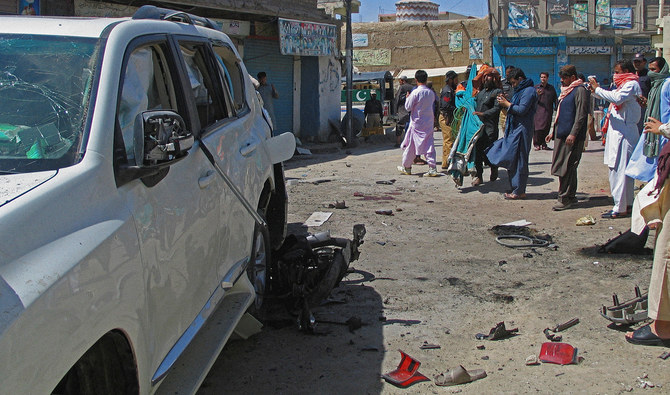
Police and residents gather at the site after a bomb blast in the Pakistan-Afghanistan border town of Chaman, Pakistan, on May 21, 2021. (REUTERS)
Short Url
Updated 21 May 2021
Follow

Seven killed in bomb attack on Palestine solidarity rally in southwest Pakistan

  • Blast occurred in Murghi Bazar area in border town of Chaman
  • Religious leader whose rally targeted safe, hospital says

QUETTA/KARACHI: At least seven people were killed and 17 injured on Friday when a bomb ripped through a rally organized by a religious party to show solidarity with Palestine in Chaman, a border city in Pakistan’s southwestern Balochistan province, police and doctors said.

The Pakistan government had announced this week Friday would be observed as Palestine Solidarity Day with rallies held through the country, and religious clerics endorsing the Palestinian cause and condemning “Israeli atrocities” during Friday sermons.

“The bomb fitted to a motorcycle was exploded when the vehicle of Abdul Qadri Loni, leader of the Jamiat Ulema-e-Islam Nazriati faction, reached Murghi Bazaar,” police officer Maqsood Ahmed told Arab News, saying the religious party leader was wounded in the blast. “This was a remote control blast.”

Dr. Akhter Muhammad, medical superintendent at the Civil Hospital, Chaman, said six dead bodies and 18 injured people had been brought to the hospital after the blast.

“Four [patients] in critical condition have been referred to Quetta for treatment,” Dr. Muhammad told Arab News, saying one had passed away en route to Quetta, taking the death toll to seven. “All the injured have received splinter wounds due to intensity of blast while some had been discharged after initial medical care.”

“I was leaving the Palestine Solidarity rally in Chaman when the powerful bang hit my convoy but I escaped unhurt in the attack,” Loni, whose rally was attacked, told Arab News by phone from a secure location. “I had been receiving death threats from armed groups for the past many months and despite multiple requests the government failed in providing us full security.”

No group has so far accepted responsibility for the attack.

Last month, a car bomb blast at a luxury hotel’s parking area in the southwestern Pakistani city of Quetta killed four people and wounded 11.

Quetta is the capital of the mineral rich Balochistan province bordering Iran and Afghanistan, which has long been the scene of a low-level insurgency by local nationalists, who want more of a share in the regional resources.

The province is home to the newly expanded Gwadar deep water port that is key to a planned $65 billion investment in China’s Belt and Road Initiative economic corridor.


Sindh assembly passes resolution rejecting move to separate Karachi

Updated 21 February 2026
Follow

Sindh assembly passes resolution rejecting move to separate Karachi

  • Chief Minister Shah cites constitutional safeguards against altering provincial boundaries
  • Calls to separate Karachi intensified amid governance concerns after a mall fire last month

ISLAMABAD: The provincial assembly of Pakistan’s southern Sindh province on Saturday passed a resolution rejecting any move to separate Karachi, declaring its territorial integrity “non-negotiable” amid political calls to carve the city out as a separate administrative unit.

The resolution comes after fresh demands by the Muttahida Qaumi Movement (MQM) and other voices to grant Karachi provincial or federal status following governance challenges highlighted by the deadly Gul Plaza fire earlier this year that killed 80 people.

Karachi, Pakistan’s largest and most densely populated city, is the country’s main commercial hub and contributes a significant share to the national economy.

Chief Minister Syed Murad Ali Shah tabled the resolution in the assembly, condemning what he described as “divisive statements” about breaking up Sindh or detaching Karachi.

“The province that played a foundational role in the creation of Pakistan cannot allow the fragmentation of its own historic homeland,” Shah told lawmakers, adding that any attempt to divide Sindh or separate Karachi was contrary to the constitution and democratic norms.

Citing Article 239 of Pakistan’s 1973 Constitution, which requires the consent of not less than two-thirds of a provincial assembly to alter provincial boundaries, Shah said any such move could not proceed without the assembly’s approval.

“If any such move is attempted, it is this Assembly — by a two-thirds majority — that will decide,” he said.

The resolution reaffirmed that Karachi would “forever remain” an integral part of Sindh and directed the provincial government to forward the motion to the president, prime minister and parliamentary leadership for record.

Shah said the resolution was not aimed at anyone but referred to the shifting stance of MQM in the debate while warning that opposing the resolution would amount to supporting the division of Sindh.

The party has been a major political force in Karachi with a significant vote bank in the city and has frequently criticized Shah’s provincial administration over its governance of Pakistan’s largest metropolis.

Taha Ahmed Khan, a senior MQM leader, acknowledged that his party had “presented its demand openly on television channels with clear and logical arguments” to separate Karachi from Sindh.

“It is a purely constitutional debate,” he told Arab News by phone. “We are aware that the Pakistan Peoples Party, which rules the province, holds a two-thirds majority and that a new province cannot be created at this stage. But that does not mean new provinces can never be formed.”

Calls to alter Karachi’s status have periodically surfaced amid longstanding complaints over governance, infrastructure and administrative control in the megacity, though no formal proposal to redraw provincial boundaries has been introduced at the federal level.