

Ultranationalist Israelis create secret online groups to organize violence against Arab Israelis

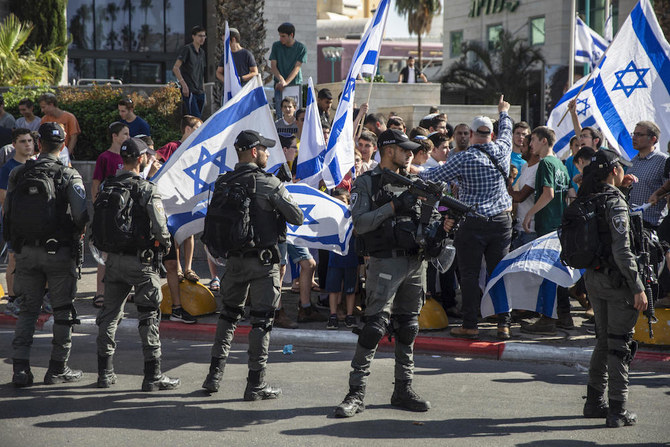
Israeli paramilitary border police stand guard as Jewish right-wing demonstrators demand the release of three Jews arrested in the shooting death of Mousa Hasoona, Lod, Israel, May 12, 2021. (AP Photo)
Short Url
Updated 20 May 2021
Follow

Ultranationalist Israelis create secret online groups to organize violence against Arab Israelis

  • News sites have reported that Israeli ultranationalist social media accounts are breeding grounds for hate speech and are being used to organize anti-Arab attacks in Israel
  • A group called La Familia-Death to Arabs, was linked to La Familia, the far-right, football supporter group of the Israeli Premier League club Beitar Jerusalem

LONDON: Ultranationalist Israelis in recent days have created secret online groups to hide their activities and to organize and spread hate against Arab Israelis. 

News sites, including Sky News, have been monitoring the activities of Israeli ultranationalist social media accounts and have reported that the accounts are breeding grounds for hate speech and are being used to organize anti-Arab attacks in Israel. 

While some of these groups are currently under review from Facebook, the encrypted messaging app Telegram previously took down a few of the channels, including one with “war group” in its title and another called “Death to Arabs.”

Reports indicated that the attack on an Arab man who was pulled from his car by a mob of right-wing Israelis and beaten in the streets of Bat Yam last week was coordinated on Telegram.

One of the groups shut down by Telegram boasted around 6,000 members who call themselves a civilian army. After it was deactivated, its members reportedly regrouped and formed a different channel that includes more than 400 users. 

Usernames on these groups include “Death to Arabs,” “State of Israel,” and “Every Arab killed is a holiday for us.” One member carrying the username “State of Israel” shared an image of a man who had been shot in the head, captioned “Father of all Arabs.”

Another group, called La Familia-Death to Arabs, was linked to La Familia, the far-right, football supporter group of the Israeli Premier League club Beitar Jerusalem. The group was also shut down by Telegram for encouraging members to take to the streets to “bring order” and for inciting violence. 

Facebook and WhatsApp groups are also vehicles for inciting violence, with some appearing to be connected to far-right Israeli political party Otzma Yehudit, meaning “Jewish Strength.” 

A post on one of these groups reads: “In Lod there is a call for all those who carry a weapon to come asap to Lod to help save Jewish lives. Yes, it’s that bad. I emphasize: ONLY those with weapons!” The page was recently deleted by Facebook. 

Most of these groups cannot be accessed without the admin’s approval and require a comprehensive set of security questions to verify prospective users. First, they must offer a photo of themselves with proof of the date and time it was taken and a link to their personal social media.

Then, they must produce a video and a written message in Hebrew vowing support for Israel and affirming a willingness to give their life for the cause. This evidence is then sent to an admin who will invite the user to the private chat. 

A spokesperson for Facebook stated that the platform has dedicated teams, comprised of native Arabic and Hebrew speakers, that are “closely monitoring the situation on the ground” and “removing content and accounts that break our rules as quickly as possible.”

“We’re reviewing the accounts shared by Sky News and have already removed one Facebook Group for breaking our rules,” the spokesperson said. 


Pioneering Asharq Al-Awsat journalist Mohammed al-Shafei dies at 74

Updated 08 January 2026
Follow

Pioneering Asharq Al-Awsat journalist Mohammed al-Shafei dies at 74

  • Egyptian was known for his fearless coverage of terrorist, extremist groups
  • One of handful of reporters to interview Taliban leader Mullah Omar in 1970s

LONDON: Mohammed al-Shafei, one of Asharq Al-Awsat’s most prominent journalists, has died at the age of 74 after a 40-year career tackling some of the region’s thorniest issues.

Born in Egypt in 1951, al-Shafei earned a bachelor’s degree from Cairo University in 1974 before moving to the UK, where he studied journalism and translation at the University of Westminster and the School of Oriental and African Studies.

He began his journalism career at London-based Arabic papers Al-Muslimoon and Al-Arab — both of which are published by Saudi Research & Publishing Co. which also owns Arab News — before joining Al-Zahira after Iraq’s 1990 invasion of Kuwait.

Al-Shafei joined Asharq Al-Awsat in 1991 and spent 15 years on the sports desk before shifting to reporting on terrorism. He went on to pioneer Arab press coverage in the field, writing about all aspects of it, including its ideologies and ties to states like Iran.

His colleagues knew him for his calm demeanor, humility and meticulous approach, marked by precise documentation, deep analysis and avoidance of sensationalism.

Al-Shafei ventured fearlessly into terrorist strongholds, meeting senior terrorist leaders and commanders. In the 1970s he was one of only a handful of journalists to interview Mullah Omar, the leader of the Taliban, and conducted exclusive interviews with senior figures within Al-Qaeda.

He also tracked post-Al-Qaeda groups like Daesh, Hay’at Tahrir al-Sham and Boko Haram, offering pioneering analysis of Sunni-Shiite extremism and how cultural contexts shaped movements across Asia and Africa.

During the war on Al-Qaeda, he visited US bases in Afghanistan, embedded with international forces, and filed investigative reports from active battlefields — rare feats in Arab journalism at the time.

He interviewed Osama bin Laden’s son, highlighting a humanitarian angle while maintaining objectivity, and was among the few Arab journalists to report from Guantanamo, where his interviews with Al-Qaeda detainees shed light on the group’s operations.

Al-Shafei married a Turkish woman in London in the late 1970s, with whom he had a son and daughter. He was still working just hours before he died in London on Dec. 31.