

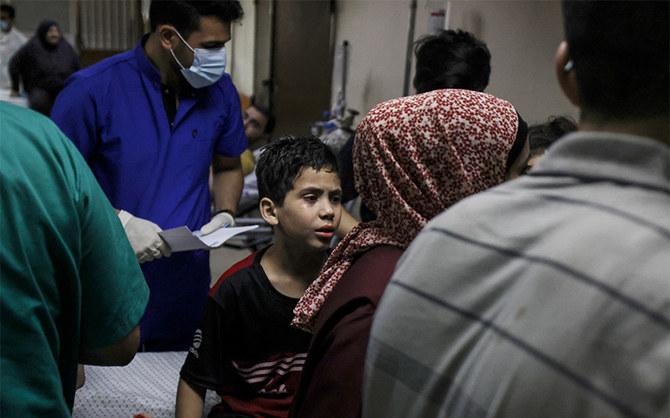

ISLAMABAD: Information Minister Chaudhry Fawad Hussain has said Pakistan would send aid to Palestine to help the country deal with the coronavirus pandemic and the “medical emergency situation” created by ongoing Israeli air strikes.
Pakistani Foreign Minister Shah Mahmood Qureshi said on Tuesday Islamabad was reaching out to different countries including Palestine, Turkey, Saudi Arabia, Egypt, Indonesia and others, to gather support to stop worsening Israeli attacks against Palestine.
Qureshi arrived in Turkey on Tuesday from where he will fly to New York to attend and address an emergency session of the United Nations General Assembly (UNGA) on Palestine, Pakistan’s permanent mission to the UN said.
“Palestine is facing a medical emergency situation and Pakistan will send aid,” Hussain told reporters on Tuesday.
Meanwhile, Radio Pakistan reported that Qureshi, who is in Turkey, had said “contacts are being established with different countries to get stopped the Israeli persecution of Palestinians.”
In a meeting with his Turkish counterpart in Ankara, Qureshi exchanged views on the “worsening situation” in the Palestinian territories.
“The two Foreign Ministers discussed ways to mobilize the international community to help stop Israeli aggression against the Palestinians,” Pakistan’s foreign office said, adding that the international community had a “collective responsibility” to ensure necessary steps were taken to restore peace and facilitate a just solution.
The statement added that the foreign ministers of Pakistan, Turkey, Palestine and other countries, would be traveling to New York to participate in-person in a meeting of the UN General Assembly on the Palestine issue.
Michael Kugelman, South Asia senior associate at the Wilson Center, wrote on Twitter about Pakistan’s efforts to galvanzie world opinion against Israel:
“Who’s been a real busy diplomat since the Gaza crisis broke out? Shah Mahmood Qureshi. Pakistan’s FM has spoken w/his Palestinian, Egyptian, Saudi, Afghan, Chinese, and US counterparts. He also made a strong statement to OIC. Now enroute to Turkey and on to US for UN meetings.”
Who’s been a real busy diplomat since the Gaza crisis broke out?
Shah Mahmood Qureshi.
Pakistan’s FM has spoken w/his Palestinian, Egyptian, Saudi, Afghan, Chinese, and US counterparts. He also made a strong statement to OIC. Now enroute to Turkey and on to US for UN meetings.— Michael Kugelman (@MichaelKugelman) May 18, 2021
On Monday, the United States for a third time prevented the United Nations Security Council from issuing a public statement on the Israeli assault as the White House said it was pursuing “quiet, intensive diplomacy.”
For the past week Washington, a strong ally of Israel, has been isolated on the 15-member council over its objection to a public statement by the Security Council on the worst violence between Israel and the Palestinians in years because it worries it could harm behind-the-scenes diplomacy.
Gaza medical officials say 217 Palestinians have been killed, including 63 children, and more than 1,400 wounded since the fighting began on May 10. Israeli authorities say 12 people have been killed in Israel, including two children.
“On the special instructions of PM Imran Khan, the FM Makhdoom Shah Mehmood Qureshi will speak at @UN General Assembly #UNGA debate on “The situation in the Middle East” & the “Question of Palestine” on 20 May 2021,” Pakistan’s permanent mission to the UN said in a Twitter post on Tuesday.
On the special instructions of PM Imran Khan, the FM Makhdoom Shah Mehmood Qureshi will speak at @UN General Assemby #UNGA debate on “The situation in the Middle East” & the “Question of Palestine”on 20 May 2021. @ImranKhanPTI @SMQureshiPTI @PakistanPR_UN #FMPakistanAtUN pic.twitter.com/C18ornjX1s
— Permanent Mission of Pakistan to UN, NY (@PakistanUN_NY) May 18, 2021
“The Foreign Minister Shah Mahmood Qureshi will hold meetings with various dignitaries in NewYork. He will hold talks with local & int’l media representatives & present Pakistan’s views on the situation in #Palestine.”
The Foreign Minister Shah Mahmood Qureshi will hold meetings with various dignitaries in NewYork.He will hold talks with local & int'l media representatives & present Pakistan's views on the situation in #Palestine @ForeignOfficePk @SMQureshiPTI @PakistanPR_UN #FMPakistanAtUN
— Permanent Mission of Pakistan to UN, NY (@PakistanUN_NY) May 18, 2021
“Pakistan joins hands with Palestine, Sudan and Turkey to address an emergency session on #Palestine called by the United Nations General Assembly. Pakistan stands firmly with the people of Palestine.”
Pakistan joins hands with Palestine, Sudan and Turkey to address an emergency session on #Palestine called by the United Nations General Assembly. Pakistan stands firmly with the people of Palestine.
— Shah Mahmood Qureshi (@SMQureshiPTI) May 17, 2021
Pakistan’s lower house of parliament on Monday passed a unanimous resolution against what FM Qureshi called the ‘unconscionable brutality’ of Israel against Palestinians.
“Today in Parliament proud to present a resolution, unanimously adopted, in support of #Palestine, condemning Israeli’s unconscionable brutality & reaffirming Pakistan support for a two-state solution,” the foreign minister said in a tweet.
Today in Parliament proud to present a resolution, unanimously adopted, in support of #Palestine, condemning Israeli’s unconscionable brutality & reaffirming support for a two-state solution, as enshrined in the relevant Security Council and General Assembly Resolutions. pic.twitter.com/8IQeCChvr7
— Shah Mahmood Qureshi (@SMQureshiPTI) May 17, 2021
The country’s National Assembly suspended its routine agenda to discuss ongoing Israeli airstrikes in which over 200 Palestinians have died so far.
The lower house passed a resolution calling upon the United Nations Security Council to ensure Israel immediately stop ongoing crimes against Palestinians and “establish an independent inquiry tribunal to investigate the crime of genocide by the apartheid Israeli regime.”
The parliament also urged the Organization of Islamic Cooperation (OIC) to take “immediate decisive steps” for the protection and safety of the Palestinian people and break the illegal Israeli blockade of Gaza in order to provide humanitarian assistance.


