

Erdogan rivals surge in polls ahead of 2023 Turkey election

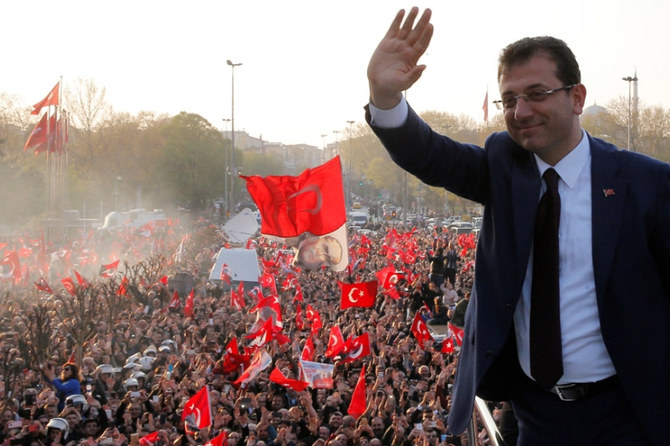
Ekrem Imamoglu greets his supporters after being elected Mayor of Istanbul. (Reuters)
Short Url
Updated 17 May 2021
Follow

Erdogan rivals surge in polls ahead of 2023 Turkey election

  • ‘Loss of trust, pandemic failures’ damaging govt support, expert says
  • Recent meetings between leaders of the opposition have hinted at efforts to develop a joint candidate figure

ANKARA: Turkish opposition figures are gaining ground among voters ahead of the country’s critical 2023 presidential elections and are likely to pose a major threat to President Recep Tayyip Erdogan and his ruling party, recent surveys show.

Istanbul mayor Ekrem Imamoglu and Ankara mayor Mansur Yavas, who head two opposition-controlled municipalities in Turkey’s largest cities, previously challenged Erdogan and his party in the March 2019 local elections.

And recent meetings between leaders of the opposition have hinted at efforts to develop a joint candidate figure who can appeal to wider segments of Turkish society.

The latest survey from Istanbul Economics, a leading research company, showed that Yavas and Imamoglu are now performing better than Erdogan in polls.

Results show that 52.5 percent of voters prefer Yavas against Erdogan’s 38.1 percent when asked who they would vote for if a presidential election was held today.

Similarly, 51.4 percent of voters would choose Imamoglu against Erdogan’s 39.9 percent  in a presidential election. They would also prefer Meral Aksener, chairwoman of the center right IYI Party, with 45.4 percent, against Erdogan’s 39.1 percent.

The survey, titled Turkey Report, was conducted across 12 cities using 1506 respondents. The polling company recently revealed that popular support for the ruling Justice and Development Party (AKP) and its nationalist partner MHP was down to 45 percent, with the opposition standing at 55 percent.

The COVID-19 pandemic has also undermined trust in the government, due to perceived failures in handling the outbreak in Turkey.

Erdogan recently asked for “forgiveness” from Turks who have faced financial struggles due to pandemic restrictions and the subsequent economic downturn.

Dr. Berk Esen, a political scientist from Sabanci University in Istanbul, said that there are several reasons for the decline in Erdogan’s popularity in recent months.

“The pandemic has worsened the economic downturn that had already severely hit the urban poor, many of whom are loyal to the ruling party,” he told Arab News.

“Many voters feel that the Erdogan administration has done a poor job of dealing with the pandemic, both medically and economically,” Esen said.

“Although Turkey has been spared the catastrophe seen in other right-wing populist cases like Brazil and India, case numbers are still too high and vaccination efforts have not gone smoothly. Turkey has only managed to vaccinate 13 percent of its population and has experienced difficulty acquiring more vaccines from multiple sources,” he added.

The number of COVID-19 vaccinations administered in Turkey reached 25 million on Monday, however, over-reliance on China’s Sinovac jab and shipment delays thought to be politically motivated have put the country in a dangerous position amid surging infection rates.

The pandemic has also threatened the livelihoods of disadvantaged people in the country, with family suicides and bankruptcies of small business owners becoming more prevalent. Many people, including AKP voters, are beginning to feel left behind, Esen said.

“Government precautions against the pandemic are seen by many to be insufficient, scientifically not all that helpful, ill-planned and selectively applied. Such restrictions hurt local businesses and created unemployment across the country,” he added.

During the first quarter of 2021, about 29,000 shopkeepers closed their businesses, an increase of 11 percent compared with the same period in 2020.

Large pro-government rallies and other “super-spreader” events like mass protests have also sparked public outcry in the country. Many Turks have accused the government of double standards regarding pandemic measures, including social distancing rules.

Esen said that despite rising poverty and unemployment figures, the government has offered only limited social assistance to the poor, distributing less than most other OECD member countries.

“There is a growing sentiment among voters that the AKP treats its own members favorably thanks to cronyism, vast corruption schemes and shady business deals,” he added.

“Against this backdrop, opposition mayors of major metropolitan areas like Istanbul and Ankara have seen their popularity rise due to the increased reliance on social assistance by the urban poor and the provision of public services to low-income neighborhoods,” Esen said.

Another survey by Turkey’s Gezici research company found that 51 percent of respondents would vote for Kemal Kilicdaroglu, the leader of the main opposition Republican Peoples’ Party, against 49 percent for Erdogan in Turkey’s presidential election runoff.


Gaza ceasefire enters phase two despite unresolved issues

Updated 16 January 2026
Follow

Gaza ceasefire enters phase two despite unresolved issues

  • Under the second phase, Gaza is to be administered by a 15-member Palestinian technocratic committee operating under the supervision of a so-called “Board of Peace,” to be chaired by Trump

JERUSALEM: A US-backed plan to end the war in Gaza has entered its second phase despite unresolved disputes between Israel and Hamas over alleged ceasefire violations and issues unaddressed in the first stage.
The most contentious questions remain Hamas’s refusal to publicly commit to full disarmament, a non-negotiable demand from Israel, and Israel’s lack of clarity over whether it will fully withdraw its forces from Gaza.
The creation of a Palestinian technocratic committee, announced on Wednesday, is intended to manage day-to-day governance in post-war Gaza, but it leaves unresolved broader political and security questions.
Below is a breakdown of developments from phase one to the newly launched second stage.

Gains and gaps in phase one

The first phase of the plan, part of a 20-point proposal unveiled by US President Donald Trump, began on October 10 and aimed primarily to stop the fighting in the Gaza Strip, allow in aid and secure the return of all remaining living and deceased hostages held by Hamas and allied Palestinian militant groups.
All hostages have since been returned, except for the remains of one Israeli, Ran Gvili.
Israel has accused Hamas of delaying the handover of Gvili’s body, while Hamas has said widespread destruction in Gaza made locating the remains difficult.
Gvili’s family had urged mediators to delay the transition to phase two.
“Moving on breaks my heart. Have we given up? Ran did not give up on anyone,” his sister, Shira Gvili, said after mediators announced the move.
Israeli Prime Minister Benjamin Netanyahu said efforts to recover Gvili’s remains would continue but has not publicly commented on the launch of phase two.
Hamas has accused Israel of repeated ceasefire violations, including air strikes, firing on civilians and advancing the so-called “Yellow Line,” an informal boundary separating areas under Israeli military control from those under Hamas authority.
Gaza’s Hamas-run health ministry said Israeli forces had killed 451 people since the ceasefire took effect.
Israel’s military said it had targeted suspected militants who crossed into restricted zones near the Yellow Line, adding that three Israeli soldiers were also killed by militants during the same period.
Aid agencies say Israel has not allowed the volume of humanitarian assistance envisaged under phase one, a claim Israel rejects.
Gaza, whose borders and access points remain under Israeli control, continues to face severe shortages of food, clean water, medicine and fuel.
Israel and the United Nations have repeatedly disputed figures on the number of aid trucks permitted to enter the Palestinian territory.

Disarmament, governance in phase two

Under the second phase, Gaza is to be administered by a 15-member Palestinian technocratic committee operating under the supervision of a so-called “Board of Peace,” to be chaired by Trump.
“The ball is now in the court of the mediators, the American guarantor and the international community to empower the committee,” Bassem Naim, a senior Hamas leader, said in a statement on Thursday.
Trump on Thursday announced the board of peace had been formed and its members would be announced “shortly.”
Mediators Egypt, Turkiye and Qatar said Ali Shaath, a former deputy minister in the Ramallah-based Palestinian Authority, had been appointed to lead the committee.
Later on Thursday, Egyptian state television reported that all members of the committee had “arrived in Egypt and begun their meetings in preparation for entering the territory.”
Al-Qahera News, which is close to Egypt’s state intelligence services, said the members’ arrival followed US Middle East envoy Steve Witkoff’s announcement on Wednesday “of the start of the second phase and what was agreed upon at the meeting of Palestinian factions in Cairo yesterday.”
Shaath, in a recent interview, said the committee would rely on “brains rather than weapons” and would not coordinate with armed groups.
On Wednesday, Witkoff said phase two aims for the “full demilitarization and reconstruction of Gaza,” including the disarmament of all unauthorized armed factions.
Witkoff said Washington expected Hamas to fulfil its remaining obligations, including the return of Gvili’s body, warning that failure to do so would bring “serious consequences.”
The plan also calls for the deployment of an International Stabilization Force to help secure Gaza and train vetted Palestinian police units.
For Palestinians, the central issue remains Israel’s full military withdrawal from Gaza — a step included in the framework but for which no detailed timetable has been announced.
With fundamental disagreements persisting over disarmament, withdrawal and governance, diplomats say the success of phase two will depend on sustained pressure from mediators and whether both sides are willing — or able — to move beyond long-standing red lines.