

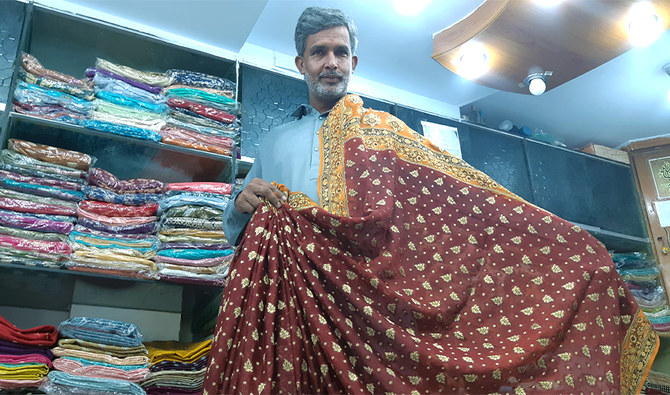

KHAIRPUR, SINDH: At Banarsi Silk Weavers Colony in Sindh’s Khairpur city, 47-year-old merchant Zafar Abbas Ansari was waiting, hoping for a few additional orders of silk Banarsi saris as Eid Al-Fitr approached.
The sari is a garment native to South Asia, where a long piece of cloth is wrapped elaborately around the body — usually in cotton or silk — and worn with a matching blouse.
Although the city does not make Banasri any longer due to the downfall of the industry that originally shifted here from India, customers still come to the city to purchase the fabric — now made in Karachi, more than 400 km away.
Inside the deserted 70-year-old market — once a bustling place — Zafar’s shop is among the last three Banasri shops left. His family is one of the 40 weaver families who migrated from India to Khairpur in 1952.
“It has been almost two decades that Khairpur stopped producing Banarsi sari after the industry’s collapse. However, even today, the brand is popular among customers. They keep demanding Khairpur’s brand,” Zafar told Arab News.
During the heydays, Khairpur’s Banarsi sari became synonymous with luxury, with vendors supplying the fabric not only locally but also exporting to Pakistani families living in the UK and other European countries.
Inside Zafar’s shop, unstitched pieces of colorful saris — the blouse, the petticoat and main sari fabric — are displayed. The shop shows off different verities of saris including the traditional katan-- a plain woven fabric with pure silk threads-- chiffon, as well as synthetic fabrics.
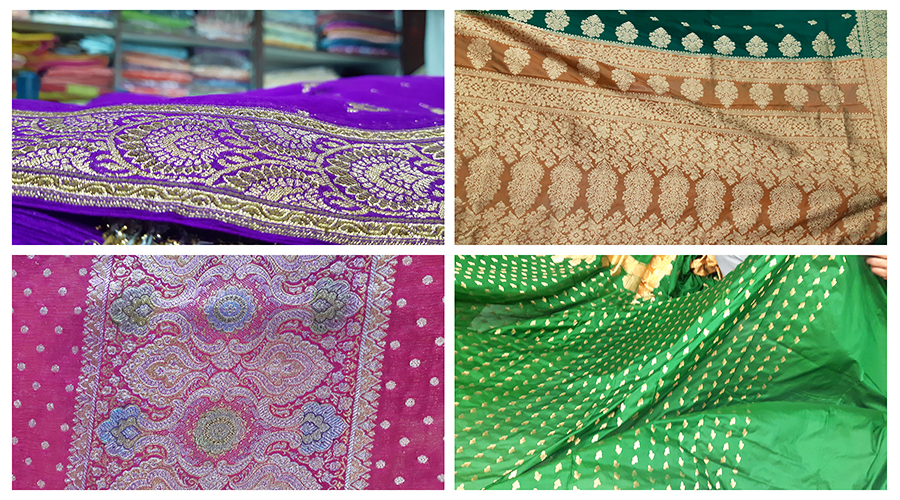
A combination of photos shows Banarsi sari collection at Merchant Zafar Abbas Ansari's shop in Banarsi Silk Weavers Colony in Khairpur, Sindh, May 1, 2021. (AN photo by Zulfiqar Kunbhar)
“Banarsi sari has a distinction and standing,” Zafar said proudly.
“It is known for royal families’ dressing because of its grace and elegance. In some families it is an essential part of the bridal trousseau,” he added.
According to vendors, the price of a sari depends upon its type. The most expensive sari fabric available in the Khairpur market currently, is worth Rs45,000 a piece ($300).
Khairpur’s colony, “Banarsi Silk Weavers Colony,” is named after India’s Banaras city (now Varanasi) because of the silk weavers who migrated from India.
There are no official records available, and the story of the garment comes from the weavers themselves. According to them, the history of the Banaras sari industry in Khairpur is linked with Ghulam Saddiquah Begum — the wife of Khairpur state’s then ruler, Mir Ali Murad Khan Talpur of the Talpur dynasty.
Saddiquah Begum herself belonged to Bahawalpur state, and in 1949, the weavers said, during a visit to India’s Hyderabad Deccan, she offered Muhammad Yusuf Ansari — a sari trader from Banaras — to start manufacturing the brand in Khairpur. Both sides agreed as she also offered her state’s support for the establishment of the manufacturing units required.
They said that around 1952, around 40 families of the Ansari clan had migrated from Banaras to Khairpur and sari manufacturing began through handlooms. Later, the saris were exported to other countries.
Arab News could not independently verify this information.
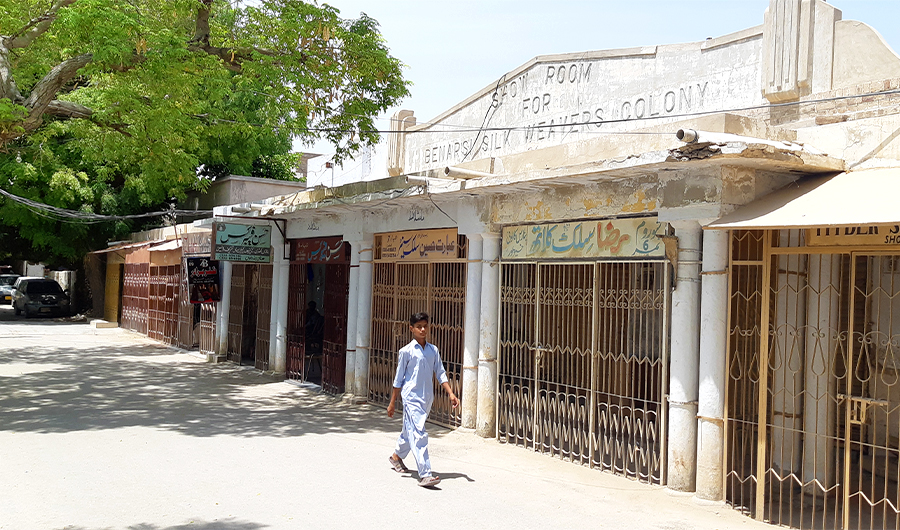
A boy walks past Banarsi Saree Market in Banarsi Silk Weavers Colony in Khairpur, Sindh, May 1, 2021. (AN photo by Zulfiqar Kunbhar)
According to Anjum Sajjad Ansari, grandson of Muhammad Yusuf Ansari and a representative of the Banarsi Silk Weavers Association Khairpur, at its peak, there were 400 handlooms in Khairpur. Today, not a single handloom remains.
“At Khairpur’s Banarsi Silk Weavers Colony, today there are 16 houses of traditional weavers. However only three are involved in this business of selling Karachi-made fabric,” Anjum told Arab News.
Like elsewhere, the Banarsi brand was associated with pure silk thread work. Initially, Khairpur used silk imported from China, but later the silk supply continued coming from Punjab’s Changa Manga as Pakistan developed hatching silkworms and silk fiber producing factories.
The whole family engaged in the manufacturing process, including silk weaving, dyeing, warping, and reeling at households where the role of women was vital. It took between two to three days of work to complete a single sari.
Weavers say that from Talpurs’ control to the 1960’s, the silk weaving industry was thriving. Then, the downfall began.
“In 1965, then President of Pakistan Ayub Khan visited the industry and gave incentives and subsidies that boosted the industry,” said Anjum.
“However in the years to come, successor governments paid little heed to this industry. Ultimately, manufacturing units were shifted to Karachi by 2000,” he added.
For Anjum, this was a vital move to reviving the past glory of Khairpur.
“We have given proposals to the government at different forums. But nothing has been done yet. The Banarsi sari has become a trademark for Khairpur,” he said.
“Khairpur’s distinction was to produce only handmade silk fabric unlike other areas where the machine is involved. If the government is sincere, factories could be re-established and skilled laborers could be recalled once more from Karachi,” he said.


