LAHORE: Shahida Khanum was 55 when she discovered her passion for construction while building her own house. Since then, she has been working in an industry that is totally dominated by men in Pakistan.
“My husband used to live in Saudi Arabia while I was here in Pakistan with my children,” she told Arab News while surveying one of her latest building projects in the eastern city of Lahore. “I constructed my own home first and felt quite good about it. Later, I started working professionally and have so far built about seven or eight houses.”
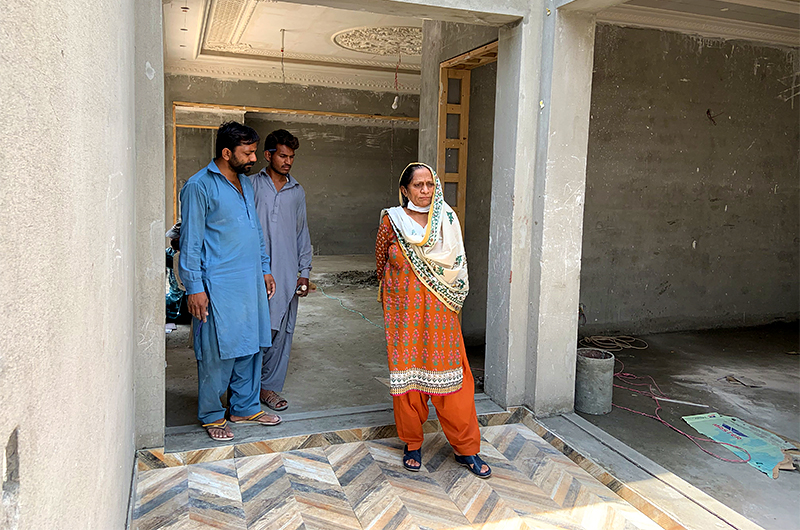
Shahida Khanum oversees laborers at a construction site in the Defense Housing Society of Lahore, Pakistan, on May 3, 2021. (AN photo)
Her newfound passion even took her to Bahawalpur, some 400 kilometers southeast of Lahore, and prompted her to encourage her husband to give up his job in the Middle East to assist her with the business affairs.
Khanum’s 74-year-old husband, Khalid Mahmood, described his wife is a successful businesswoman.
“When she joined the construction profession, I knew she was going to excel at it,” he said.
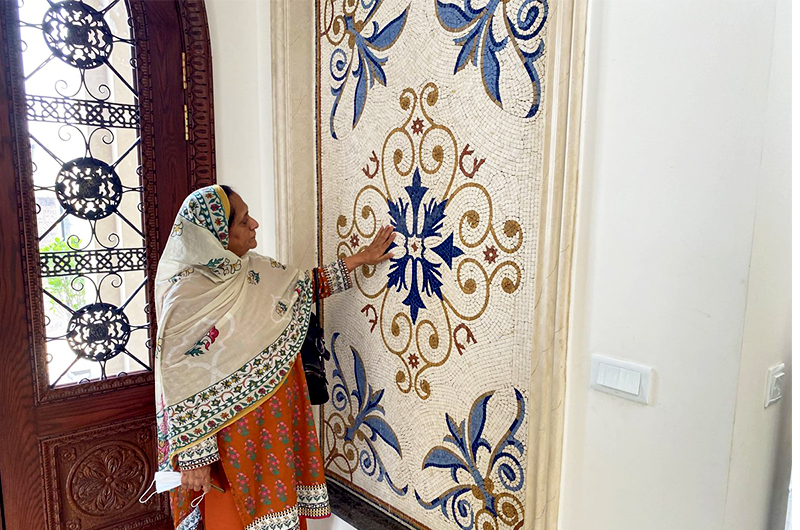
In this picture taken on May 3, 2021, Shahida Khanum glances at the mosaic work at a house she recently completed in Lahore. (AN photo)
However, Khanum maintained that her journey had not been an easy one in a country where cultural conservatism, traditional social structures and gender stereotypes always militated against her.
“It was daunting to manage my own house and children while working in the field and doing things that were was both time-consuming and labor-intensive,” she said. “One has to be extremely vigilant in this business and protect the building material from being stolen ... It can be too much work for a woman my age and can get really hectic.”
The 65-year-old construction contractor believes she is still in the learning phase. Despite ten years of experience, she can still be swindled by people and blames her trusting nature for that.
She recently made a significant payment to a vendor while carrying out a project before discovering that he was not willing to take her phone calls anymore. Khanum said it would have been easier to resolve the issue, if she were not a woman.
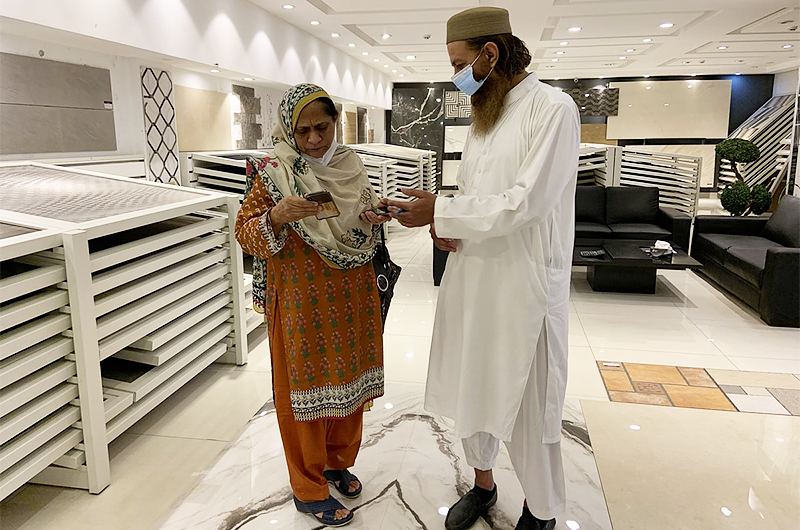
A sales manager shows samples of tiles to Shahida Khanum on his mobile phone in Lahore, Pakistan, on May 3, 2021. (AN photo)
She continued that many vendors tried to sell her substandard construction material, assuming she would not know the intricacies of her craft. Such instances, she added, sometimes led to delays in project completion, forcing her to be extra vigilant and at the top of her game all the time.
At present, Khanum is constructing a residence with a covered area of 5,400 square feet in Lahore’s upscale Defense Housing Authority neighborhood with four other projects in the pipeline.
“The construction work is obviously far more difficult for me than any man in this field,” she said. “However, by the grace of God, I work better than most men since I pay attention to detail. Most male contractors take a cursory glance at things while visiting a site and leave. I keep an eye on everything — from cutting of tiles to brick masonry.”
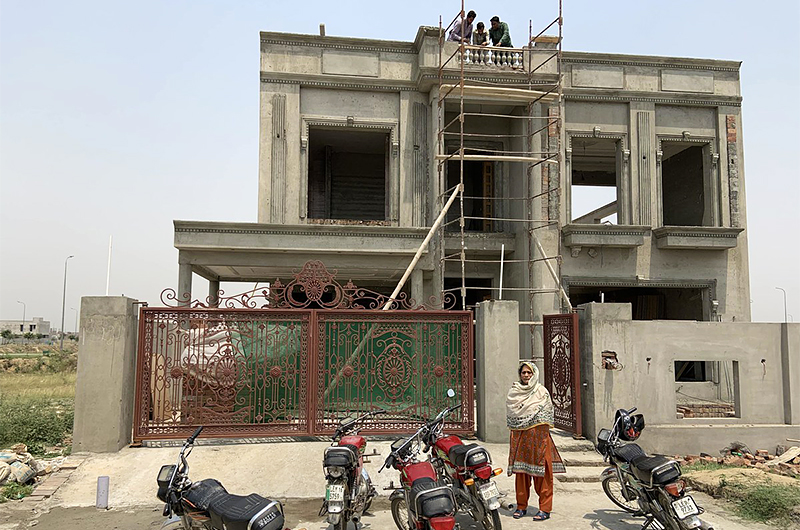
Shahida Khanum poses for a picture outside a house she is building in Lahore, Pakistan, on May 3, 2021. (AN photo)
Mohammad Mohyuddin, a carpenter who has been with Khanum since 2013, said she handled construction workers astutely.
“Male contractors are always trying to find way to cut costs,” he added. “Aunty [Shahida Khanum] focuses on the quality of work instead.”
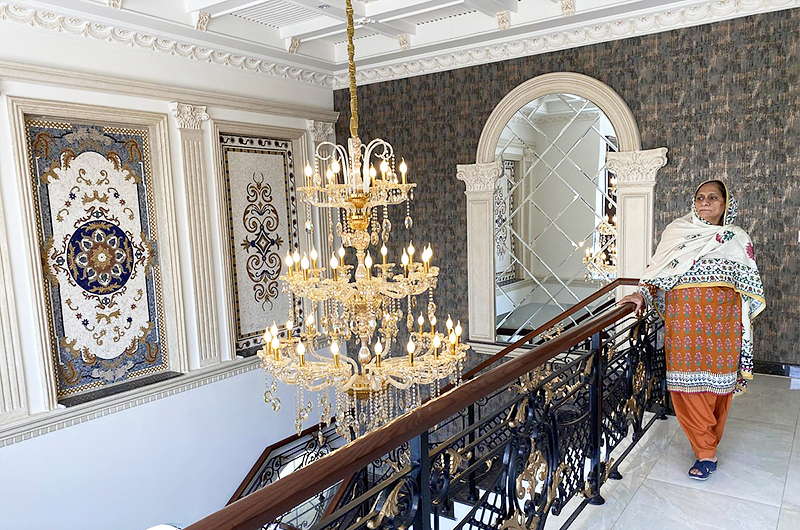
In this picture taken on May 3, 2021, Shahida Khanum glances at the mosaic work at a house she recently completed in Lahore. (AN photo)
Chaudhry Naeem Akhtar, vice chairman of the Constructors Association of Pakistan, said there were about 200,000 contractors in the country, but he had only come across two women in the whole construction industry.
He maintained that construction was a very dynamic field and women could play a pivotal role in it.
Khanum, who has worked on projects in other cities as well, said the biggest and most difficult job of her career was to build a 16,200 square feet house in Bahawalpur where she used to go from Lahore every week. She added that she now desired to step into other domains for the construction business as well.
“I have received new contracts to build a house and a warehouse in Bahawalpur, each measuring about 5,400 square feet,” she said with her eyes gleaming with joy.