

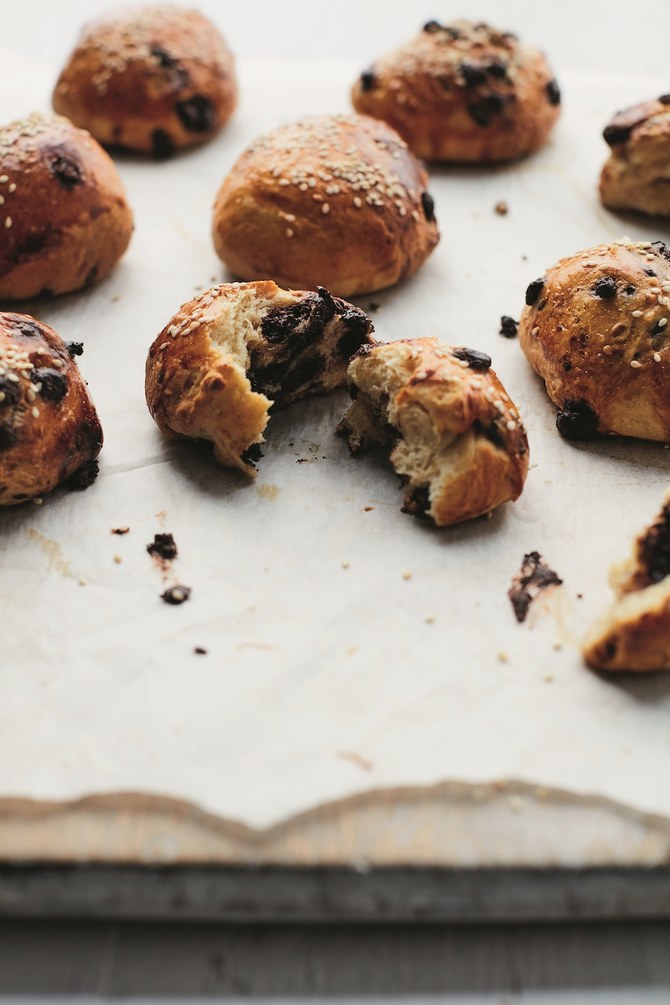
Eid treat: Moroccan chef Nargisse Benkabbou’s chocolate chip krachel

Chocolate chip krachel. Supplied
Short Url
Updated 12 May 2021
Follow

Eid treat: Moroccan chef Nargisse Benkabbou’s chocolate chip krachel

DUBAI: Moroccan chef Nargisse Benkabbou is on a mission to demystify her country’s cuisine for international foodies, especially those in the UK where she lives.

Here, she shares her recipe for chocolate chip krachel to sweeten up your Eid Al-Fitr celebrations.

Ingredients:

60g unsalted butter

2 ½ tbsp sesame seeds

2 tsp dried active yeast

50g caster sugar

1 tbsp warm water

300g plain flour, plus extra if needed and for dusting

1 tsp aniseed

½ tsp salt

1 egg

80–120ml warm full-fat milk

1 ½ tbsp orange blossom water

100g dark chocolate chips or chunks

Vegetable oil

1 egg yolk, beaten


Instructions:

1.      Melt the butter, then leave it to cool. Toast the sesame seeds in a dry pan over a medium-high heat for about 6 minutes.

2.      In a small bowl, mix the dried yeast with 1⁄4 teaspoon of the sugar and the measured warm water using a fork. Leave the yeast to activate for about 5 minutes.

3.      Mix 2 tablespoons of the toasted sesame seeds, the remaining sugar, the flour, aniseed and salt together in a large bowl. In a separate bowl, whisk the melted butter, yeast mixture, egg, 80ml warm milk and the orange blossom water together until smooth. Combine both bowls and mix to form a soft dough.

4.      Lightly dust a work surface with flour and knead the dough for about 10 minutes until smooth and elastic and add the chocolate chips. Form the dough into a ball and place in a lightly oiled bowl. Cover with cling film and leave to rise for about 45 minutes or until it almost doubles in size.

5.      Divide the dough into 8 equal-sized pieces and shape each into a ball. Place them on a baking sheet, leaving about 5cm between each ball. Cover with cling film and leave the buns to rise for about 30 minutes.

6.      Preheat the oven to 190°C. Brush the buns with the beaten egg yolk and sprinkle with the remaining toasted sesame seeds. Bake for about 17–20 minutes.


At Jazan festival, Suad Al-Asiri paints memory, land and leadership

Updated 13 January 2026
Follow

At Jazan festival, Suad Al-Asiri paints memory, land and leadership

  • Local artist channels personal hardship into works that reflect Jazan’s identity, heritage
  • Jazan: A Nation and a Prince, places region at the heart of a composition featuring Prince Mohammed bin Abdulaziz and Prince Nasser bin Mohammed bin Abdullah bin Jalawi

RIYADH: At the Ahad Al-Masarihah pavilion at Jazan Festival 2026, Suad Al-Asiri’s paintings blend memory, place and personal history, offering visual narratives shaped by beauty and hardship. 

A novelist and visual artist, Al-Asiri has long used art as a storytelling tool. After a near-fatal car accident in March 2024, her work took on a new urgency. Bedridden for 11 months, cut off from the public world for more than a year, she describes that period as one of the most painful in her life — yet also transformative. 

“First of all, praise be to God for granting me life, as the accident was extremely severe,” she said. “By God’s grace, I was given a new life. All my thinking after the accident was about becoming an inspiration to others — about enduring pain and obstacles, and still leaving an impact.” 

Her return to public life came in 2025, when she participated in National Day celebrations with the ministry of interior. By the time she arrived at Jazan Festival, she was ready to channel that experience into her art. 

The centerpiece of her display, “Jazan: A Nation and a Prince,” places the region at the heart of a composition featuring Prince Mohammed bin Abdulaziz and Prince Nasser bin Mohammed bin Abdullah bin Jalawi, governor and deputy governor of Jazan respectively. 

Visitors linger over the details: the painting incorporates coffee beans, sesame and khudair — materials drawn from local products.

“I wanted people to recognize these products immediately,” she said. “They are part of Jazan’s daily life, and using them makes the work more tangible, more connected to everyday experience.” 

The painting sparks conversation. Visitors discuss leadership, identity, and the intimate relationship between people and their environment. 

Beyond the central piece, Al-Asiri presents individual portraits of the two princes, expanding the dialogue into a broader exploration of heritage and memory.  

Her journey into art is tied to her life as a storyteller. Early experiments with charcoal and pencil evolved into abstract art, drawn by its expressive freedom. 

From there, she explored realism, surrealism, and eventually modern art, particularly pop art, which has earned her wide recognition in artistic circles. Her novels and media work complement her visual practice, earning her the title “the comprehensive artist” from the governor.

Yet what stands out most in this exhibition is how Al-Asiri’s personal resilience flows through each piece. Her experience of surviving a devastating accident, enduring months of immobility, and returning to the public eye informs every brushstroke. 

Visitors sense not just her artistic skill, but her determination to turn life’s hardships into inspiration for others. 

Walking through the pavilion, one can see it in the way she blends heritage symbols, southern landscapes, and scenes of daily life. 

Each painting becomes both a document and a dialogue — a celebration of Jazan’s culture, a reflection on identity, and a testament to the power of human perseverance. 

At Jazan Festival 2026, Suad Al-Asiri’s art is a quiet, persistent inspiration for anyone who pauses long enough to listen.