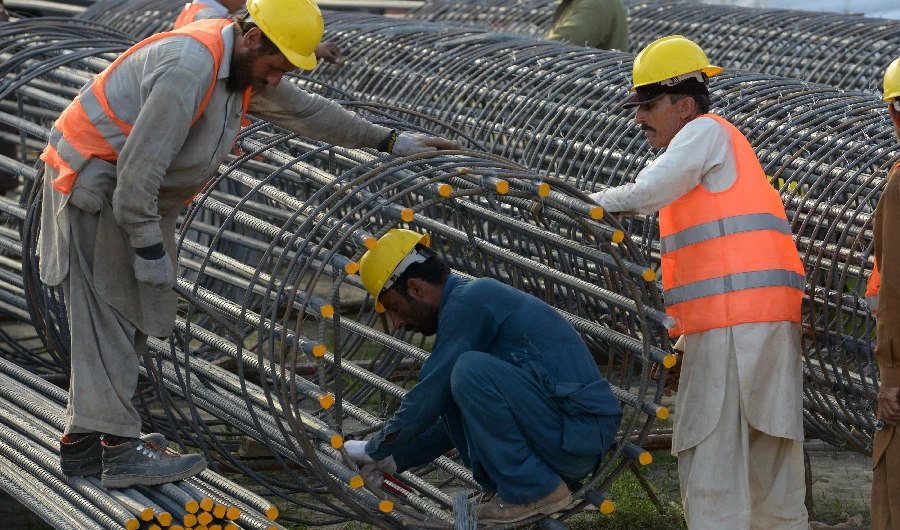
- PM Khan’s advisor on overseas Pakistanis says his ministry is working with relevant Saudi authorities to prepare a standardized labor contract for Pakistani nationals
- Pakistani workers in Saudi Arabia sent $5.7 billion to their country between July and March, making the kingdom the single largest source of remittances to the South Asian state
KARACHI: Pakistan is striving to benefit from Saudi Arabia’s Vision 2030 program which is expected to create millions of employment opportunities in the kingdom by helping its workforce build its professional capacity, a top Pakistani official told Arab News on Tuesday.
The program is a strategic transformation initiative to reduce the kingdom’s dependence on oil by diversifying its economy and turning it into a global industrial hub.
The plan requires the Saudi authorities to invest $320 billion to develop its non-oil sector by undertaking a string of mega projects, such as developing technologically smart cities that help their inhabitants with further innovation in their respective fields.
“I have already directed my ministry to identify the economic sectors at the heart of the Saudi initiative along with the skillsets required to capture the greatest number of emerging employment opportunities,” Special Assistant to Prime Minister on Overseas Pakistanis Sayed Zulfikar Abbas Bukhari said while talking to Arab News.
“The ministry has also been directed to coordinate along with Pakistan’s National Vocational and Technical Training Commission with relevant Saudi organizations for accreditation and mutual skill recognition to effectively utilize the future demand,” he added.
Bukhari said his ministry was working with relevant Saudi authorities to develop a standardized labor contract for Pakistani nationals.
Home to over two million Pakistani migrants, Saudi Arabia is already the single largest source of remittances to the South Asian state.
During July-March 2021 period, the Pakistani diaspora in the kingdom sent $5.7 billion to their homeland. Such inflows of remittances continue to support Pakistan’s balance of payment position and keep its foreign reserves stable.
In an interview with Pakistan’s state-owned news channel on Sunday, Saudi Foreign Minister Prince Faisal bin Farhan Al-Saud applauded the role of Pakistani expatriates in the development and progress of his country.
“We have a very ambitious plan, Vision 2030,” he said. “Under that plan, we expect to grow significantly the employment base in the kingdom. That means of course that there will be significant opportunities for additional employment for Pakistani nationals.”
The Saudi foreign minister also invited Pakistani business community to benefit from the emerging investment opportunities in the kingdom.
“We also hope that Pakistani businesses will continue to increase their investment in the kingdom because there are some very successful entrepreneurs who I think will find excellent and exciting opportunities,” he added.
The Saudi prince also mentioned new labor reforms, hoping that they would help foreign workers find flexible job opportunities.
“We have recently undergone significant labor reforms which have improved to a great extent the flexibility of third country labor within the Saudi labor market. They are now free to transfer their work from one employer to other,” he said.
Pakistani experts say their country needs to train its human resource to suit the market requirements of other countries.
“Apart from the construction sector, foreign countries are now demanding knowledge-based labor,” Haroon Sharif, member of the prime minister’s task force on economic diplomacy, told Arab News.
“It is imperative for us to provide new and specialized training to our workforce in view of the changing demand in international markets and our universities can play a pivotal role in that,” he continued. “We can also achieve the desired objective by involving the countries for which we are training our labor force.”