

Foreign diplomats start to leave India as COVID-19 surge hits embassies

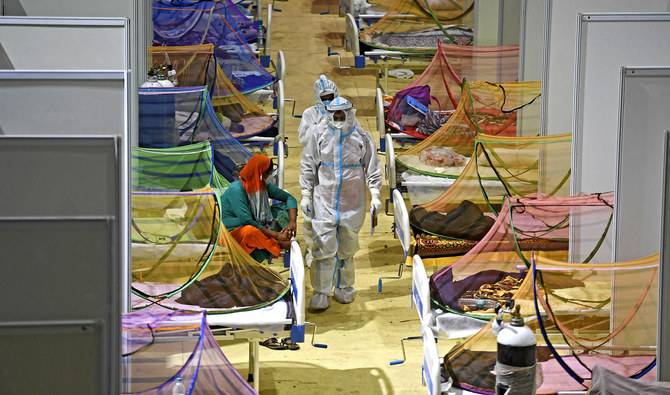
Health workers wearing personal protective equipment (PPE) suits attend Covid-19 coronavirus patients inside a centre of the Commonwealth Games (CWG) village temporarily converted into a Covid care facility, in New Delhi on May 2, 2021. (AFP)
Short Url
Updated 08 May 2021
Follow

Foreign diplomats start to leave India as COVID-19 surge hits embassies

  • US, Germany and Poland approve the voluntary departure of their government employees from India
  • According to a CNN report on Saturday, at the US embassy more than 200 staff have contracted the virus

NEW DELHI: A number of embassies in New Delhi have issued advisories for their staff, giving them the option of leaving India as the coronavirus pandemic is sweeping through the country with no signs of abating.

Since late April India has been reporting the world’s highest daily tally of coronavirus cases. It surpassed 401,000 new cases and 4,000 virus-related deaths on Saturday. Coronavirus positivity rate in seven Indian states, including the capital, New Delhi, has crossed 30 percent according to health ministry data.

As India's medical infrastructure is overwhelmed by a shortage of beds and oxygen supplies to treat coronavirus ill and the disease outbreaks have been reported at several foreign missions. At some of them staff members have been allowed to leave the country.

The US, Germany and Poland earlier this week said they had approved the voluntary departure of their government employees from India because of the COVID-19 surge.

According to a CNN report on Saturday, at the US embassy more than 200 staff have contracted the virus and had the US State Department has to conduct a medical evacuation from the country.

The embassy's spokesman told Arab News the mission is "closely monitoring the situation and we will take all necessary measures to safeguard the health and wellbeing of our employees, including offering vaccines to employees."

Citing privacy concerns, he declined comment on the scale of the embassy outbreak or evacuation process.  

Germany, meanwhile, confirmed several members of its embassy staff had returned home.

"German Embassy has opened the possibility for staff and families to return to Germany," the embassy's spokesman, Hans Christian Winkler, told Arab News. He added, however, that there was no "repatriation process" as only "a small number" of embassy workers have left so far.

Also the Polish Foreign Ministry told Arab News in a written statement that it had "presented the employees of the Embassy of the Republic of Poland in New Delhi with an option of returning to Poland."

The statement came after last week's Polish media reports that a senior diplomat from the country's New Delhi embassy had been airlifted back to Warsaw for hospitalization after contracting COVID-19.

The Swiss embassy admitted that two of its "transferable staff" are in Switzerland but the ambassador, Dr. Ralf Heckner, said that they had been home "from the beginning of this long COVID crisis," while no other staff members had left any of the country's missions in India.  

The French embassy declined comment on whether its staff had received any advisory regarding permission to leave India.


C. Africa’s displaced youth bet on vote for brighter future

Updated 2 sec ago
Follow

C. Africa’s displaced youth bet on vote for brighter future

BIRAO: Amani Abdramane bustled around her donkey in the makeshift camp where she lives in the Central African Republic.
In this northern part of the country, on the edge of the Sahel, the sun is scorching and sand is swallowing the last traces of vegetation.
The 18-year-old adjusted a pink scarf covering her head and shoulders and pondered what she wanted from Sunday’s general election that will choose local and regional officials, members of parliament and a new president.
“I hope the person I vote for brings peace,” she said of the seven candidates vying to become head of state.
They include President Faustin-Archange Touadera, who is seeking a third consecutive term.
Displaced by decades of conflict, young people like Abdramane who live in camps around the town of Birao in the far northeast, see the elections as a chance for a better future.
Abdramane fled ethnic violence in El-Sisi, her home village seven kilometers (four miles) from Birao, in 2015 with her mother and eight siblings.
Her father had been killed a few months earlier.
“I just want my brothers, sisters and me to be able to go to school,” she said.

- First-time voters -

Abdramane had just completed her second year of school, aged eight, when her family had to flee.
She has not returned to lessons since.
Now the teenager and other young people are counting on the elections to bring them peace, education and opportunities beyond life as displaced persons.
The last polls were in 2020 but lack of security meant even those old enough to vote at the time were unable to do so.
There is a crowd outside the community radio station in the Korsi neighborhood of Birao, which serves as a distribution center for voter registration cards.
Marina Hajjram, also 18, will be voting for the first time.
“I’m so happy,” she told AFP, clutching her voter card.
Behind her in the queue, 25-year-old Issa Abdoul agreed the elections were essential “to continue the reconstruction of our country.”
Korsi is home to thousands of internally displaced persons, as well as many refugees from neighboring Sudan.
Across CAR, there were 416,000 internally displaced persons as of November, the vast majority of whom are under 25 and will be voting for the first time this weekend.

- A brighter future -

For them, the mere act of obtaining a voter registration card is a challenge.
First they must produce an identity document. But many lost everything when they fled, including ID papers for those who had them.
Three quarters of people in the CAR are under 35, according to a 2018 report by the United Nations Population Fund.
And peace is one of the things these young people most want.
Although the situation has improved in much of the country, particularly in cities, violence persists in the northeast on the border between the two Sudans.
This is mainly due to incursions by Sudanese armed forces, who are waging war in a region already plagued by abuses blamed on rebel groups.
Issene Abdoulkasim, 23, only made it to the third year of primary school.
Now he wants to become a tailor so he can afford to study again.
“I dream of studying so I can become a member of parliament. Because as an MP I’ll be able to bring peace and development,” he said.
“I want to put an end to conflicts, tensions and everything that is destroying our country.”