KHAIRPUR: Five years ago, 70-year-old Ghulam Qasim Jiskani, a farmer in Khairpur, Pakistan’s largest date-producing region, experimented with Middle Eastern varieties of the fruit to see if he could increase his yield.
Today, he is spearheading a successful campaign to produce Arabian dates at home.
Pakistan is one of the top date producers and exporters in the world, with annual date production of over 535,000 tons, according to data from the Trade Development Authority. The main region for date cultivation is Khairpur district in southern Sindh province, Jiskani’s hometown.
On his farmland in Kot Diji village, Jiskani has planted date palm varieties that are grown in Saudi Arabia, the United Arab Emirates and Morocco.
“It can be a game changer for the area’s date production and export,” Jiskani told Arab News last week, saying by planting foreign varieties of the fruit, Pakistani farmers could earn up to 15 times more from their harvest.
“I brought 400 tissues of 15 date palm varieties from Dubai five years ago,” he said. “These trees are now laden with fruit and I plan to market the yield in July when they are ready for harvest. My experiment has been successful.”
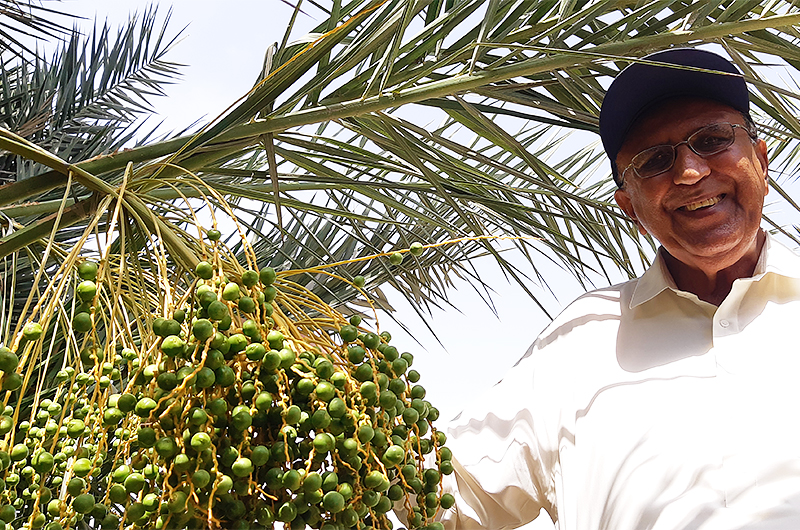
Ghulam Qasim Jiskani, a date grower, poses with newly grown dates at his farm in Kot Dijji in Pakistan’s Khairpur district on May 01, 2021. (AN photo by Zulfiqar Kunbhar)
Jiskani’s plantation covers two acres of land, but as his Arabian varieties of dates have grown so well on the land, he now plans to dedicate three more acres to the fruit and hopes other growers would follow suit. Jiskani believes that with the Arabian varieties, local growers would be able not only to tap into domestic demand but also boost Pakistan’s date exports.
“Pakistani date farmers also have a good chance to penetrate the international market with their yield,” he said. “With that in mind, we are striving to replace local varieties with foreign ones.”
Local farmers have already developed interest in growing the foreign varieties.
“After Jiskani’s experiment, a significant number of Khairpur’s date farmers want the government to facilitate the procurement of foreign palm tissues at feasible rates,” Mushtaq Soomro, a senior official at the Sindh Agriculture Extension Department, told Arab News. “If they start cultivating today, 40 percent of the region’s date cultivation will transform, and we will see the exotic varieties of the fruit covering much of this land.”
One of the reasons for the growing interest was climate.
“Monsoon in Pakistan arrives in June and persists for a few months,” Soomro said. “This is also the harvesting season for locally produced dates. Rainfall on the ready-to-rip crops is destructive, however. To get away from possible losses, growers opt for dried dates, though they are comparatively less lucrative for them. By growing the Middle Eastern varieties, though, date famers are hoping for a more exotic early monsoon crop.”
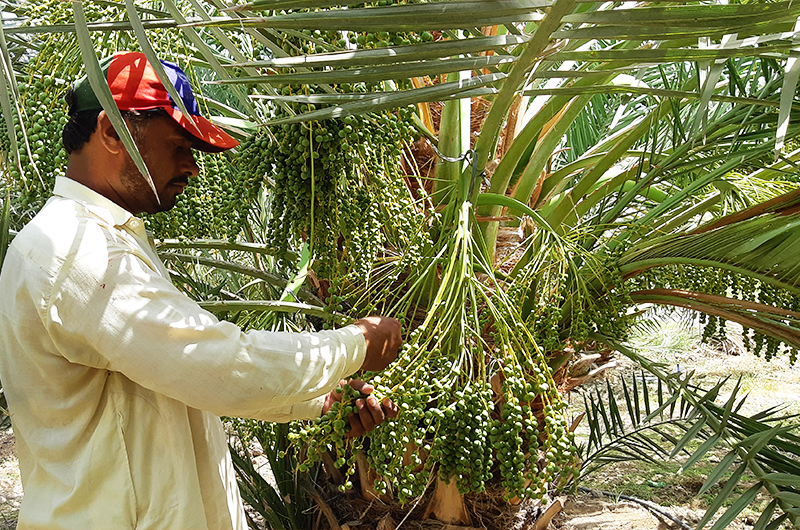
A gardener works at a date farm at Kot Dijji in Pakistan’s Khairpur district on May 01, 2021. (AN photo by Zulfiqar Kunbhar)
One problem with dried dates from Kahirpur is that their main export destination is India.
“For the last four years or so, however, direct trade of dried dates between India and Pakistan is on a halt which has resulted in significant losses for local farmers,” Jiskani said, adding that another advantage of the Arabian dates was their longer shelf life and the fact that with higher fiber component they were also healthier.
Rustam Phulpoto, a representative of Khairpur’s KHajjoor Market, said by sticking to its native date types, Pakistan was not focusing on the value addition that the foreign varieties bring.
“This lack of value addition not only makes us import more but also limits our exports as well,” he told Arab News.
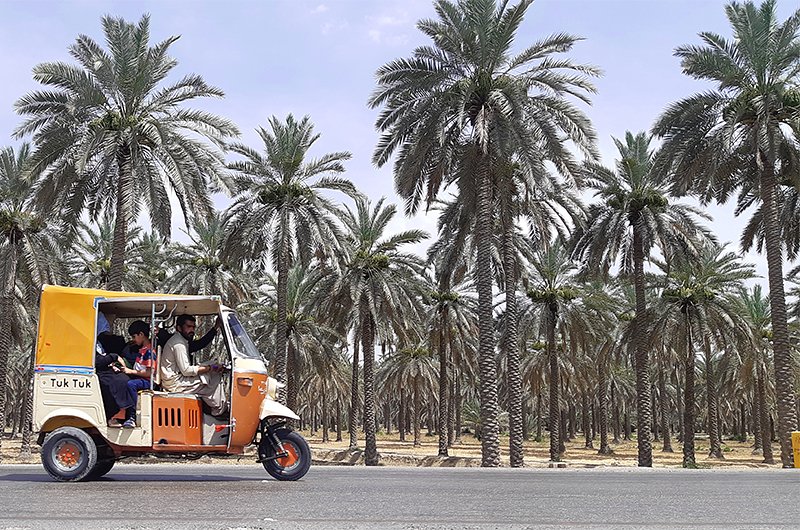
A view of date palm trees in Khairpur’s Thehri area in Pakistan's Sindh province on May 01, 2021. (AN photo by Zulfiqar Kunbhar)
Under the Sindh administration’s Agriculture Growth Project 2015-2020, the government was required to import 3,000 exotic date tissues and provide them to local farmers at 70 percent subsidized rates. But that did not happen.
Jiskani, who was the focal person for the project from the growers’ side, thinks the failure was due to internal departmental rifts.
“The government should establish a laboratory for plant tissue culture or facilitate the initiative through public-private partnership,” he said. “The growers are interested in this, but they lack the required investment.”