KHAPLU, GHANCHE: In a mountainous region of northern Pakistan that has a high potential to generate energy from hydropower, daily power cuts of up to 20 hours or more in some districts have pushed locals to come out in the streets in protest and observe the holy fasting month of Ramadan in darkness.
Gilgit-Baltistan, the impoverished, mountainous part of the larger Kashmir region, is the gateway of the China-Pakistan Economic Corridor (CPEC) but its residents have so far reaped few rewards of the $65 billion infrastructure project.
Last month, the region’s chief minister, Khalid Khurshid, ordered the provincial secretary power to ensure there were no power cuts at least during the suhoor and iftar meals in Ramadan. When Gilgit-Baltistan went to local assembly polls in November last year, Prime Minister Imran Khan promised to set up hydroelectric power plants. Last week, he announced a Rs370 billion ($2.4 billion) development package for the region, part of which is intended to address the electricity crisis. In a meeting this week between the finance minister of Pakistan and the chief minister of Gilgit-Baltistan, the federal government promised to “undertake several projects for hydel power generation.”
The construction of “the biggest dam in Pakistan’s history,” the Diamer-Bhasha Dam, was inaugurated by PM Khan in July last year. A number of other hydropower projects are also being built in the area, including the Kohala and Neelum Jhelum projects, with the former still under construction and the latter completed in 2019.
But despite the flurry of activity and promises, for now, local businesses and Ramadan and upcoming Eid Al-Fitr celebrations have been largely upended by power outages.
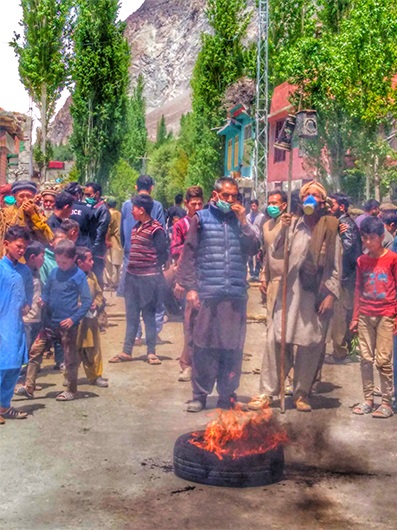
Residents of Chorbat Valley protest against prolonged power outages in Ghanche district of Gilgit-Baltistan, Pakistan, on May 5, 2021 (Photo Courtesy: Social media)
“There is no electricity in our village,” Ghulam Nabi Sanai from Ghanche district told Arab News on Wednesday. “We registered complaints about the absence of electricity, but no power department officials heard us. That’s why we had to stage a sit-in.”
For the past few days, Sanai said, residents of his hometown had been preparing, and eating, their iftar and suhoor meals in darkness.
Large-scale construction of new power plants — largely coal-fired ones funded by China — has dramatically boosted the country’s energy capacity in the last couple of years. But even as supply surges, electric power is still not reaching up to 50 million people in Pakistan who need it, according to a 2018 World Bank report, though expansion of transmission lines is planned.
Power outages also remain common.
Sher Ali Rana, a tailor in Ghanche, said he normally sewed some 400 outfits for Eid Al-Fitr, the festival to mark the end of Ramadan, when it is a common practice for Muslims to buy new clothes. This year, however, he would hardly be able to make 150 dresses due to electricity shortages.
“Our tailor community has to face power outages every year, but this year we are facing the worst kinds of load shedding ... there is no electricity for 24 hours,” Rana said.
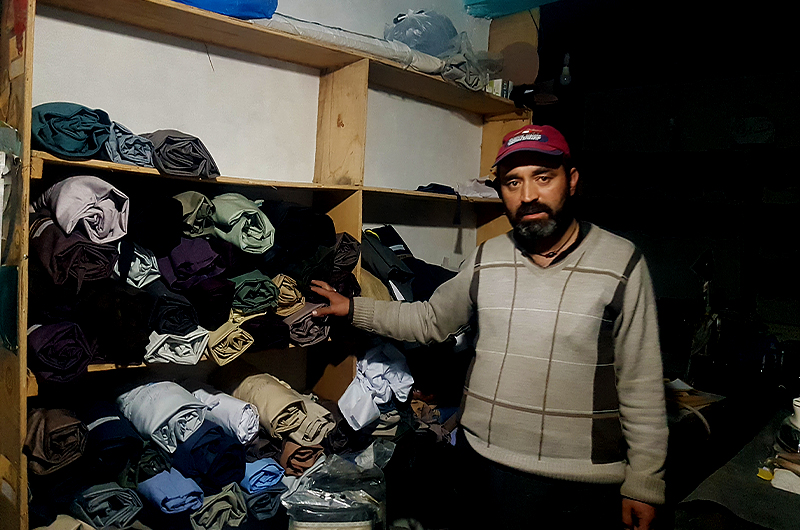
A tailor poses for a photograph during night time at his shop without electricity in Ghanche district of Gilgit-Baltistan, Pakistan on May 4 , 2021. (AN photo: Nisar Ali)
Locals in many other districts, including Skardu and Gilgit, also complain worsening power cuts have paralyzed their daily lives.
Riaz Ai, an executive engineer at Gilgit-Baltistan’s power department, said a major problem of power supply in the region was that its electricity system was not fully connected to the national grid. Low production capacity of existing power stations was another problem, he said.
Generation capacity in winter was 92 megawatts while the demand was 452MW, Ali said. In summer, generation capacity was 122MW against a demand of 132MW.
But the engineer said he was hopeful new projects promised under CPEC would solve the region’s power crisis for good.
“If big projects are launched,” he said, “Gilgit Baltistan has the potential to generate more than thousands of megawatts of electricity.”