

Pakistan offers to share counterterrorism expertise with Philippines

Philippine President Rodrigo Duterte salutes to the personnel of the Pakistan Navy upon boarding the Pakistan Navy Ship Saif docked in Manila on December 14, 2017. (Photo courtesy: Philippine President Office)
Short Url
Updated 02 May 2021
Follow

Pakistan offers to share counterterrorism expertise with Philippines

  • Draft of Memorandum of Understanding on Defense Cooperation between Islamabad and Manila is in its final phase
  • The Philippines’ main security threats come from the Abu Sayyaf militant group, Daesh affiliates and communist rebels

MANILA: Pakistan is willing to share its counterterrorism expertise with Philippine security forces, Islamabad’s envoy to Manila told Arab News in an interview on Saturday.

The Philippines’ main security threats come from the Abu Sayyaf militant group, Daesh affiliates and communist rebels.

The Communist People’s Party (CPP) and its armed wing, the New People’s Army (NPA) are considered by the Philippine government as one of the most significant internal security threats and were also designated foreign terrorist organizations by the US in 2002.
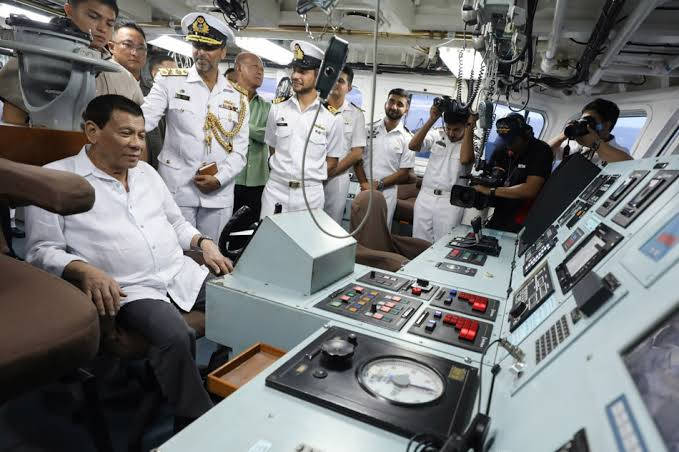


Philippine President Rodrigo Duterte takes a tour inside the Pakistan Navy Ship Saif docked in Manila on December 14, 2017. (Photo courtesy: Philippine President Office)

Abu Sayyaf Group (ASG) was founded in the 1990s. Some factions of ASG have pledged allegiance to Daesh in 2014. ASG mostly engage in piracy and kidnappings for ransom. Experts say the group is fragmented and lacks a central command, operating largely in cells run by different commanders across the Sulu Archipelago in the southwestern Philippines.

“Having vast and valuable experience in the war against terror, Pakistan is willing to share its best practices in fighting terrorism and violent extremism to friendly countries, among them the Philippines,” Pakistani Ambassador Imtiaz Kazi said.

He cited his country’s success in Operation Zarb-e-Azb — a joint military offensive conducted by Pakistan’s armed forces against various militant groups, including the Pakistani Taliban, in the northern areas along the Pakistan-Afghanistan launched in 2014 — and the follow-up Operation Radd-ul-Fasaad launched in 2017.

“Pakistan can rightly claim it has won the war on terror, albeit at a costly price. And it is ready to share the Pakistani forces’ capabilities and its experience of operation, namely Zarb-e-Azb and Radd-ul-Fasaad, (to help) countries in their fight against terrorism,” Kazi said.

He mentioned the successful operations in reference to the 2017 Marawi siege in the southern Philippine island of Mindanao, where more than 1,100 people were killed when pro-Daesh militants attacked and held Marawi for five months, leading to massive destruction across the scenic lakeside city.

While Islamabad and Manila have signed Memorandum of Understanding (MOU) on Combatting Terrorism and Other Crimes in 2005, the ambassador said he is now pushing for Memorandum of Understanding on Defense Cooperation between the two countries.

“Once the MoU on Defense Cooperation which is presently under consideration is finally concluded and implemented, I am confident our existing level of cooperation will be strengthened,” Kazi said.

According to Department of National Defense (DND) Assistant Secretary Teodoro Cirilo Torralba III, the Philippines has accepted the final draft of the defense agreement and is now awaiting confirmation from the Pakistani side.

He told Arab News that the Southeast Asian nation could “learn a lot from the experience and best practices of Pakistan on counterterrorism.”


UN says 270,000 Afghans have returned from Iran, Pakistan this year

Updated 10 March 2026
Follow

UN says 270,000 Afghans have returned from Iran, Pakistan this year

  • UNHCR says 110,000 Afghans returned from Iran while 160,000 returned from Pakistan since start of 2026
  • Return numbers seem to have risen since Gulf war erupted on Feb. 28, says UNHCR official in Afghanistan

GENEVA: Some 270,000 Afghans have returned to their country from Pakistan and Iran so far this year, the UN said Tuesday, warning that the escalating Middle East war risked pushing the numbers higher.

UNHCR, the United Nations’ refugee agency, said that 110,000 Afghans had returned from Iran and another 160,000 had returned from Pakistan since the start of 2026.

And the numbers seem to have risen since the Middle East erupted on February 28, with the United States and Israel unleashing a barrage of strikes on Iran, and Tehran responding with drone and missile strikes on Israeli and US interests across the region.

Since then, there have been some 1,700 returns from Iran to Afghanistan each day, Arafat Jamal, UNHCR’s representative in Afghanistan, told reporters in Geneva.

Speaking from Islam Qala, on the Afghan-Iranian border, he said the situation there was “deceptively calm.”

“Returns are orderly but freighted with tension and apprehension,” he said, adding that with the hostilities elsewhere escalating, “I do fear there is more to come.”

“We are preparing for massive returns.”

He pointed out that Afghanistan was “facing the ramifications of what is happening with Iran,” while clashes have erupted along the Afghan border with Pakistan.

The new Middle East war, he warned, was “layering itself on top of an existing war on another frontier,” Jamal said.

UNHCR highlighted that the latest crises came after returns to Afghanistan had already been “exceptionally high” in recent years.

More than five million Afghans had returned from neighboring countries in the past two years, including 1.9 million returning from Iran last year alone.

Jamal warned that “many Afghan families are now facing cycles of displacement: first forced to flee Afghanistan, later displaced again inside Iran due to conflict, and now returning once more to Afghanistan.”

“And upon return in Afghanistan, the triply-displaced enter a spiral of precarity and uncertainty.”
Returns from Pakistan had meanwhile stabilized in recent weeks, as the main crossing point at Torkham remained closed due to the tensions there, Jamal said.

But he warned that “movements could increase sharply once the border reopens.”

UNHCR and the UN children’s agency UNICEF said Tuesday they were working to strengthen their capacity to operate at the borders and within Afghanistan.

But “given the scale of returns and the financial constraints facing humanitarian operations, additional support will be needed if arrivals increase,” UNHCR said, without specifying the amount needed.