

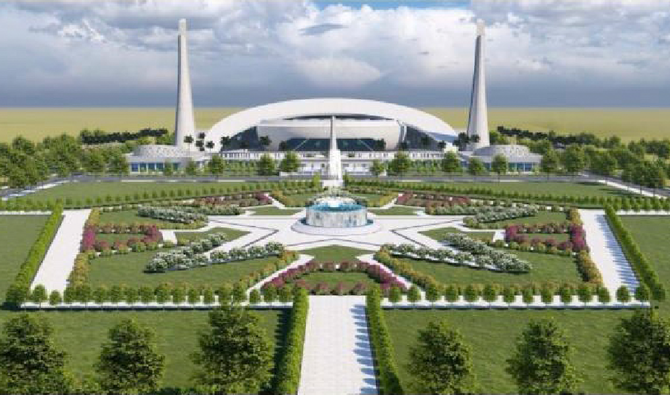
Saudi Arabia to build King Salman bin Abdulaziz mosque at Islamabad’s Islamic university

This undated photo shows the proposed design of the King Salman bin Abdulaziz Mosque that Saudi Arabia will build at the International Islamic University in Islamabad. (Photo courtesy: International Islamic University, Islamabad)
Short Url
Updated 04 May 2021
Follow

Saudi Arabia to build King Salman bin Abdulaziz mosque at Islamabad’s Islamic university

  • The mosque will be able to accommodate 12,000 worshipers and have a research and cultural center
  • The rector of the International Islamic University says the center will focus on Arabic language, Islamic culture and heritage

ISLAMABAD: Saudi Arabia will build the King Salman bin Abdulaziz Mosque along with a research and cultural center at the new campus of the International Islamic University (IIU) in Islamabad, the institute’s rector told Arab News on Saturday.
“The Custodian of the Two Holy Mosques has decided to build the King Salman bin Abdulaziz Mosque with a capacity of 12,000 worshippers at the new campus of the International Islamic University,” Dr. Masoom Yasinzai said.
“This is not just going to be a mosque but will have a huge complex with a research and cultural center for scholars and students,” he continued, adding that there would also be a library and museum along with an auditorium named after Crown Prince Mohamed bin Salman.
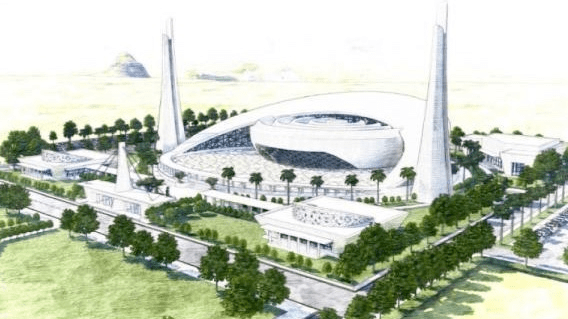


This undated photo shows the proposed design of the King Salman bin Abdulaziz Mosque that Saudi Arabia will build at the International Islamic University in Islamabad. (Photo courtesy: International Islamic University, Islamabad) 

Yasinzai said the project was another evidence of the strong Saudi-Pakistan relationship.
“The research center will focus on Arabic language, Islamic culture and heritage. The center will be equipped with digital technology to provide online Arabic courses from Islamabad to the whole world,” the IIU rector said.
He also informed that researchers from other Muslim countries would also make intellectual contributions to the center.
“Initially, the construction of the mosque was going to cost Rs500 million,” Yasinzai said. “But now the research and cultural center has also been included in the project which will raise its cost.”
He added that the proposed model of the mosque was an exceptional representation of Islamic art and architecture.
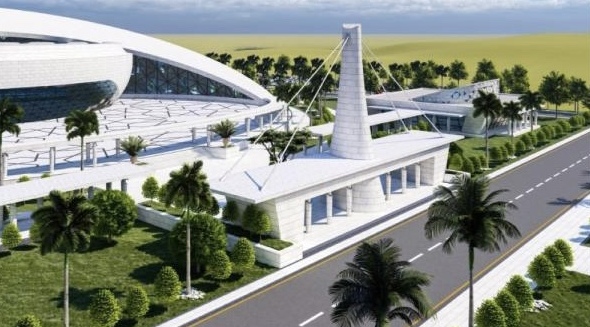


This undated photo shows the proposed design of the King Salman bin Abdulaziz Mosque that Saudi Arabia will build at the International Islamic University in Islamabad. (Photo courtesy: International Islamic University, Islamabad) 

In addition to that, the IIU official said Saudi Arabia would send 15 professors from some of the top universities in the kingdom to teach Arabic, Shariah and other Islamic subjects.
“They will come to Islamabad on deputation and will be financed by the Saudi government,” he continued. “The Saudi authorities have also announced 250 fully funded scholarships for needy students in Pakistan.”
Prime Minister Imran Khan’s adviser on religious harmony Hafiz Tahir Ashrafi said that people of Pakistan were thankful to the Saudi government for deciding to build the mosque.
“This grand mosque will have the capacity to accommodate 10,000 men and 2,000 women,” he told Arab News. “It will be yet another monument of the Saudi-Pak friendship and lead to better progress in the bilateral relations of the two countries.”


Pakistan Navy tests surface-to-air missile in Arabian Sea, reaffirms defense resolve

Updated 5 sec ago
Follow

Pakistan Navy tests surface-to-air missile in Arabian Sea, reaffirms defense resolve

  • The test follows a brief conflict with India that involved missile, artillery and drone exchanges but no naval clashes
  • Pakistan has stepped up battle readiness more recently, with senior commanders overseeing major training exercises

ISLAMABAD: The Pakistan Navy reaffirmed its resolve to defend the country’s territorial waters on Monday after conducting a live firing test of a surface-to-air missile in the northern Arabian Sea, according to a military statement.

The missile test involved the FM-90(N) ER, a medium-range naval air-defense system designed to intercept aerial threats, and comes months after a brief but intense military conflict between Pakistan and India in which the nuclear-armed neighbors exchanged missile and artillery fire and deployed drones and fighter jets.

While the four-day confrontation did not escalate into a naval clash, the Pakistan Navy remained on high alert until a US-brokered ceasefire brought the fighting to an end.

“Pakistan Navy successfully conducted a Live Weapon Firing (LWF) of the FM-90(N) ER Surface-to-Air Missile in the North Arabian Sea,” the military’s media wing, Inter-Services Public Relations (ISPR), said in a statement.

“During the firepower demonstration, a Pakistan Navy ship effectively engaged highly manoeuvrable aerial targets, reaffirming the Navy’s war-fighting capability and combat readiness,” it added. “Commander Pakistan Fleet witnessed the live firing at sea onboard a Pakistan Navy Fleet unit.”

ISPR said the fleet commander commended officers and sailors involved in the exercise for their professionalism and operational competence, and reiterated the navy’s resolve to safeguard Pakistan’s maritime interests under all circumstances.

Pakistan has placed greater emphasis on battle readiness in recent months.

Last week, Chief of Defense Staff Field Marshal Asim Munir visited frontline garrisons of Gujranwala and Sialkot to observe a field training exercise involving tanks and drones, where he highlighted the importance of technological adaptability, saying modern warfare required agility, precision, situational awareness and rapid decision-making.