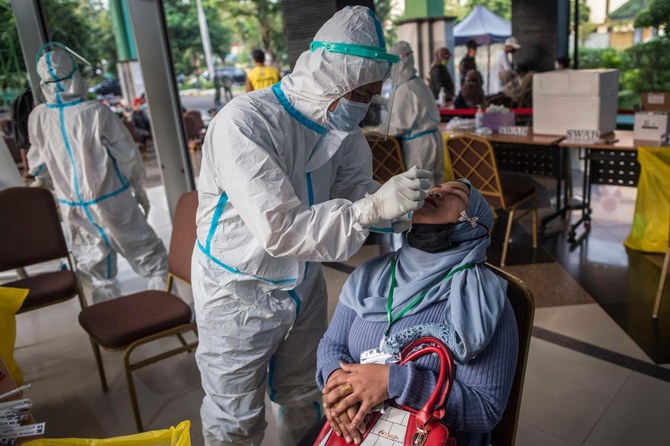
Indonesia approves Sinopharm COVID-19 vaccine for emergency use

Indonesia has suffered one of the worst COVID-19 outbreaks in Asia, with 1.66 million infections and more than 45,000 deaths reported. (AFP)
Short Url
Updated 30 April 2021
Follow

Indonesia approves Sinopharm COVID-19 vaccine for emergency use

  • Sinopharm is the third company to have its vaccine approved by Indonesia
  • Indonesia’s vaccine program has slowed due to an export ban from India and other supply issues

JAKARTA: Indonesia’s drug regulator on Friday approved the COVID-19 vaccine of China’s Sinopharm, which it will use in a private immunization scheme where companies buy government-procured vaccines to inoculate their staff.
After Sinovac Biotech and AstraZeneca, Sinopharm is the third company to have its vaccine approved by Indonesia, which is seeking to inoculate 181.5 million people by January 2022.
It has suffered one of the worst COVID-19 outbreaks in Asia, with 1.66 million infections and more than 45,000 deaths reported.
Penny K. Lukito, chief of Indonesia’s food and drug agency (BPOM), said Sinopharm vaccine recipients had reported higher antibody rates and rare side effects, such as swelling or diarrhea.
“Based on the evaluation and the benefits or risks consideration ... BPOM has issued an emergency use authorization (for Sinopharm),” she told a news conference.
Verdi Budidarmo, CEO of pharmaceutical company Kimia Farma which distributes the vaccine, said the private vaccination program, which starts next month, could “back up the government to reach herd immunity.”
Over 482,000 ready-to-use doses of the Sinopharm vaccine arrived on Friday.
No detailed efficacy data of Sinopharm’s vaccine has been publicly released.
However, its developer, Beijing Biological Products Institute, a unit of Sinopharm subsidiary China National Biotec Group, has said the vaccine was 79.34 percent effective in preventing people from developing the disease, based on interim data.
Indonesia’s vaccine program has slowed due to an export ban from India and other supply issues, although health minister Budi Gunadi Sadikin said he hoped it could get back on track in May.
It has administered at least one shot of COVID-19 vaccine to about 12.3 million of its 270 million population.
The country received 6 million doses of the Sinovac Biotech vaccine in bulk on Friday. It has also received 3.85 million ready-to-use doses of the AstraZeneca vaccine this week and Budi said 10 million to 15 million additional Sinovac vaccine doses would be received in the next few weeks.


Macron pushes back against Trump’s tariff threats, calls for stronger European sovereignty at Davos

Updated 5 sec ago
Follow

Macron pushes back against Trump’s tariff threats, calls for stronger European sovereignty at Davos

  • French president calls for stronger European sovereignty and fair trade rules, signaling Europe will not bow to economic coercion amid US tariff threats 

LONDON: French President Emmanuel Macron warned about global power and economic governance, implicitly challenging US President Donald Trump’s trade and diplomatic approach, at the World Economic Forum in Davos on Tuesday.

Without naming Trump, Macron described a world sliding toward a “law of the strongest,” where cooperation is replaced by coercion and economic pressure becomes a tool of dominance.

His comments come as Europe faces renewed threats of tariffs and coercive measures from Washington following the fallout over Greenland and other trade disputes.

Macron, wearing sunglasses on stage, warned political and business leaders of a world under pressure, marked by rising instability, weakened international law, and faltering global institutions.

“We are destroying the systems that help us solve shared problems,” he said, warning that uncontrolled competition, especially in trade, puts collective governance at risk.

In recent days, Trump has threatened punitive tariffs on European exports, including a 200 percent levy on French wine, after Macron refused to join the “Board of Peace” for Gaza.

Trump also announced a 10 percent tariff on exports from Britain and EU countries unless Washington secured a deal to purchase Greenland from Denmark, a move European officials have privately called economic blackmail.

Macron rejected what he described as “vassalization and bloc politics,” warning that submitting to the strongest power would lead to subordination rather than security.

He also criticized trade practices that demand “maximum concessions” while undermining European export interests, suggesting that competition today is increasingly about power rather than efficiency or innovation.

Macron also said that Europe has long been uniquely exposed by its commitment to open markets while others protect their industries.

“Protection does not mean protectionism,” he said, emphasizing that Europe must enforce a level playing field, strengthen trade defense instruments, and apply the principle of “European preference” where partners fail to respect shared rules.

Macron warned against passive moral posturing, arguing that it would leave Europe “marginalized and powerless” in an increasingly harsh world. His dual strategy calls for stronger European sovereignty alongside effective multilateralism.

The timing of the speech underscored its urgency. Trump recently published private messages from NATO leaders and Macron, following a diplomatic controversy over Greenland.

Macron closed his Davos speech with a clear statement of principles: “We prefer respect to bullying, science to obscurantism, and the rule of law to brutality.”