Pakistan, Gulf countries resume free-trade talks after 13-year gap

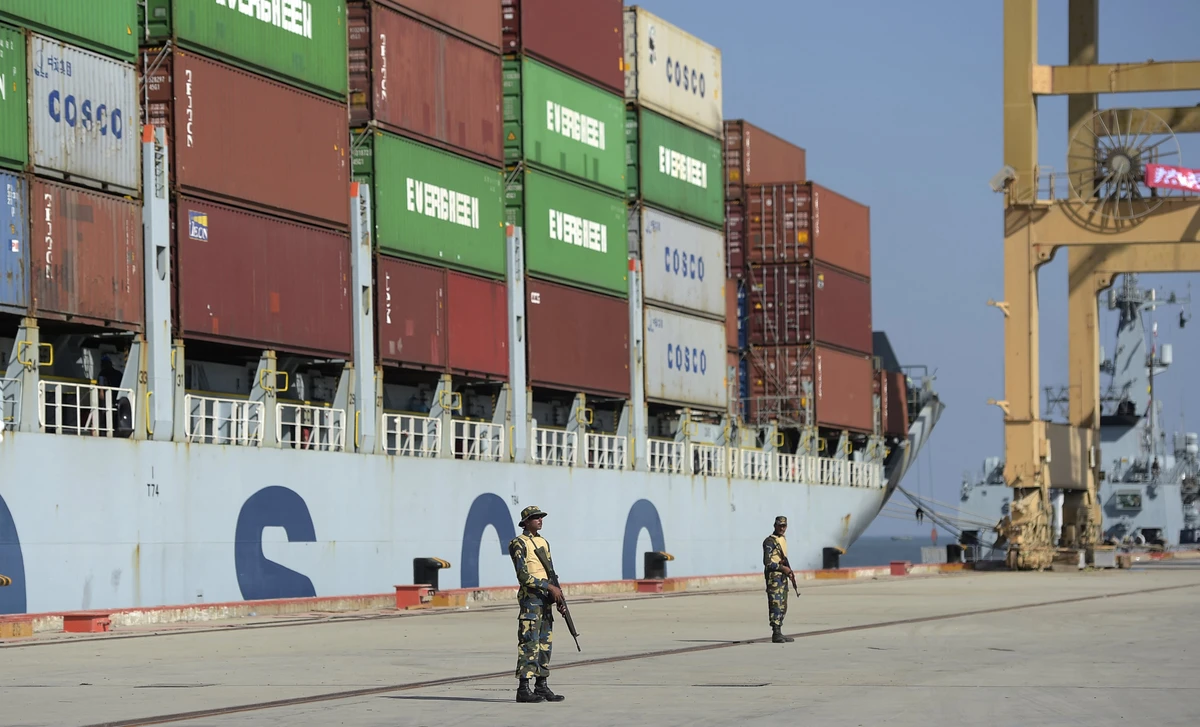
In this photograph taken on November 13, 2016, Pakistani Naval personnel stand guard near a ship carrying containers at the Gwadar port, some 700 kms west of Karachi. ( AFP/ File photo)
Short Url
Updated 28 April 2021
Follow

Pakistan, Gulf countries resume free-trade talks after 13-year gap

  • GCC and Pakistan agree to form technical teams for the process soon after Eid Al-Fitr 
  • Intention to resume the talks was declared during Saudi Crown Prince Mohammed bin Salman’s visit to Islamabad in 2019

KARACHI: After a gap of 13 years, Pakistan and the Gulf Cooperation Council (GCC) on Wednesday resumed negotiations on a free trade agreement (FTA), a top Pakistani diplomat in Riyadh said.

Islamabad started free-trade negotiations with the GCC — an intergovernmental economic union of Bahrain, Kuwait, Oman, Qatar, Saudi Arabia, and the United Arab Emirates — in 2004, but after two rounds of talks in 2006 and 2008, only a broader outline was reached.

The intention to resume the talks was declared during Saudi Crown Prince Mohammed bin Salman’s visit to Islamabad in 2019, but they were further delayed by the coronavirus outbreak.

“The third round of free trade negotiations was held virtually between Pakistan and GCC officials today after continuous efforts of Trade Mission Riyadh,” Azhar Ali Dahar, trade and investment minister at the Pakistani mission in Riyadh, told Arab News over the phone on Wednesday. 
During the talks, the GCC side was led by Saudi Arabia’s deputy finance minister, Dr. Hamad Al-Bazai, while Pakistan was represented by Muhammad Humair Kareem, additional secretary for trade diplomacy at the Ministry of Commerce.
“During the first such dialogue since 2008, both sides reiterated their commitment for speedy and logical conclusion of talks into the Free Trade Agreement,” Dahar said, adding that technical teams from both sides will be formed and announced soon after Eid, when the talks will focus on the sectors of services, banking, insurance, manufacturing, information technology, and construction.

Maria Kazi, joint secretary for the Middle East at the Ministry of Commerce Ministry has been appointed Pakistan’s focal person for the process, while her GCC counterpart is Abdulrazzaq Al-Jraid — head of the council’s FTA negotiations section.
Since Islamabad’s positions will be based on feedback from the country’s trade community, Dahar said the relevant stakeholders should submit their recommendations as soon as possible. 
“The progress on FTA with GCC will be made soon after Eid, so Pakistani trade associations must submit their recommendations for the agreement with GCC to joint secretary Middle East at Commerce Ministry in Islamabad as soon as possible,” Dahar said. 

Pakistan has FTAs only with three countries: China, Malaysia, and Sri Lanka. If its GCC deal materializes, it would greatly expand the country’s export market in the Middle East, especially for agricultural products.
Islamabad steps up vehicle checks to boost security as 166,000 cars get electronic tags

Updated 4 sec ago
Follow

Islamabad steps up vehicle checks to boost security as 166,000 cars get electronic tags

  • Authorities say over 3,000 vehicles registered in past 24 hours as enforcement intensifies
  • Extended service hours introduced to push full compliance with digital monitoring system

ISLAMABAD: Authorities in the Pakistani capital have intensified enforcement against vehicles without mandatory electronic tags with more than 166,000 cars now registered, according to data released on Sunday evening, as Islamabad moves to strengthen security and digital monitoring at key entry and exit points.

The Islamabad Capital Territory (ICT) administration introduced the electronic tagging system late last year as part of a broader effort to regulate traffic, improve record-keeping and enhance surveillance in a city that hosts the country’s main government institutions, foreign missions and diplomatic enclaves.

Under the system, vehicles are fitted with electronic tags that can be read automatically by scanners installed at checkpoints across the capital, allowing authorities to identify unregistered vehicles without manual inspections. Vehicles already equipped with a motorway tag, or m-tag, are exempt from the requirement.

“A total of 166,888 vehicles have successfully been issued M-Tags so far, including 3,130 vehicles in the last 24 hours,” the ICT administration said, according to the Excise Department.

Officials said readers installed at checkpoints across Islamabad are fully operational and are being used to stop vehicles still without tags, as enforcement teams carry out checks across the city.

To facilitate compliance, authorities have expanded installation facilities and extended operating hours. The Excise Department said m-tag installation is currently available at 17 booth locations, while select centers have begun operating beyond normal working hours.

According to Director General Excise Irfan Memon, m-tag centers at 26 Number Chungi and 18 Meel are providing services round the clock, while counters at Kachnar Park and F-9 Park remain open until midnight to accommodate motorists unable to visit during daytime hours.

Officials said the combination of enforcement and facilitation was aimed at achieving full compliance with minimal disruption, adding that operations would continue until all vehicles operating in the capital are brought into the system.

The enforcement drive builds on a wider push by the federal government to integrate traffic management, emergency response and security monitoring through technology-driven “safe city” initiatives. Last month, Interior Minister Mohsin Naqvi reviewed Islamabad’s surveillance infrastructure and said reforms in monitoring systems and the effective use of technology were the “need of the hour.”

Authorities have urged motorists to obtain electronic tags promptly to avoid delays and penalties at checkpoints as enforcement continues across the capital.