

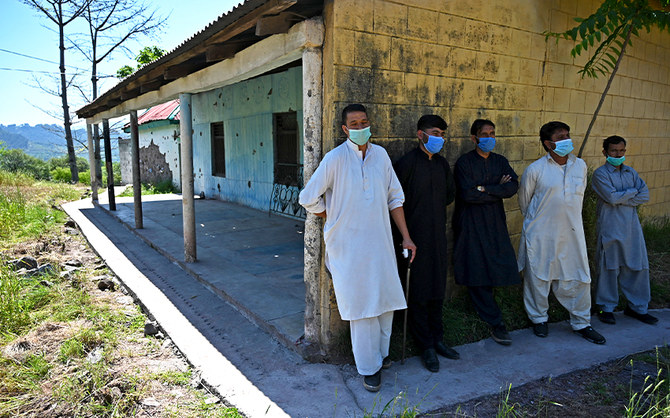

ISLAMABAD: People living along the de facto border separating the disputed Kashmir region between Pakistan and India told Arab News on Monday there had been no skirmishes between the two nuclear-armed neighbors since February when senior military officials of the two countries agreed to abide by a cease-fire accord between them.
The Line of Control (LoC) is said to be among the most militarized frontiers in the world, where the armies of the two South Asian rivals frequently exchange fire and mortars shells.
In a surprise announcement made in the last week of February, Pakistan and India said there had been a “hotline contact” between their director generals of military operations in which it was decided that the two sides would follow the 2003 cease-fire agreement and address the “core issues” that undermined peace and stability between them.
Zameer Begum, a local resident whose house was completely destroyed by Indian mortars, said there was finally some respite for the people living in her hometown near the LoC.
“We used to put up with daily shooting incidents in this settlement,” she said. “Sometimes the exchange of fire even took place three or four times during the day. Now we have been enjoying peace for the last two months, though there is no guarantee that Indians won’t initiate border hostilities again.”
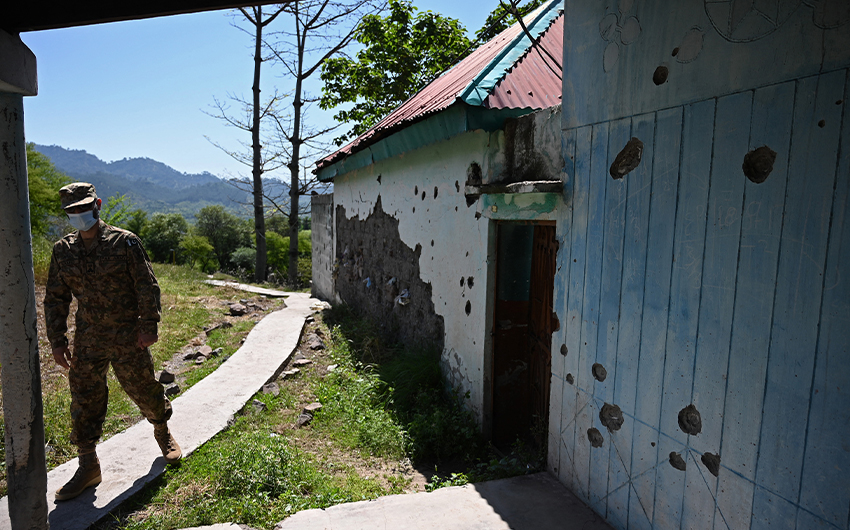
An army official walks past a damaged house following cross border shelling on the Line of Control, de facto border between India and Pakistan at Salohi village in Poonch district of Pakistan-administered Kashmir on April 26, 2021. (AFP)
A senior Pakistani military official, who did not want to be named, told Arab News at the Battal Sabz sector there had been no cease-fire violations since February 25.
“It was decided during the conversation between the two director generals that there would be no cease-fire violations, no speculative firing, no technical air space violations and no defense constructions at the LoC,” he said, adding that such incidents endangered the lives of 1.5 million Kashmiris living along the de facto frontier.
“We have built 3,183 protection bunkers for the local population to save their lives,” he continued. “More than 1,300 bunkers will also be built for civilian protection during the course of this year.”
Kashif Hussain, a district coordination officer in Poonch district, said the cease-fire had provided the administration an opportunity to address the social needs of the people.
“Previously, much of our development budget was spent on rehabilitation of local people due to continual firing incidents,” he told Arab News. “In the last two months, we have built a water filtration plant, dispensary and operationalized a school for local students.”
Nadia Javed, a local resident, said schools were open after a long time and parents were “somewhat relaxed” that their children were safe.
“Life is much better after the cease-fire,” she added. “We have also witnessed greater flow of goods in the local market. Until recently, we used to visit other places to shop for some of the most basic items.”

A Pakistani soldier stands guard near the Line of Control, de facto border between India and Pakistan at Salohi village in Poonch district of Pakistan-administered Kashmir on April 26, 2021. (AFP)
But while local residents applaud the cease-fire, they said it would be hard to forget the tragedies inflicted on them by the decades-long conflict over Kashmir.
“I have lost many of my relatives during the last two years due to Indian firing,” Afzal Ahmed, another resident of the town, told Arab News. “While there has been no exchange of fire during the last two months, we continue to live in a state of trauma. It’s hard for us to put our fears behind.”
Pakistan and India reached a cease-fire agreement in November 2003 along the frontier in Jammu and Kashmir. The arrangement held up for a few years, but violations have been a regular feature since 2008.
Tense ties between the two nations worsened on August 5, 2019, when New Delhi decided to strip the disputed Kashmir region of its special autonomy and integrate it with the rest of the Indian union, resulting in a major diplomatic row that has had implications for peace along the LoC.


