

KUALA LUMPUR: Two weeks into the holy month of Ramadan, and despite supporting the government’s decision to reopen traditional food bazaars, several Malaysians say they now fear a spike in coronavirus disease (COVID-19) infections, citing poor implementation of health protocols at the highly popular markets.
Unlike last year, when the government had canceled the famous bazaars in the early days of the pandemic to limit the spread of the outbreak, the markets are now allowed to operate, provided traders and visitors adhere to strict standard operating procedures (SOP) and checks.
Earlier this month, the Kuala Lumpur City Council said that 65 bazaars would be allowed to operate from 3 p.m. to 8 p.m. during Ramadan, before reiterating that compliance with SOPs was of utmost importance, especially those set by the National Security Council, such as mandatory face masks, body temperature scans and checking in with a dedicated mobile application.
Malaysia’s Ramadan bazaars date back to the 1980s. Eddin Khoo, a cultural activist focusing on Malay cultures, said that the concept gained popularity for its “food sharing culture.”
“In the 1970s, it was a smaller-scale home industry based on the idea of communal eating,” Khoo told Arab News.
He added that the bazaars’ unique selling point is that they cater to both Muslims and non-Muslims in Malaysia.
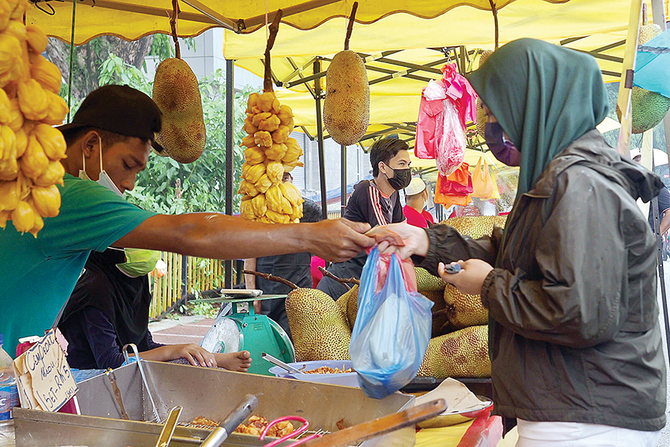
The bazaars are usually attended by thousands of people, who go out for late-night meals after breaking their fast at sunset or iftar time.
They feature hundreds of stalls with hawkers and street vendors selling local delicacies and hot food.
FASTFACT
Unlike last year, when the government had canceled the famous bazaars in the early days of the pandemic to limit the spread of the outbreak, the markets are now allowed to operate.
“Last year, everyone sorely missed the bazaars when they were canceled due to the pandemic. That was when we realized how important they are to the Malaysian community,” he said.
Adit Rahim, 44, told Arab News that the bazaars were smaller compared to those of the past few years.
Still, he has “adapted to the situation,” hoping for things to improve in the country.
On Monday, Malaysia had registered 395,718 COVID-19 cases and 1,449 deaths, while 369,556 people had recovered from the disease since the start of the pandemic last year.
Rahim said that while the SOPs are in place, they are not “well-explained, documented and disseminated” at the bazaars.
“When I arrived at the check-in counter, I had to remind the enforcement officer to enforce physical distancing, especially with children present,” he explained.
Nurul Syazwani Yahi, 29, said she was “excited to visit a bazaar” but “genuinely concerned” about the spike in infections as well.
“I believe basic hygiene needs to be emphasized more at the bazaar because it is still very poor,” she told Arab News.
Meanwhile, City Mayor Mahadi Che Ngah told Arab News that health protocols are necessary for the bazaars to run smoothly. To control the crowds at the bazaars, the mayor said an enforcement team comprising officials from various departments within the council had been deployed at the bazaars.
“We are also working closely with the police and immigration departments throughout the period,” he added.
Authorities in Malaysia are aiming to more strictly enforce the SOPs, while one bazaar in the state of Selangor has already been ordered to shut down due to compliance failures.