Lebanese officials say drug-stuffed pomegranate shipment originated in Syria

1 / 2
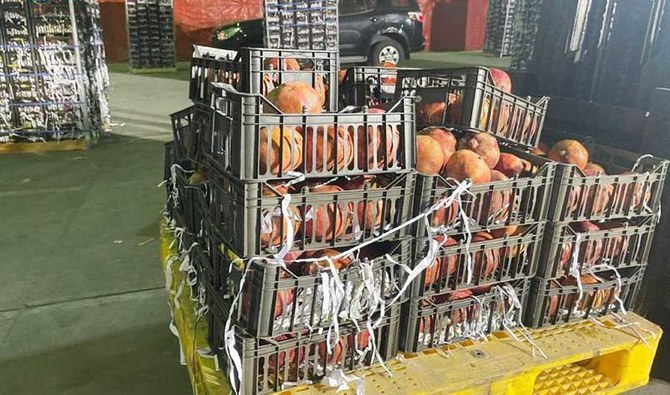
The pomegranate consignments that entered in stages were collected in an abandoned hangar in the town of Taanayel in the central Bekaa. (SPA)
2 / 2
The pomegranate consignments that entered in stages were collected in an abandoned hangar in the town of Taanayel in the central Bekaa. (SPA)
Short Url
Updated 26 April 2021
Follow

Lebanese officials say drug-stuffed pomegranate shipment originated in Syria

  • Customs source tells Arab News of ‘constant war’ with smugglers

BEIRUT: A pomegranate shipment hiding millions of Captagon pills entered Lebanon in stages through the Masnaa border crossing with Syria, a Lebanese customs official has claimed in an interview with Arab News where he tried to lessen his country’s responsibility for the drug-stuffed fruit shipment which has recently caused Saudi Arabia to ban all fruit and vegetables imports from Lebanon.

The narcotic-stuffed shipment was seized in Dammam last Friday.

On Monday President Michel Aoun said Lebanon was keen not to endanger the safety of any country, while caretaker Prime Minister Hassan Diab said neither Lebanon nor its people would accept any harm caused to the Saudis.

“We are with the Kingdom in combating smuggling networks and pursuing those involved,” Diab said.

Preventing smuggling from Lebanon’s borders was the focus of a meeting chaired by Aoun, with ministers and officials from security and customs services taking part.

Saudi Arabia was urged to “reconsider” its ban, which came into effect on Sunday, and Interior Minister Mohammed Fahmi was assigned to communicate and coordinate with the Kingdom’s authorities to “follow up the procedures to discover the perpetrators and prevent the recurrence of such odious practices.”​

But a customs source revealed the scale of the challenge, as well sharing insights into the smuggling process.

“It is a constant war with smugglers and it needs advanced equipment while we work manually,” the customs source told Arab News. “The quantity of pomegranates that contained Captagon tablets entered Lebanon in stages on more than one truck at the end of January through the Masnaa border crossing with Syria. Documents of the consignments indicated that the pomegranates were imported for internal Lebanese consumption and bear a certificate that they are of Syrian origin and not intended for transit.”

The scanners that trucks and refrigerators passed through from Syria to Lebanon at land crossings and the port were defective. They were Chinese-made, 30 years old, and had not had any maintenance.

“So the goods are inspected manually. Customs at the Masnaa border crossing usually inspect 20 percent of the truckload in transit​.”

The pomegranate consignments that entered in stages were collected in an abandoned hangar in the town of Taanayel in the central Bekaa.

They were re-loaded into Lebanese refrigerated trucks to export them to Saudi Arabia as a Lebanese product in the name of the Cedar Company, which was owned by two Syrians with cover from a Lebanese person who was a major shareholder.

The owners of the company paid all the fees due on the shipment and they were usually high.

“The smugglers know that transit goods from Syria to Saudi Arabia are subject to vigilant inspection.”

Smugglers used Lebanese refrigerated trucks to avoid detection of their cargo because Saudi authorities had more confidence in dealing with the Lebanese side and the scrutiny was “less intense​,” according to the source.

The shipment set off from Lebanon in early February and needed about 15 days to reach Saudi Arabia by sea.

When the existence of drugs in the shipment was discovered in the Kingdom, authorities informed the Lebanese side before announcing it in the media.

Lebanese security services followed the course of the shipments, discovered what had happened in Taanayel and arrested the two Syrians, who were brothers.

The customs source told Arab News that Gulf states had long complained of drug smuggling operations to their territories from Syria via Lebanon.

“Lebanese security services have been keen to tighten supervision in this regard. However, drug traffickers always invent new unexpected methods.”

One of the participants at the Monday meeting was ​the head of the Farmers and Peasants Association in the Bekaa Valley Ibrahim Tarshishi, who was hopeful about the ban being lifted.

“​What we have heard about the measures that will be taken makes us optimistic about the possibility of reopening the borders to Lebanese agricultural products to the Gulf countries,” he told Arab News.

He said 40 trucks loaded with Lebanese agricultural products were currently stuck between Beirut and Jeddah. “Their fate is unknown,” he added.

Aoun stressed that smuggling of all kinds, including drugs, fuel and other materials, harmed Lebanon and “cost it dearly, and the recent smuggling operation to Saudi Arabia demonstrates this.”

He asked about the reasons for the delay in purchasing scanners to be placed at crossings, even though the decision to do that was taken last July, and called for the swift completion of the purchasing process.

​There was a statement from the meeting at the presidential palace about Lebanon’s keenness on “maintaining the strength of fraternal relations” with Saudi Arabia and the condemnation of everything that would “prejudice its social security or the safety of its brotherly people, particularly the smuggling of prohibited and narcotic materials, especially since Lebanon categorically rejects that its facilities be a gateway for such disgraceful crimes.”

​The meeting also requested that exporters abide by the rules of foreign trade and to check exported products to preserve Lebanon’s reputation.


Sudan’s prime minister takes his peace plan to the UN, but US urges humanitarian truce now

Updated 57 min 20 sec ago
Follow

Sudan’s prime minister takes his peace plan to the UN, but US urges humanitarian truce now

  • Sudan’s prime minister is proposing a wide-ranging peace initiative to end a nearly 1,000-day war with a rival paramilitary force
  • It seems unlikely the RSF would support the proposal, which would essentially give government forces a victory and take away their military power

UNITED NATIONS: Sudan’s prime minister on Monday proposed a wide-ranging peace initiative to end a nearly 1,000-day war with a rival paramilitary force, but the United States urged both sides to accept the Trump administration’s call for an immediate humanitarian truce.
Kamil Idris, who heads Sudan’s transitional civilian government, told the Security Council his plan calls for a ceasefire monitored by the United Nations, African Union and Arab League, and the withdrawal of paramilitary forces from all areas they occupy, their placement in supervised camps and their disarmament.
Sudan plunged into chaos in April 2023 when a power struggle between the military and the powerful paramilitary Rapid Support Forces exploded into open fighting, with widespread mass killings and rapes, and ethnically motivated violence. This has amounted to war crimes and crimes against humanity, according to the UN and international rights groups.
It seemed highly unlikely the RSF would support the prime minister’s proposal, which would essentially give government forces a victory and take away their military power.
In an indirect reference to the truce supported by the US and key mediators Saudi Arabia, Egypt and the United Arab Emirates, known as the Quad, Idris stressed to the UN Security Council that the government’s proposal is “homemade — not imposed on us.”
In early November, the Rapid Support Forces agreed to a humanitarian truce. At that time, a Sudanese military official told The Associated Press the army welcomed the Quad’s proposal but would only agree to a truce when the RSF completely withdraws from civilian areas and gives up their weapons — key provisions in the plan Idris put forward on Monday.
Idris said unless the paramilitary forces were confined to camps, a truce had “no chance for success.” He challenged the 15 members of the Security Council to back his proposal.
“This initiative can mark the moment when Sudan steps back from the edge and the international community — You! You! — stood on the right side of history,” the Sudanese prime minister said. He said the council should “be remembered not as a witness to collapse, but as a partner in recovery.”
US deputy ambassador Jeffrey Bartos, who spoke to the council before Idris, said the Trump administration has offered a humanitarian truce as a way forward and “We urge both belligerents to accept this plan without preconditions immediately.”
Bartos said the Trump administration strongly condemns the horrific violence across Darfur and the Kordofan region — and the atrocities committed by both the Sudanese Armed Forces and the Rapid Support Forces, who must be held accountable.
UAE Ambassador Mohamed Abushahab, a member of the Quad, said there is an immediate opportunity to implement the humanitarian truce and get aid to Sudanese civilians in desperate need.
“Lessons of history and present realities make it clear that unilateral efforts by either of the warring parties are not sustainable and will only prolong the war,” he warned.
Abushahab said a humanitarian truce must be followed by a permanent ceasefire “and a pathway toward civilian rule independent of the warring parties.”
UN Assistant Secretary-General for political affairs Khaled Khiari reflected escalating council concerns about the Sudan war, which has been fueled by the continuing supply of increasingly sophisticated weapons.
He criticized unnamed countries that refuse to stop supplying weapons, and both government and paramilitary forces for remaining unwilling to compromise or de-escalate.
“While they were able to stop fighting to preserve oil revenues, they have so far failed to do the same to protect their population,” Khiari said. “The backers of both sides must use their influence to help stop the slaughter, not to cause further devastation.”
The devastating war in Sudan has killed more than 40,000 people according to UN figures, but aid groups say the true number could be many times higher. The conflict has created the world’s largest humanitarian crisis, with over 14 million people displaced, disease outbreaks and famine spreading in parts of the country.