

Chip shortage deals big blow to auto sector

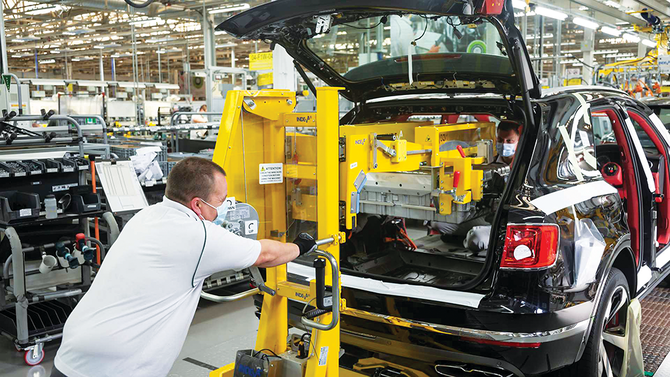
Carmakers were planning to rev up production this year to meet an expected surge in demand but without enough chips those hopes are fading. (File photo)
Short Url
Updated 26 April 2021
Follow

Chip shortage deals big blow to auto sector

  • Carmakers expect improvement in the situation by the end of 2021

PARIS: What was initially downplayed as a brief hiccup in the supply of semiconductors looks more and more like a shortage that may last throughout the year in what would be a big blow to automakers.

They were planning to rev up production this year to meet an expected surge in demand from consumers as the pandemic wanes and to recover from last year’s losses. But without enough chips those hopes are fading.

The shortage of chips has pushed automakers to idle production lines for brief periods when they temporarily run out of supplies.

Toyota, Volkswagen, Ford, Peugeot, Fiat, Jeep, Honda, Jaguar Land Rover and even the Chinese startup Nio have had to pause production in their factories in the past months.

Automakers have reduced the stocks of parts they keep on hand in recent years as part of cost-cutting measures, so delivery delays can quickly force an entire shutdown.

Renault CEO Luca de Meo told shareholders this past week that “the semiconductor shortage could cause a drop in production volume this year of at least 100,000 vehicles.” In Germany, thousands of autoworkers were on reduced work hours or temporary unemployment as Volkswagen and Mercedes factories were forced to halt production.

Fiat slowed production at its Brazilian factory in Betim for the second time this month.

The Stellantis factory in Rennes-La Janais in France, where 2,000 people work, was also nearly idle.

Computer processors are a key element in today’s vehicles, which can easily have several dozen to control elements such as the engine, automatic braking system, airbags, automatic parking system and the infotainment system.

The main manufacturers are located in Asia, such as TSMC in Taiwan and Samsung and SK Hynix in South Korea, although there are still some factories in the US and Europe. The surge in demand for electronic devices during the pandemic is the main cause of today’s shortage of chips. A fire in a Japanese factory did not help and now a drought in Taiwan may force a reduction in output.

Automakers say they are managing the situation on a day-by-day basis and are trying to avoid shutting down production lines completely.

Due to the chip shortage, “GM is building some vehicles without certain modules when necessary,” the US carmaker said in a statement.

“They will be completed as soon as more semiconductors become available,” it added.

Stellantis was able to resume production of the new Peugeot 308 at half the normal pace after a three-week halt. It went back to a dashboard console that uses an analogue speedometer.

Most automakers say they hope to make up lost production during the second half of the year.

Current shortages of semiconductor chips that are slowing car production worldwide “can be compensated for by the end of the year,” Daimler CEO Ola Kallenius said in a statement.

Others are more pessimistic.

“An improvement in the short term is not to be expected,” said Volkmar Denner, the CEO of Bosch, which is a major supplier of components for automakers.

French auto component maker Faurecia does not expect an improvement before the very end of the year as the consumer electronics industry is gearing up for its peak manufacturing period.


Saudi Arabia set to attract $500bn in private investment, Al-Falih tells conference

Updated 09 December 2025
Follow

Saudi Arabia set to attract $500bn in private investment, Al-Falih tells conference

RIYADH: Sustainability, technology, and financial models were among the core topics discussed by financial leaders during the first day of the Momentum 2025 Development Finance Conference in Riyadh.

The three-day event features more than 100 speakers and over 20 exhibitors, with the central theme revolving around how development financial institutions can propel economic growth.

Speaking during a panel titled “The Sustainable Investment Opportunity,” Saudi Investment Minister Khalid Al-Falih elaborated on the significant investment progress made in the Kingdom.

“We estimate in the midterm of 2030 or maybe a couple of years more or so, about $1 trillion of infrastructure investment,” he said, adding: “We estimate, as a minimum, 40 percent of this infrastructure is going to be financed by the private sector, so we’re talking in the next few years $400 (billion) to $500 billion.”

The minister drew a correlation between the scale of investment needs and rising global energy demand, especially as artificial intelligence continues to evolve within data processing and digital infrastructure in global spheres.

“The world demand of energy is continuing to grow and is going to grow faster with the advent of the AI processing requirements (…) so our target of the electricity sector is 50 percent from renewables, and 50 percent from gas,” he added.

Al-Falih underscored the importance of AI as a key sector within Saudi Arabia’s development and investment strategy. He made note of the scale of capital expected to go into the sector in coming years, saying: “We have set a very aggressive, but we believe an achievable target, for AI, and we estimate in the short term about $30 billion immediately of investments.”

This emphasis on long-term investment and sustainability targets was echoed across panels at Momentum 2025, during which discussions on essential partnerships between public and private sectors were highlighted.

The shared ambition of translating the Kingdom’s goals into tangible outcomes was particularly essential within the banking sector, as it plays a central role in facilitating both projects and partnerships.

During the “Champions of Sectoral Transformation: Development Funds and Their Ecosystems” panel, Saudi National Bank CEO Tareq Al-Sadhan shed light on the importance of partnerships facilitated via financial institutions.

He explained how they help manage risk while supporting the Kingdom’s ambitions.

“We have different models that we are working on with development funds. We co-financed in certain projects where we see the risk is higher in terms of going alone as a bank to support a certain project,” the CEO said.

Al-Sadhan referred to the role of development funds as an enabler for banks to expand their participation and support for projects without assuming major risk.

“The role of the development fund definitely is to give more comfort to the banking sector to also extend the support … we don’t compete with each other; we always complement each other” he added.