

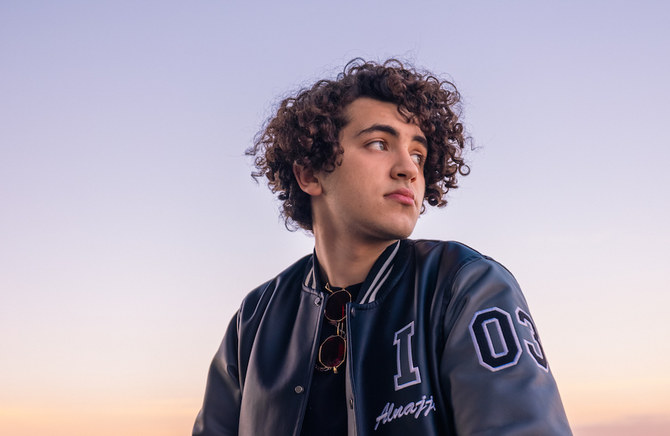
Meet Issam Al-Najjar, the Jordanian teen with a viral TikTok song and a Spotify billboard in Times Square

Portrait of Jordanian singer Issam Al-Najjar. Supplied
Short Url
Updated 28 April 2021
Follow

Meet Issam Al-Najjar, the Jordanian teen with a viral TikTok song and a Spotify billboard in Times Square

DUBAI: From recording covers at home to having his face emblazoned across a billboard in New York City’s Times Square this month, Jordanian singer Issam Al-Najjar has been making moves in the region with his Arabic hit “Hadal Ahbek” that went viral on social media app TikTok.

His TikTok hashtag “#hadal_ahbek” so far has more than 480 million views, while his music, lyric and performance videos on YouTube have a total of 77 million views.  

The catchy upbeat song, which was released a few months ago, also took the top spot on Spotify’s Global Viral 50 with more than 30 million streams — and he is using the fame to pioneer a new genre of music, A-Pop.

“It’s Arabian pop. You know how Koreans have K-pop, I just wanted it to be a possibility — you know — because the music that I am making is a little bit different than the normal Arabic music that we hear,” the young star, who turns 18 in May, told Arab News.

“I’ve been singing professionally for the past year,” said the musician, recalling his rise to fame over the past year with the smash hit “Hadal Ahbek.”

“We wrote this song and we posted a video of it on Instagram and people actually liked it. Six months later, we recorded that song ‘Hadal Ahebek,’ which was a success,” he said. “We just dropped it unofficially because we weren’t expecting anything from this song.”

The music sensation, who is now signed with Universal Arabic Music — the label under the umbrella of Universal Global — said that he was only hoping for 10,000 views, which he hit in a day, he recalled.

“The story behind this song was that I was facetiming one of my friends and she had her head on the pillow and I said ‘Hoty rasek aal makhade’ (place your head on the pillow) and it went from there,” Al-Najjar said. 

Managed by Lebanese-Canadian mogul Wassim Slaiby — who also counts Canadian superstar The Weeknd as a client — Al-Najjar is set to make waves with his dual-language repertoire, although he believes his audience prefers it when he croons in Arabic.

His first recorded song was “One of a Kind,” which was an English song that Al-Najjar said he recorded in his room. “But, I think because I have an Arabian audience, I feel like people accepted (“Hadal Ahebek”) or liked it more.” 

Earlier this month, Spotify collaborated with Al-Najjar who became its latest RADAR artist in the Middle East and North Africa region. 

RADAR is an emerging-artist program that spotlights rising talent from around the world.

The partnership saw the global chart-topper collaborate with Canadian music production and DJ duo Loud Luxury and Iraqi-Canadian singer and songwriter Ali Gatie for the release of “Turning Me Up,” the English version of “Hadal Ahbek.”


At Jazan festival, Suad Al-Asiri paints memory, land and leadership

Updated 13 January 2026
Follow

At Jazan festival, Suad Al-Asiri paints memory, land and leadership

  • Local artist channels personal hardship into works that reflect Jazan’s identity, heritage
  • Jazan: A Nation and a Prince, places region at the heart of a composition featuring Prince Mohammed bin Abdulaziz and Prince Nasser bin Mohammed bin Abdullah bin Jalawi

RIYADH: At the Ahad Al-Masarihah pavilion at Jazan Festival 2026, Suad Al-Asiri’s paintings blend memory, place and personal history, offering visual narratives shaped by beauty and hardship. 

A novelist and visual artist, Al-Asiri has long used art as a storytelling tool. After a near-fatal car accident in March 2024, her work took on a new urgency. Bedridden for 11 months, cut off from the public world for more than a year, she describes that period as one of the most painful in her life — yet also transformative. 

“First of all, praise be to God for granting me life, as the accident was extremely severe,” she said. “By God’s grace, I was given a new life. All my thinking after the accident was about becoming an inspiration to others — about enduring pain and obstacles, and still leaving an impact.” 

Her return to public life came in 2025, when she participated in National Day celebrations with the ministry of interior. By the time she arrived at Jazan Festival, she was ready to channel that experience into her art. 

The centerpiece of her display, “Jazan: A Nation and a Prince,” places the region at the heart of a composition featuring Prince Mohammed bin Abdulaziz and Prince Nasser bin Mohammed bin Abdullah bin Jalawi, governor and deputy governor of Jazan respectively. 

Visitors linger over the details: the painting incorporates coffee beans, sesame and khudair — materials drawn from local products.

“I wanted people to recognize these products immediately,” she said. “They are part of Jazan’s daily life, and using them makes the work more tangible, more connected to everyday experience.” 

The painting sparks conversation. Visitors discuss leadership, identity, and the intimate relationship between people and their environment. 

Beyond the central piece, Al-Asiri presents individual portraits of the two princes, expanding the dialogue into a broader exploration of heritage and memory.  

Her journey into art is tied to her life as a storyteller. Early experiments with charcoal and pencil evolved into abstract art, drawn by its expressive freedom. 

From there, she explored realism, surrealism, and eventually modern art, particularly pop art, which has earned her wide recognition in artistic circles. Her novels and media work complement her visual practice, earning her the title “the comprehensive artist” from the governor.

Yet what stands out most in this exhibition is how Al-Asiri’s personal resilience flows through each piece. Her experience of surviving a devastating accident, enduring months of immobility, and returning to the public eye informs every brushstroke. 

Visitors sense not just her artistic skill, but her determination to turn life’s hardships into inspiration for others. 

Walking through the pavilion, one can see it in the way she blends heritage symbols, southern landscapes, and scenes of daily life. 

Each painting becomes both a document and a dialogue — a celebration of Jazan’s culture, a reflection on identity, and a testament to the power of human perseverance. 

At Jazan Festival 2026, Suad Al-Asiri’s art is a quiet, persistent inspiration for anyone who pauses long enough to listen.