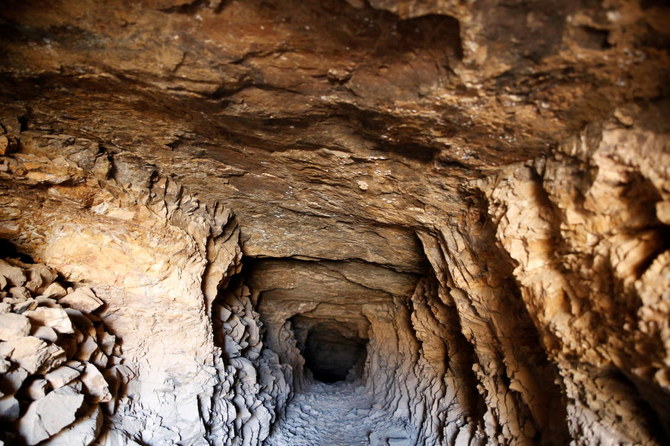
CAIRO: Mining companies awarded blocks in Egypt’s Eastern Desert are set to start exploring for gold under a legislative overhaul that seeks eventually to unlock vast untapped mineral resources.
Despite plentiful reserves and a rich mining history that gave rise to elaborate Pharaonic gold jewelry, Egypt has just one commercial gold mine in operation. Foreign investment in oil and gas has grown, but mining has languished.
Now, the country is banking on high gold prices and amended mining laws that scrap red tape and a profit-sharing rule, unpopular in the industry, to lure interest.
One year after launching its first bid round under the new rules, it has so far clinched five gold exploration contracts in a first bidding round and kept the tendering system rolling as it tries to build momentum.
The government is looking to attract $1 billion in annual investments in mining, a target industry sources say could be within reach.
“Success is ultimately going to be measured by how many mines are going to be discovered and advanced to production,” said Patrick Barnes, Head of Metals & Mining Consulting EMEARC at Wood Mackenzie, which advised Egypt’s government on its mining law reforms.
“Early indicators show us that this bid round was much better than the ones held previously.”
In its initial tender, Egypt in November awarded 82 exploration blocks to what metals analysts say is a healthy mix of 11 companies, ranging from junior explorers to industry giants such as Barrick Gold.
The blocks on offer are in the Arabian-Nubian shield geological formation, which flanks the Red Sea and is believed to be one of the most mineral rich areas in the world.
Egypt’s mining drive is still at an early stage.
UK-based Altus Strategies told Reuters it was looking to build up its technical team and conduct remote sensing and mapping operations on the 1,500 square kilometers of land it has been awarded before starting exploration.
It expects to invest several million dollars in the short term but that could rise above $100-$200 million if a economic discovery is made.
A spokeswoman for Canada-based B2Gold, which also won concessions, said the company was looking forward to starting exploration soon “given the relative under-investment in modern exploration, and therefore untapped potential in the historically prospective Arabian-Nubian Shield.”
Mining firms welcomed the elimination of a requirement to form joint ventures with the Egyptian government, and the capping of state royalties at 20 percent.
However, the retention of a tendering process for exploration blocks limits the chances of any gold boom, said Sami El Raghy, Chairman of Australia-based Nordana.
“No other successful mining countries use this process. They all have a clear transparent mining laws stipulating the qualification, obligations and the rights of investors. (They) work on the principle first come, first served,” said El Raghy, who was also a founder of Egypt’s first and only commercial gold mine, Sukari.
The Ministry of Petroleum and Mineral Resources declined to comment.
On average, a mining project goes from discovery to production in 10-15 years. While gold prices have eased after reaching a record in 2020, economists expect they will remain high by historical standards over coming years.
“If you get to a point where several discoveries are made, Egypt could be one of the largest gold producers in Africa ... It had top-tier potential,” said Steven Poulton, CEO of Altus Strategies.
Environmental campaigners, however, say there is no justification for gold mining. It generates emissions, can add to water-stress and in contrast to copper and battery minerals is not in demand from technologies that can bring about a low carbon economy.
The government has said it is open to other minerals, but gold is the focus for now.
“Gold is absolutely the best thing for them to start with, because there’s a known amount of it,” said Wood Mackenzie’s Barnes.
“Egypt has immense potential for mining copper and gold and other commodities. The biggest concern in the industry is lack of supply for copper, places like Egypt which are considered under explored and high potential are going to get a lot of attention if they can maintain investment conditions,” he added.


Miners seek gold under the desert sands after Egypt changes rules
https://arab.news/nmegd
Miners seek gold under the desert sands after Egypt changes rules

- Five firms have signed gold exploration contracts
- Government seeking $1 billion of investment annually
Related


PIF’s Humain invests $3bn in Elon Musk’s xAI prior to SpaceX acquisition
JEDDAH: Humain, an artificial intelligence company owned by Saudi Arabia’s Public Investment Fund, invested $3 billion in Elon Musk’s xAI shortly before the startup was acquired by SpaceX.
As part of xAI’s Series E round, Humain acquired a significant minority stake in the company, which was subsequently converted into shares of SpaceX, according to a press release.
The transaction reflects PIF’s broader push to position Saudi Arabia as a central hub in the global AI ecosystem, as part of its Vision 2030 diversification strategy.
Through Humain, the fund is seeking to combine capital deployment with infrastructure buildout, partnerships with leading technology firms, and domestic capacity development to reduce reliance on oil revenues and expand into advanced industries.
The $3 billion commitment offers potential for long-term capital gains while reinforcing the company’s role as a strategic, scaled investor in transformative technologies.
CEO Tareq Amin said: “This investment reflects Humain’s conviction in transformational AI and our ability to deploy meaningful capital behind exceptional opportunities where long-term vision, technical excellence, and execution converge, xAI’s trajectory, further strengthened by its acquisition by SpaceX, one of the largest technology mergers on record, represents the kind of high-impact platform we seek to support with significant capital.”
The deal builds on a large-scale collaboration announced in November at the US-Saudi Investment Forum, where Humain and xAI committed to developing over 500 megawatts of next-generation AI data center and computing infrastructure, alongside deploying xAI’s “Grok” models in the Kingdom.
In a post on his X handle, Amin said: “I’m proud to share that Humain has invested $3 billion into xAI’s Series E round, just prior to its historic acquisition by SpaceX. Through this transaction, Humain became a significant minority shareholder in xAI.”
He added: “The investment builds on our previously announced 500MW AI infrastructure partnership with xAI in Saudi Arabia, reinforcing Humain’s role as both a strategic development partner and a scaled global investor in frontier AI.”
He noted that xAI’s trajectory, further strengthened by SpaceX’s acquisition, exemplifies the high-impact platforms Humain aims to support through strategic investments.
Earlier in February, SpaceX completed the acquisition of xAI, reflecting Elon Musk’s strategy to integrate AI with space exploration.
The combined entity, valued at $1.25 trillion, aims to build a vertically integrated innovation ecosystem spanning AI, space launch technology, and satellite internet, as well as direct-to-device communications and real-time information platforms, according to Bloomberg.
Humain, founded in August, consolidates Saudi Arabia’s AI initiatives under a single entity. From the outset, its vision has extended beyond domestic markets, participating across the global AI value chain from infrastructure to applications.
The company represents a strategic initiative by PIF to diversify the Kingdom’s economy and reduce oil dependence by investing in knowledge-based and advanced technologies.