KARACHI: Pakistan is ready to construct the multibillion-dollar ML-1 railway project after receiving a much anticipated $6 billion loan from the Exim Bank of China, a Pakistan Railways spokesperson has said.
Pakistan approved the project last year, its costliest to date, as part of the multibillion-dollar China-Pakistan Economic Corridor (CPEC) agreement, giving the go-ahead for a $6.8 billion project to upgrade its railway lines.
CPEC has seen Beijing pledge over $60 billion for infrastructure projects in Pakistan, central to China’s wider Belt and Road Initiative (BRI) to develop land and sea trade routes in Asia and beyond.
The railway project, known as Mainline-1 (ML-1), is meant to be built on a cost-sharing basis between Islamabad and Beijing, with major financing expected through China’s Government Concessional Loan (GCL), though Pakistani authorities will also provide about $800 million as equity for the project.
“After finalizing technical and administrative details, Pakistan sent all project documents to the Exim Bank of China through the authorities in Beijing for the approval of loan,” Pakistan Railways spokesperson Hamdan Nazir told Arab News. “The Pakistan Railways has already finalized all documents and the next milestone will be to float the tender,” he continued.
The Exim Bank of China is one of three institutional banks in China chartered to implement state policies in industry, foreign trade, economy, and foreign aid to other developing countries, and provide policy financial support to promote the export of Chinese products and services.
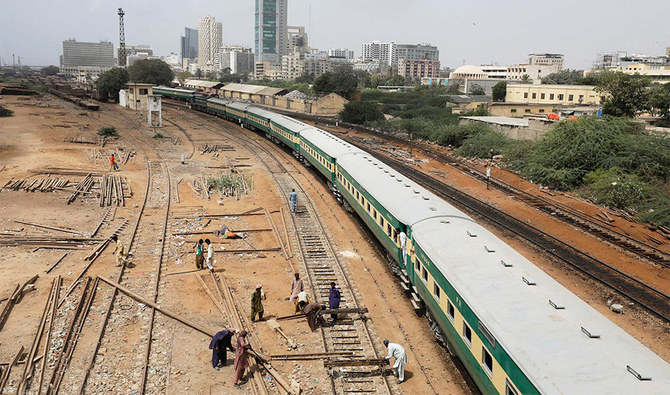
The ML-1 line will lay down parallel railway tracks along with existing ones that connect the port city of Karachi and Peshawar, allowing trains to run at a speed of 160-kilometer per hour instead of the usual 65 to 110 km/h. Freight trains will operate at 120 km/h after the railway system is upgraded and a computer-based signal and control technology will be introduced.
Pakistan Railways will be the proposing and implementing agency of the project and work will be awarded through open bidding as per Public Procurement Regulatory Authority (PPRA) Rules through an engineering, procurement, and construction (EPC) contract.
“All the pre-funding formalities, including preliminary feasibilities reports, have been done and tender documents have been completed,” the spokesman said, adding: “When the tender documents are accepted, the actual loan will be sanctioned.”
The country’s current railway minister Azam Khan Swati did not respond to request for comment for this article.


![]()

Pakistan awaits $6 bln loan from Exim Bank of China for ML-1 railway project
Short Url
https://arab.news/56j3p
Pakistan awaits $6 bln loan from Exim Bank of China for ML-1 railway project
- Project to be built on cost-sharing basis between Islamabad and Beijing, major financing coming from China’s Government Concessional Loan
- Last year Pakistan approved the project, its costliest to date, as part of multibillion-dollar China-Pakistan Economic Corridor agreement
Latest updates


© 2026 SAUDI RESEARCH & PUBLISHING COMPANY, All Rights Reserved And subject to Terms of Use Agreement.