

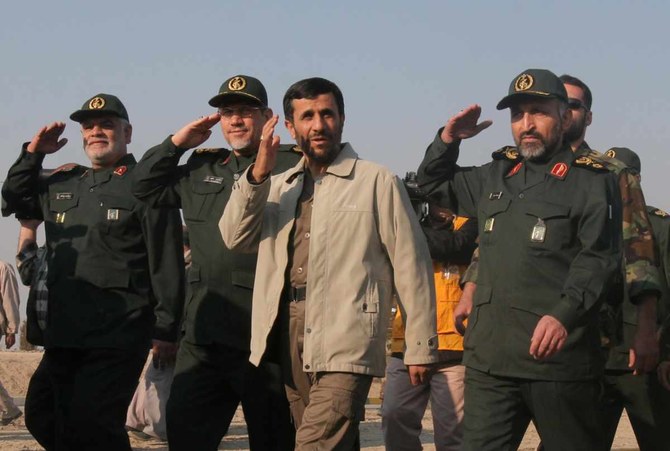

LONDON: Two senior commanders from the Islamic Revolutionary Guard Corps (IRGC) have died suddenly just days apart, and obscure reports from Iranian media have prompted suspicion that there is more to their deaths than Tehran is willing to admit.
Brig. Gen. Mohammad Hosseinzadeh Hejazi, 65, was deputy head of the IRGC’s Quds Force. Iranian media reported that he had died suddenly last weekend from a heart attack.
Hejazi was notorious for his role in violently suppressing the 2009 anti-regime protests while head of the IRGC’s domestic force, the Basij, and for commanding significant influence over the group’s missile program and relations with its proxies in Yemen and Lebanon.
He was promoted to his position in the Quds Force last year, when Esmail Qaani was assigned leadership of the organization following the killing of Maj. Gen. Qassem Soleimani.
Just days after Hejazi’s death, another general from the Quds Force, Brig. Gen. Mohammad Ali Haghbin, was reported dead.
State media blamed COVID-19 for his death, but images circulating online showed him in a hospital bed with breathing apparatus and two heavily bandaged legs.
This prompted rumors that he had actually died from wounds sustained fighting alongside one of Iran’s proxies in Syria or Yemen. Iranian media later retracted the image and replaced it with one hiding his injured legs.
The two generals’ deaths have prompted speculation that the killings were conducted by Israel, which sees Iran’s relationship with Hezbollah, which Hejazi worked with closely, as a major security concern.
Eloise Scott, Middle East, North Africa and Turkey analyst at political risk consultancy Sibylline, told Arab News that not only will Iran suffer from the loss of two seasoned commanders, but their deaths are the latest in a long series of embarrassing setbacks for the image-conscious IRGC.
Both Hejazi and Haghbin “have had quite considerable experience both internally in Iran, but also in places like Lebanon and Syria,” she said.
“The IRGC … has put a huge amount of effort into its proxies and its networks on the military front, but it’s also incredibly concerned and anxious about its perception at home, certainly in the last couple of years.”
Earlier in April, a large blast struck Iran’s flagship nuclear facility in Natanz, in an act of sabotage that observers said bears the hallmarks of Israel, Tehran’s regional arch-nemesis.
“The IRGC looks a bit chaotic at the moment. Coming off the back of the Natanz incident … a lot of things are building up. The impact on morale could be quite significant,” Scott said, pointing to other incidents from the past two years that have hurt the paramilitary group’s reputation.
The downing of a Ukrainian jet in early 2020 and huge anti-regime protests in November 2019 — the anger of which, Scott said, was largely targeted at the IRGC — have left it in a “very fragile position in terms of its own domestic standing, particularly given the chaos in the country with regards to the pandemic.”
Iran is currently experiencing its worst wave of infections from COVID-19, and is grappling with hundreds of deaths every day.
“It’s setback after setback for them,” Scott said. “They’re trying to advance their causes in places like Lebanon, which is very fragile, while they barely look like they’re keeping it together at home.”


