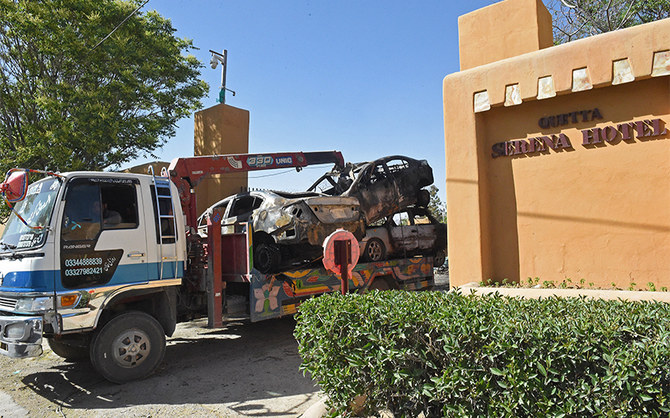

ISLAMABAD/KARACHI: Pakistan's Interior Minister Sheikh Rashid Ahmed said on Thursday a blast that took place in the country's southwestern city of Quetta on Wednesday night was a suicide attack that killed five people including the bomber and injured eleven others.
The explosion took place in the parking lot of the Serena Hotel while the Chinese ambassador was also in Quetta, though he was not present at the facility at the time of the blast.
"It was a suicide attack. The bomber detonated his vest from inside the car," the minister said. "Around 60 to 80 kilograms of explosive was used in the attack."
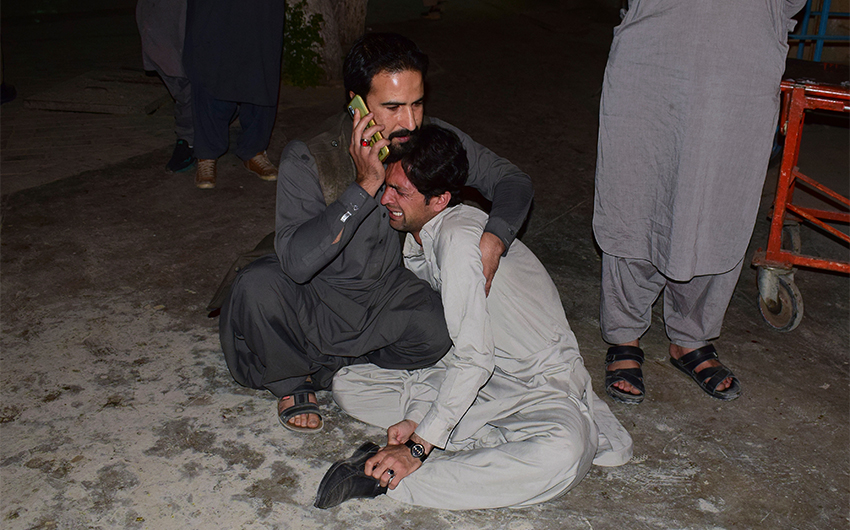
A Pakistani comforts to another mourning over the death of his family member in a bomb blast, at a hospital in Quetta, Pakistan, Wednesday, April 21, 2021. (AP)
The minister said a forensic investigation into the attack was underway and the bomber was yet to be identified.
"The Chinese ambassador was not at the hotel [at the time of the attack]," he said. "He was staying somewhere else and is safe."
The minister added the Chinese ambassador was in the city for the last several days and was still busy in his routine activities.
"China is a time-tested friend of Pakistan," he said. "The actual purpose of the attack was to destroy peace in Pakistan."
Quetta is the capital of the mineral rich Balochistan province bordering Iran and Afghanistan, long the scene of a low-level insurgency by local nationalists who want a larger share of the region's resources.
The province, Pakistan's largest but most impoverished, is also home to the newly expanded Gwadar deep-water port, a flagship of China's $65 billion investment in the Pakistani section of its Belt and Road Initiative.
The interior minister said that all 22 law enforcement institutions under the ministry were directed to be on high alert.
"We remain committed to the idea of defeating terrorists and foreign elements who want to destabilize Pakistan from within," he said.
Ahmed said that six of the injured had been discharged from hospitals in Quetta while only "one or two" of those hospitalized were in critical condition.
Wednesday's blast took place at the well-fortified Serena Hotel situated next to the Iranian Consulate and the provincial parliament building.
Dr. Waseem Baig, a spokesperson at the civil hospital in Quetta, told Arab News five people had been killed in the hotel bombing.
The Tehreek-e-Taliban Pakistan (TTP), a militant group fighting to overthrow the government, claimed the attack and said it was carried out by a suicide bomber "on high officials, including police officers," adding that the assault showed the strong leadership and intelligence capabilities of the group.
Designated a terrorist group by the United States, the TTP has been in disarray in recent years, especially after several of its top leaders were killed by US drone strikes on both sides of the Pakistan-Afghanistan border, forcing its members into shelter in Afghanistan, or fleeing to urban Pakistan.
Earlier, Zia Ullah Langau, home minister Balochistan, declined to confirm if the Chinese ambassador was the target of the assault, saying investigations were ongoing.
"The Chinese ambassador is in Quetta, and I have just met him," he told reporters. "His spirit was high, and he has said he will continue his activities, the activities he has tomorrow [Thursday] morning."
China said Thursday it "strongly condemns" the Wednesday night bombing, which it described as a "terrorist attack." Beijing's foreign ministry spokesman Wang Wenbin was quoted by AFP as saying the Chinese delegation was not present when the explosion occurred.
Chairman of Pakistan's CPEC Authority Asim Saleem Bajwa said in a Twitter post on Thursday that the hotel bombing was "a grim reminder of hostile attempts to disrupt Pakistan's economic growth."
"Make no mistake, we have the will and resilience to continue our path to development and prosperity," he wrote. "We will chase and eliminate whatever malice comes our way."
Replying to reporters' questions about how the attacker managed to reach the parking lot of the hotel despite strict security measures, Deputy Inspector General Quetta, Azhar Akram, said: "Our security was high alert, and we are assessing all aspects."
A statement from Pakistani prime minister Imran Khan's office said the PM had condemned the incident and ordered the federal interior ministry to investigate it.
Khan wrote on Twitter: "I am deeply saddened by the loss of innocent lives in the condemnable & cowardly terrorist attack in Quetta yesterday. Our nation has made great sacrifices in defeating terrorism & we will not allow this scourge to rise again. We remain alert to all internal & external threats."
I am deeply saddened by the loss of innocent lives in the condemnable & cowardly terrorist attack in Quetta yesterday. Our nation has made great sacrifices in defeating terrorism & we will not to allow this scourge to rise again. We remain alert to all internal & external threats
— Imran Khan (@ImranKhanPTI) April 22, 2021