

Syria’s Idlib to get first batch of COVID-19 vaccines

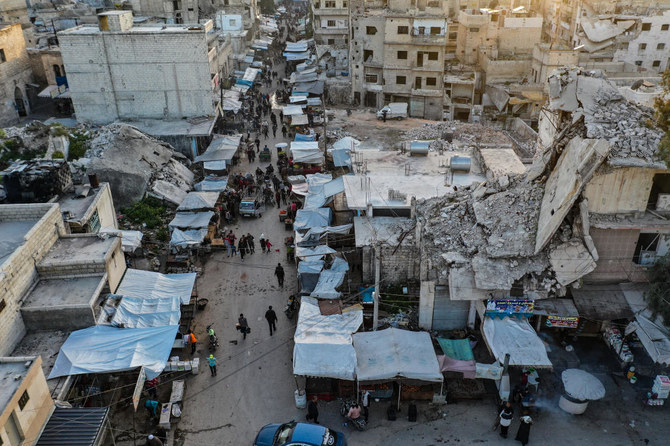
Syrians buying produce at a market ahead of iftar, the evening meal that ends the daily fast at sunset, in the war-ravaged city of Ariha in the Idlib province on the second day of Ramadan, April 15, 2021. (File/AFP)
Short Url
Updated 21 April 2021
Follow

Syria’s Idlib to get first batch of COVID-19 vaccines

  • The delivery will be the first to Syria as part of the Covax program
  • 912,000 doses have been allocated to Syria for a first phase of vaccination

BAB AL-HAWA: A first batch of COVID-19 vaccine doses was expected to arrive Wednesday in war-torn northwestern Syria, where millions of people live in dire humanitarian conditions, a UN official said.

The 53,800 doses of the AstraZeneca vaccine were dispatched to the rebel-dominated region as part of the Covax facility, which ensures the world’s poorest economies get access to jabs for free.

“Once the vaccines arrive, we are prepared to start vaccination to priority groups through our implementing partners,” said Mahmoud Daher, a senior official with the UN’s World Health Organization (WHO).

The delivery will be the first to Syria as part of the Covax program, which has already sent vaccine doses to more than 100 different territories worldwide.

The vaccine doses are intended for the extended northwestern Syrian region, which includes the jihadist-dominated Idlib enclave.

The first categories of people to be vaccinated in the coming days in the Idlib region will be medical personnel involved in the battle against the pandemic and first aid responders.

The next group will be people above the age of 60, followed by people from younger age groups with chronic diseases, said Daher, who is based in the Turkish city of Gaziantep.

Much of the Idlib enclave is controlled by Hayat Tahrir Al-Sham, a jihadist organization that includes ex-members of Syria’s former Al-Qaeda franchise.

Other regions of Syria will also receive vaccine doses through Covax, under which 92 countries are eligible.

Imad Zahran, a media officer for the Idlib region’s health department, told AFP that the vaccination campaign was expected to begin early next month and would last approximately three weeks.

According to the WHO, a separate 912,000 doses have been allocated to Syria for a first phase of vaccination in regime controlled and semi-autonomous Kurdish areas.

The aim is to vaccinate 20 percent of the population by year’s end.

Vaccination for health workers has started in government-controlled areas but not with doses received as part of the Covax program.

The official COVID-19 death toll in Syria is low compared to some other countries in the region but credible data collection across the conflict-ravaged country is almost impossible.

Syria’s war has killed more than 388,000 people since it started in 2011 with the repression of anti-government protests.


January settler attacks cause record West Bank displacement since Oct 2023: UN

Updated 8 sec ago
Follow

January settler attacks cause record West Bank displacement since Oct 2023: UN

RAMALLAH: Israeli settler violence and harassment in the occupied West Bank displaced nearly 700 Palestinians in January, the United Nations said Thursday, the highest rate since the Gaza war erupted in October 2023.
At least 694 Palestinians were forcefully driven from their homes last month, according to figures from the UN’s humanitarian agency OCHA, which compiles data from various United Nations agencies.
The UN Human Rights Office (OHCHR) said in late January that settler violence has become a key driver of forced displacement in the West Bank.
January’s displacement numbers were particularly high in part due to the displacement of an entire herding community in the Jordan Valley, Ras Ein Al-Auja, whose 130 families left after months of harassment.
“What is happening today is the complete collapse of the community as a result of the settlers’ continuous and repeated attacks, day and night, for the past two years,” Farhan Jahaleen, a Bedouin resident, told AFP at the time.
Settlers in the West Bank, which Israel has occupied since 1967, use herding to establish a presence on agricultural lands used by Palestinian communities and gradually deny them access to these areas, according to a 2025 report by Israeli NGO Peace Now.
To force Palestinians out, settlers resort to harassment, intimidation and violence, “with the backing of the Israeli government and military,” the settlement watchdog said.
“No one is putting the pressure on Israel or on the Israeli authorities to stop this and so the settlers feel it, they feel the complete impunity that they’re just free to continue to do this,” said Allegra Pacheco, director of the West Bank Protection Consortium, a group of NGOS working to support Palestinian communities against displacement.
She pointed to a lack of attention on the West Bank as another driving factor.
“All eyes are focused on Gaza when it comes to Palestine, while we have an ongoing ethnic cleansing in the West Bank and nobody’s paying attention,” she told AFP.
West Bank Palestinians are also displaced when Israel’s military destroys structures and dwellings it says are built without permits.
In January, 182 more Palestinians were displaced due to home demolitions, according to OCHA.
Excluding Israeli-annexed east Jerusalem, the West Bank is home to more than 500,000 Israelis living in settlements and outposts considered illegal under international law.
Around three million Palestinians live in the West Bank.