

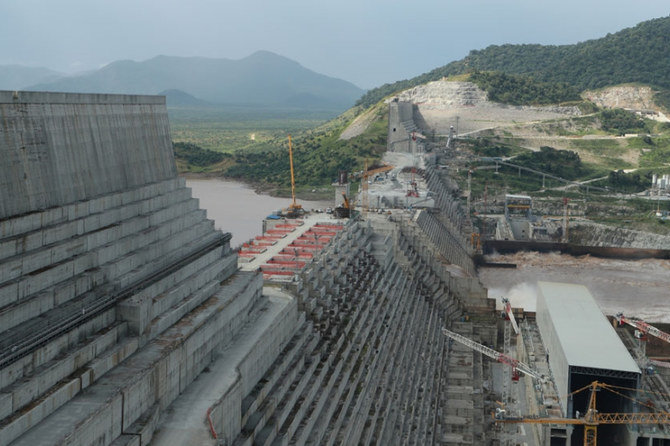
Ethiopia rejected 15 Egyptian ideas to resolve Nile dam dispute: Water minister

The Grand Ethiopian Renaissance Dam (GERD) on the Blue Nile. (Reuters)
Short Url
Updated 19 April 2021
Follow

Ethiopia rejected 15 Egyptian ideas to resolve Nile dam dispute: Water minister

  • Egyptian Foreign Minister Sameh Shoukry highlights project developments on African tour as Addis Ababa accused of ‘intransigence’
  • Minister of Water Mohammed Abdel-Ati said that Egypt had presented 15 scenarios for filling and operating the dam in a way that met with Ethiopian requirements

CAIRO: Ethiopia had rejected 15 different ideas put forward by Egypt to help resolve a bitter row over the development of a highly controversial Nile dam project, a senior minister has revealed.

Egyptian Minister of Water Resources and Irrigation Mohammed Abdel-Ati said Addis Ababa had poured cold water on all of Cairo’s suggestions to reach agreement about water rights and other issues related to the Grand Ethiopian Renaissance Dam (GERD) scheme.

His claims came as Egyptian Foreign Minister Sameh Shoukry embarked on a tour of African countries to highlight Egypt’s position regarding the latest developments in the GERD negotiations.

During his trip – taking in Comoros, South Africa, the Democratic Republic of the Congo, Senegal, Kenya, and Tunisia – Shoukry delivered letters from Egyptian President Abdel Fattah El-Sisi to the leaders of the countries explaining Cairo’s stance on the matter.

Ahmed Hafez, a spokesman for the Egyptian Foreign Ministry, said the tour was aimed at reviving talks and supporting the process of reaching a binding legal agreement between Egypt, Sudan, and Ethiopia on issues such as the filling and operation of the dam.

Addressing a meeting of the Egyptian Senate’s defense and national security committee, Abdel-Ati said Cairo had shown great flexibility during its discussions with Ethiopia.

He pointed out that most of Egypt’s estimated annual 60 billion cubic meters of water resources came from the Nile, with limited quantities of rainwater and deep groundwater from the deserts.

“The total water needs in Egypt reach about 114 billion cubic meters annually,” he added.

The supply gap was compensated for through the reuse of agricultural drainage water and surface groundwater in the Nile valley and delta, in addition to importing food products from abroad corresponding to 34 billion cubic meters of water annually, he said.

Abdel-Ati blamed the failure in negotiations on Ethiopian “intransigence” and “unilateral measures” taken by Addis Ababa.

“Egypt has already signed the initials of the Washington agreement, which confirms Egypt’s clear desire to reach a deal,” the minister added.

He noted that Egypt had presented 15 scenarios for filling and operating the dam in a way that met with Ethiopian requirements and prevented tangible harm to the two downstream countries, but Ethiopia had dismissed the proposals.

The volume of rainwater in Ethiopia amounted to more than 935 billion cubic meters per year, and 94 percent of its land was green compared to 6 percent in Egypt, Abdel-Ati said.

He added that Ethiopia had more than 100 million livestock animals that consumed 84 billion cubic meters of water annually, which was equal to the combined water share of Egypt and Sudan, and its share of blue water (running water in the river) was about 150 billion cubic meters every year.

Ethiopia, he said, also withdrew water from Lake Tana for agricultural uses.


Gaza’s Nasser Hospital condemns move by MSF to suspend most services

Updated 16 sec ago
Follow

Gaza’s Nasser Hospital condemns move by MSF to suspend most services

  • On Saturday, MSF said the security breaches, arrests and intimidation put staff and patients at serious risk
  • Nasser Hospital rejects the claims, and says civilian police are inside to protect patients and staff
CAIRO: One of Gaza’s last functioning large hospitals condemned the move by an international organization to pull out of operations over concerns about armed men, claiming on Sunday that the hospital had installed civil police for security. The move comes as at least 10 Palestinians were killed in clashes with the Israeli military in Gaza.
Doctors Without Borders, also known by its acronym MSF, said in a statement Saturday that all its noncritical medical operations at Nasser Hospital were suspended due to security breaches that posed “serious” threats to its teams and patients. MSF said there had been an increase in patients and staff seeing armed men in parts of the compound since the US-brokered October ceasefire was reached.
Nasser Hospital said Sunday that the increase in armed men was due to a civilian police presence aimed at protecting patients and staff and said MSF’s “allegations are factually incorrect, irresponsible, and pose a serious risk to a protected civilian medical facility.”
Nasser Hospital one of few functioning hospitals left in Gaza
Nasser Hospital in Khan Younis is one of the territory’s few functioning hospitals. Hundreds of patients and war-wounded have been treated there daily, and the facility was a hub for Palestinian prisoners released by Israel in exchange for Israeli hostages as part of the current ceasefire deal.
“MSF teams have reported a pattern of unacceptable acts including the presence of armed men, intimidation, arbitrary arrests of patients and a recent situation of suspicion of movement of weapons,” the organization said. The suspension occurred in January but was only recently announced.
Nasser Hospital staff say that in recent months it has been repeatedly attacked by masked, armed men and militias, which is why the presence of an armed civilian police force is crucial. Hamas remains the dominant force in areas not under Israeli control, including in the area where Nasser Hospital is located. But other armed groups have mushroomed across Gaza as a result of the war, including groups backed by Israel’s army in the Israeli-controlled part of the strip.
Throughout the war, which began with the Hamas-led attack on Israel on Oct. 7, 2023, Israel has repeatedly struck hospitals, including Nasser, accusing the militant group of operating in or around them. Hamas security men often have been seen inside hospitals, blocking access to some areas.
Some hostages released from Gaza have said they spent time during captivity in a hospital, including Nasser Hospital.
Ten Palestinians killed in strikes across Gaza
At least 10 Palestinians were killed Sunday by Israeli fire in the Gaza Strip, hospital authorities said.
The dead include five men, all in their 20s, who were killed in an Israeli strike in the eastern part of Khan Younis city, according to the Nasser Hospital, which received the bodies. The strike hit a group of people in an area close to the Yellow Line which separates Israeli-controlled areas from the rest of Gaza, it said.
The Israeli military did not comment on the strike but has said in the past it will attack militants if its troops are threatened, especially near the Yellow Line.
Rami Shaqra said his son, Al-Baraa, was among the militants who were securing the area from potential attacks by the Israeli forces or Israeli-backed armed groups, when they were hit by the Israeli military. He said that they were killed by an airstrike.
Associated Press footage from the morgue showed at least two of the men had headbands denoting membership in the Qassam Brigades, the militant arm of Hamas. In northern Gaza, a drone strike hit a group of people in the Falluja area of Jabaliya refugee camp, killing five people, according to the Shifa Hospital.
The Israeli military said it was striking northern Gaza in response to several ceasefire violations near the Yellow Line, including militants attempting to hide in debris and others who attempted to cross the line while armed.
The Oct. 10 US-brokered ceasefire deal attempted to halt a more than two-year war between Israel and Hamas. While the heaviest fighting has subsided, the ceasefire has seen almost daily Israeli fire.
Israeli forces have carried out repeated airstrikes and frequently fire on Palestinians near military-held zones, killing 601 Palestinians, according to Gaza health officials. The ministry, which is part of the Hamas-led government, maintains detailed casualty records that are seen as generally reliable by UN agencies and independent experts. But it does not give a breakdown of civilians and militants.
Militants have carried out shooting attacks on troops, and Israel says its strikes are in response to that and other violations. Four Israeli soldiers have been killed.