

Egypt’s non-oil exports rise to $7.4bn in Q1 2021

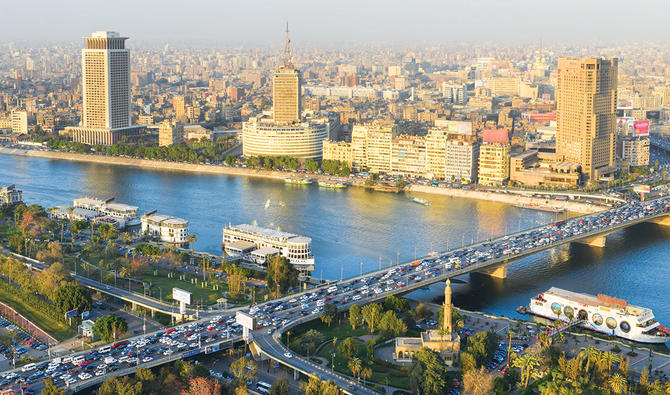
Egyptian imports saw a slight increase in the first quarter of 2021 to $16.9 billion, compared to $16.67 billion in the same period last year. (Reuters/File)
Short Url
Updated 19 April 2021
Follow

Egypt’s non-oil exports rise to $7.4bn in Q1 2021

  • Trade deficit also decreased by 1 percent to $9.5 billion in the same period

CAIRO: Egypt’s non-oil exports rose 7.2 percent in the first quarter of 2021 compared to the same period last year, reaching $7.4 billion, said Trade and Industry Minister Nevin Jameh.

“This tangible increase came despite the current circumstances related to the coronavirus crisis that the whole world is suffering from, thanks to the efforts made by the government to support the production and export sectors during the crisis,” she added.

Egyptian imports saw a slight increase in the first quarter of 2021 to $16.9 billion, compared to $16.67 billion in the same period last year.

Jameh said these positive indicators contributed to achieving a 1 percent decrease in the trade balance deficit to $9.5 billion, compared to $9.6 billion in the same period last year.

Ismail Jaber, head of the General Organization for Export and Import Control, said the chemical products and fertilizer sectors dominated Egypt’s export list in the first quarter of 2021.

Exports of chemical products and fertilizers amounted to $1.5 billion, building materials $1.3 billion, food industries $965 million, and engineering and electronic goods $739 million.

FASTFACTS

• Chemical products and fertilizer sectors dominated Egypt’s export list in the first quarter of 2021.

• Egypt’s top export destinations were China ($3.1 billion), the US ($1.49 billion), Germany ($970 million), Russia ($855 million) and Italy ($689 million).

• These five countries accounted for 42.1 percent of Egyptian imports.

Jaber said Egypt’s top export destinations were China ($3.1 billion), the US ($1.49 billion), Germany ($970 million), Russia ($855 million) and Italy ($689 million). These five countries, he added, accounted for 42.1 percent of Egyptian imports.

Egypt is expecting economic growth of 5.4 percent in the next fiscal year 2021/2022, up from 3.3 percent expected in 2020/2021.

The country recently approved its budget, which aims to reduce the country’s deficit and focuses on pushing social protection efforts, improving citizens’ standard of living, increasing wage allocations and rewards for workers, and financing grant incentives and transportation allowances for workers transferred to the New Administrative Capital.

The proceeds of budget revenues are likely to reach about EGP1.3 trillion  ($80 billion), according to estimates for the next fiscal year 2020/2021, compared to expected revenues of EGP1.117 trillion during the current fiscal year.

The estimates reflect an annual growth in revenues of 16.4 percent, achieved by expanding the tax base, activating electronic payments, expanding the use of modern methods of risk management, collecting government revenues and working to increase linking the proceeds to economic activity.


Global investors commit more than $3bn to King Salman Park as Saudi giga-project secures new deals

Updated 10 March 2026
Follow

Global investors commit more than $3bn to King Salman Park as Saudi giga-project secures new deals

RIYADH: The King Salman Park Foundation has secured more than $3.8 billion in new private-sector commitments at the MIPIM 2026 real estate conference, including a landmark $3 billion fund backed by international investors to develop a major mixed-use district in the heart of Riyadh.

According to a press release, the announcements bring total committed investment in the 17.2 sq. kilometers urban regeneration project to over $5.3 billion across five major packages.

Launched in 2019 under Saudi Vision 2030, the development is designed to be the world’s largest city park and aims to boost green space, improve quality of life, and feature over 1 million trees and extensive leisure facilities.

A $3 billion metro-connected district

The largest of the two packages, designated Package 5, will see a consortium led by Kolaghassi Development Co. deliver a residential-led district with a total built-up area exceeding 1 million sq. meters. 

It will provide approximately 3,700 residential units, a K–12 school, around 300 hospitality keys and more than 100,000 sq m of Grade A office space alongside a wide variety of retail and dining offerings.

The development is supported by a Saudi-domiciled, Capital Market Authority-regulated fund managed by Mulkia Investment Co. that has attracted leading investors from the Kingdom and across the world.

Kolaghassi Development Co. will lead the project alongside Al Othaim Investment, one of the Kingdom’s real estate players, and RXR, a New York-headquartered real estate investor and operator.

“Securing investment of this scale, supported by international capital and expertise, is an important milestone for King Salman Park,” said George Tanasijevich, CEO of King Salman Park Foundation. 

$850 million cultural district package

In a separate announcement, the Foundation confirmed the award of Package 4 to a consortium led by Retal Urban Development Co., with support from a fund managed by SAB Invest.

The project has a total value exceeding $850 million and will host more than 600 residential units, over 140 hotel keys, and almost 50,000 sq m of Grade A office space, alongside curated retail and food and beverage experiences.

“This opportunity reflects the maturity of Saudi Arabia’s real estate investment landscape and our confidence in culture-led, mixed-use urban destinations as a driver of sustainable returns,” said Abdullah Al-Braikan, CEO and founder of Retal Urban Development Co.

Ali Al-Mansour, CEO of SAB Invest, said the fund structure brings together “long-term capital, experienced development partners, and a shared commitment to place-making excellence” while contributing to Riyadh’s cultural vibrancy and the Kingdom’s quality-of-life ambitions under Vision 2030.