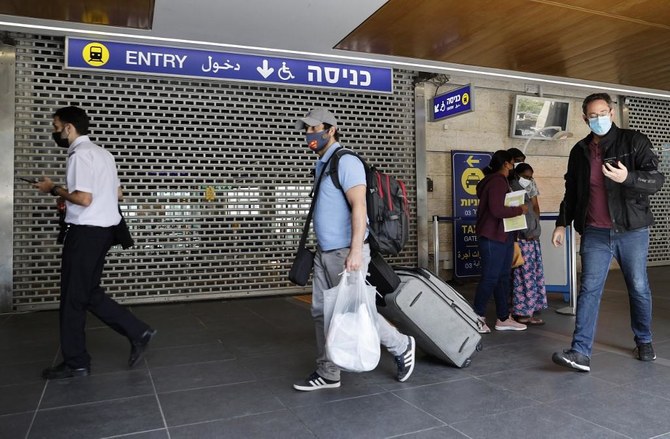
Israel rescinds outdoor coronavirus mask requirement

With almost 54 percent of its 9.3 million population having received COVID-19 vaccine, Israel has logged sharp drops in contagion and cases. (AFP)
Short Url
Updated 18 April 2021
Follow

Israel rescinds outdoor coronavirus mask requirement

  • Police-enforced wearing of protective masks outdoors scrapped from Sunday
  • But requirement still applied for indoor public spaces

JERUSALEM: Israel rescinded the mandatory wearing of face masks outdoors and fully reopened schools on Sunday in the latest return to relative normality, boosted by a mass-vaccination campaign against the COVID-19 pandemic.
With almost 54 percent of its 9.3 million population having received both shots of the Pfizer/BioNTech COVID-19 vaccine, Israel has logged sharp drops in contagion and cases.
The police-enforced wearing of protective masks outdoors, ordered a year ago, was scrapped from Sunday, but the Health Ministry said the requirement still applied for indoor public spaces and urged citizens to keep masks to hand.
With Israeli kindergarteners, elementary and high school students already back in class, middle school pupils who had been kept at home or attended class sporadically returned to pre-pandemic schedules.
The education ministry said that schools should continue to encourage personal hygiene, ventilation of classrooms and to maintain social distancing as much distance as possible during breaks and lessons.
Israel counts East Jerusalem Palestinians among its population and has been administering the vaccines there.
The 5.2 million Palestinians in the occupied West Bank and the Islamist Hamas-controlled Gaza Strip have been receiving limited supplies of vaccines provided by Israel, Russia, the United Arab Emirates, the global COVAX vaccine-sharing scheme and China.


Second US aircraft carrier is being sent to the Middle East, AP source says

Updated 57 min 57 sec ago
Follow

Second US aircraft carrier is being sent to the Middle East, AP source says

  • Move by the USS Gerald R. Ford, first reported by The New York Times, will put two carriers and their accompanying warships in the region
  • Trump told Axios earlier this week that he was considering sending a second carrier strike group to the Middle East

WASHINGTON: The world’s largest aircraft carrier has been ordered to sail from the Caribbean Sea to the Middle East, a person familiar with the plans said Thursday, as US President Donald Trump considers whether to take possible military action against Iran.
The move by the USS Gerald R. Ford, first reported by The New York Times, will put two carriers and their accompanying warships in the region as Trump increases pressure on Iran to make a deal over its nuclear program. The person spoke on condition of anonymity to discuss military movements.
The USS Abraham Lincoln aircraft carrier and three guided-missile destroyers arrived in the Middle East more than two weeks ago.
It marks a quick turnaround for the USS Ford, which Trump sent from the Mediterranean Sea to the Caribbean last October as the administration build up a huge military presence in the leadup to the surprise raid last month that captured then-Venezuelan President Nicolas Maduro.
It also appears to be at odds with Trump’s national security strategy, which put an emphasis on the Western Hemisphere over other parts of the world.
Trump on Thursday warned Iran that failure to reach a deal with his administration would be “very traumatic.” Iran and the United States held indirect talks in Oman last week.
“I guess over the next month, something like that,” Trump said in response to a question about his timeline for striking a deal with Iran on its nuclear program. “It should happen quickly. They should agree very quickly.”
Trump told Axios earlier this week that he was considering sending a second carrier strike group to the Middle East.
Trump held lengthy talks with Israeli Prime Minister Benjamin Netanyahu on Wednesday and said he insisted to Israel’s leader that negotiations with Iran needed to continue. Netanyahu is urging the administration to press Tehran to scale back its ballistic missile program and end its support for militant groups such as Hamas and Hezbollah as part of any deal.
The USS Ford set out on deployment in late June 2025, which means the crew will have been deployed for eight months in two weeks time. While it is unclear how long the ship will remain in the Middle East, the move sets the crew up for an usually long deployment.
The White House didn’t immediately respond to a request for comment.