

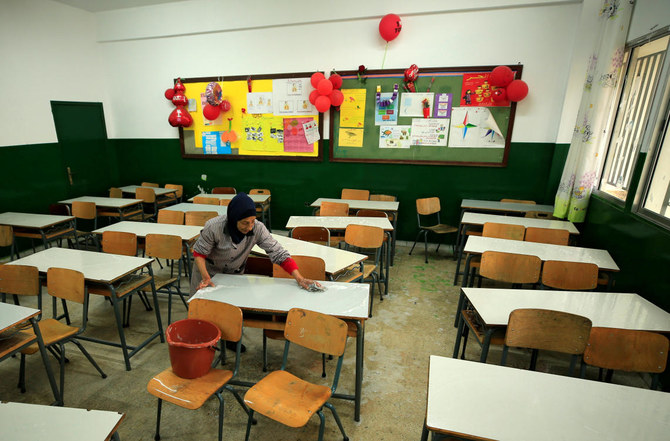

BEIRUT: The Lebanese Education Ministry has decided to reopen all schools for blended learning as of April 21, after closing for more than three months.
Minister of Education Tarek Majzoub said the move to return to blended learning is related to the rate of vaccination among teachers.
But the head of the Lebanese Doctors’ Syndicate Sharaf Abu Sharaf warned that since the vaccination process started in February, it has covered only “5 percent of the Lebanese, with 10,000 persons working in the health sector who have still not received the vaccine.”
Majzoub said: “The education in Lebanon is in danger, especially the good education that used to be equally provided for poor, middle, and rich classes
“The harsh economic conditions have affected everyone. Therefore, we must cooperate to save the academic year. We have nothing left in Lebanon but education, and our goal as a ministry is to save this academic year.”
The ministry has announced the schedule for the official exams, which will be taken in person. The Grade 12 Baccalaureate exams will take place on July 26, and the required curriculum will be reduced. The exams, according to the minister, will not be “formal,” but “the difficulty level will be studied.”
The government canceled the official exams last year, instead granting certificates to students in line with their grades in school and from online learning.
The Grade 9 Brevet exams will be replaced by school tests, which will be prepared and controlled by the ministry. The exams will take place on July 12.
Schools in Lebanon have relied on online learning since the beginning of the year. A surge in coronavirus disease (COVID-19) cases in schools following the holidays brought about their closing. Some private schools and universities violated closures by imposing attendance, while abiding by COVID-19 precautionary measures.
Abu Sharaf, who is also a pediatrician, said that “closing educational institutions has increased psychological problems among students, such as stress, introversion, social media addiction, obesity, and domestic violence. Western reports have even shown an increase in the suicide rate, in addition to a significant fall in the intellectual development of students, especially those under the age of 10.”
The decision to return students to schools excludes those with health issues, who can continue learning remotely. However, the return does not exclude students with special needs, those who have learning disabilities, or public schools’ students enrolled in the afternoon shift, such as Syrian refugees.
The return to schools has been taken during a crippling financial and economic crisis in Lebanon that has further deteriorated during the education shutdown.
A draft law proposed in July 2020 to allocate 500 million Lebanese pounds ($327 million) to support the education sector is still awaiting approval by parliament.
Majzoub said: “The country is going through a very delicate and exceptional situation, both on the health and economic levels. It is very easy for us to stop the whole education process and grant students pass certificates instead of going through the whole examination process, but this is not the ministry’s mission.”
He added: “A total of 17,000 vaccines have been secured for the teaching staff, to cover high school teachers in the first phase. The World Bank has supported us to become a priority in vaccinations, as well as UNICEF, the World Health Organization, and the Lebanese Red Cross.
“However, the committee following up on the COVID-19 preventive measures said that not receiving the vaccine does not mean we cannot resume classes, in line with the preventive and precautionary measures.”
The ministry has introduced a new operation room to follow-up on news regarding blended education. It will work in cooperation with the Red Cross around the clock.
Majzoub’s decision has angered some parents and teachers, who accused him on social media of being “oblivious to the people’s situation and the impacts of his decision.”
Teachers expressed fears over “being unprotected” and expressed concern over “receiving AstraZeneca, the vaccine that has been allocated for them, due to reports about the possibility of the vaccine causing blood clots.”
Complaints against the minister’s decision were also made by some parents who said they are no longer capable of providing transport fees for their children to and from school, and others who said they cannot even give their children money to buy lunch at school.
Due to the worsening economic collapse, more than 50 percent of the Lebanese and 97 percent of Palestinian and Syrian refugees now live under the poverty line.
Jennifer Moorehead, director of Save the Children Lebanon, warned on April 1 that “the education for thousands of children in Lebanon is hanging by a thread.”
She added: “Many of them might never come back to school, either because they have missed so much learning already or because their families cannot afford to send them to school.”
According to the NGO: “Children not enrolled in schools are at a higher risk of falling victim to child labor, child marriage, and other forms of abuse and exploitation.”


