

In a first for Pakistan, climbers from Gilgit-Baltistan scale Nepal's Annapurna mountain

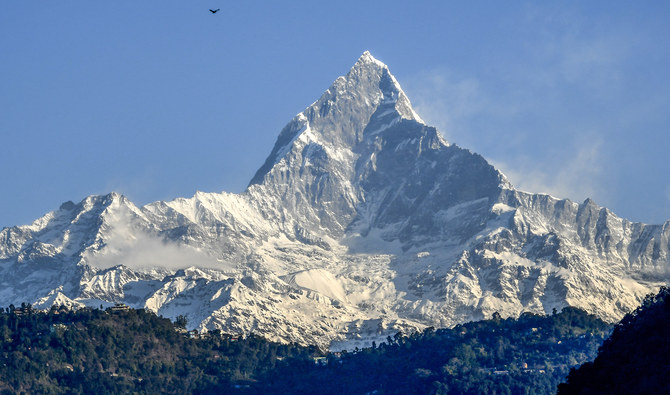
A great cormorant flies above the Mount Machhapuchhre, center, and Annapurna mountain range, in Pokhara, some 200 kms west of Kathmandu on January on 22, 2020. (AFP/File)
Short Url
Updated 16 April 2021
Follow

In a first for Pakistan, climbers from Gilgit-Baltistan scale Nepal's Annapurna mountain

  • More than 8,000 meters tall, Annapurna is considered to be a tough climb and has claimed the lives of over 60 mountaineers
  • The Pakistani climbers, Sirbaz Khan and Abdul Joshi, dedicated their expedition to Muhammad Ali Sadpara

KHAPLU: A two-member team of climbers from Gilgit-Baltistan became the first from Pakistan to summit the world's 10th tallest peak on Friday along with more than a dozen mountaineers from Nepal, China and the United States.

More than 8,000 meters high, Mount Annapurna in Nepal is widely considered to be a tough climb and has claimed over 60 lives of those striving to make an ascent.

The Pakistani climbers, Sirbaz Khan and Abdul Joshi, belong to Hunza district and were accompanied by two other supporting members, Kamran Ali and Saad Munawar, from Gilgit-Baltistan.

In a social media post, Munawar announced that Khan and Joshi had reached the top of the mountain "at 1:30 pm on 16th April 2021."

"This is Pakistan's first ever summit of Mt Annapurna," he wrote in a social media post. "This is not the success of 2 climbers only but the whole Pakistani mountaineering community. Time has come for [our] unsung heroes to get the respect, recognition, and appreciation that they deserve."

Last month, Sirbaz Khan dedicated his forthcoming expedition to Muhammad Ali Sadpara who lost his life while trying to scale the world's second tallest mountain in winter earlier this year.

"For the last few years, we had been working together with Ali bhai for the welfare of Pakistani mountaineering community," Khan wrote on his Facebook timeline while announcing the Annapurna expedition on March 7. "He might not be physically present anymore but in my heart he is always going to be alive — singing, laughing and dancing."

Seven Summit Treks Manager Thaneswar Guraga confirmed the news from Nepal over the phone.

"Two Pakistani climbers Sirbaz Khan and Abdul Joshi with other climbers have summited Mount Annapurna," he said.

"On behalf of the Alpine Club of Pakistan, its president, executive board, and members, I congratulate the climbing team of Sirbaz Khan and Abdul Joshi on the first successful Pakistani ascent of the 10th highest and most difficult peak Annapurna 8,091-M," said Alpine Club Secretary Karrar Haidri in a statement. "It is an outstanding achievement, and we all are very proud of you."


Pakistan’s Mahnoor Omer named among TIME’s ‘Women of the Year’ for 2026

Updated 56 min 18 sec ago
Follow

Pakistan’s Mahnoor Omer named among TIME’s ‘Women of the Year’ for 2026

  • Omer moved a Pakistani court against the so-called ‘period tax’ in Sept. 2025 which has since sparked a national debate
  • Taxes on sanitary pads in Pakistan can add up to 40 percent to retail price, UNICEF says only around 12 percent women use such products

ISLAMABAD: Pakistani women’s rights activist Mahnoor Omer, who fought against taxes on menstrual products, has been named among the TIME magazine’s ‘Women of the Year’ for 2026.

Omer’s efforts have been recognized alongside 16 activists, artists, athletes and businesswomen in the TIME’s Women of the Year 2026 list, including Olympic gold medalist Sydney McLaughlin-Levrone and Oscar-nominated filmmaker Chloe Zhao.

Dissatisfied with the efforts to educate Pakistani girls about sexual violence, Omer founded the Noor Foundation at the age of 14 and held her own workshops with village girls about everything from climate change to menstruation, according to the TIME magazine.

Two years later, a conversation with a domestic worker about the price of pads made her realize that not everyone could afford these essentials. She moved a court against the so-called “period tax” in Sept. 2025 and the case has sparked a national debate on the subject, considered a taboo by many in Pakistan, since its first hearing late last year.

“A decade and one law degree after her interest in activism was sparked, Omer, now 25, is putting her passion and expertise to work in the name of gender equity,” TIME wrote about Omer on its website.

Taxes imposed on sanitary products in Pakistan can add up to 40 percent to the retail price. UNICEF estimates just 12 percent of women in the country use commercially produced pads or tampons. The alternative, using cloth, risks health impacts including rashes and infections, and can make it impossible for girls to attend school while menstruating.

Omer’s suit, which awaits the government response, has sparked a national discussion. She says she spoke about menstruation to her father and male cousins, who thanked her for standing up for their daughters.
The 25-year-old, who is currently enrolled in a master’s degree in gender, peace, and security at the London School of Economics, sees this case as just the first of many.

“I’m not free until every woman is free,” she was quoted as saying by TIME. “I want to leave no stones unturned in terms of what I can do with the next few decades, as a lawyer for the women in my country and gender minorities in general.”