WASHINGTON: The United States announced economic sanctions against Russia on Thursday and the expulsion of 10 diplomats in retaliation for what Washington says is the Kremlin's US election interference, a massive cyber attack and other hostile activity.
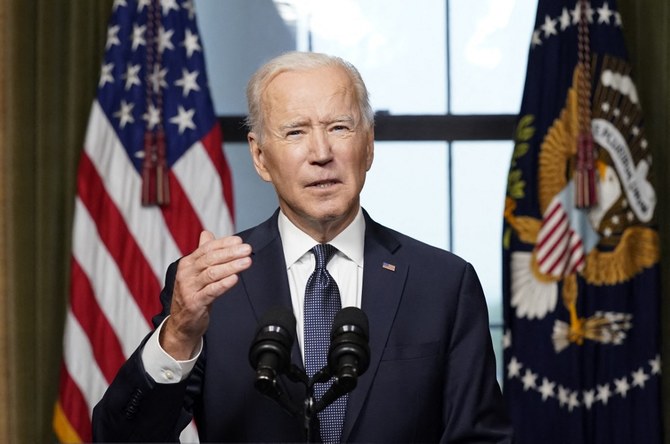
President Joe Biden ordered a widening of restrictions on US banks trading in Russian government debt, expelled 10 diplomats who include alleged spies, and sanctioned 32 individuals alleged to have tried to meddle in the 2020 presidential election, the White House said.
Biden's executive order "sends a signal that the United States will impose costs in a strategic and economically impactful manner on Russia if it continues or escalates its destabilizing international action," the White House said in a statement.
The statement listed in first place Moscow's "efforts to undermine the conduct of free and fair democratic elections and democratic institutions in the United States and its allies and partners."
This referred to allegations that Russian intelligence agencies mounted persistent disinformation and dirty tricks campaigns during the 2016 and 2020 presidential elections, in part to help Donald Trump's candidacy.
The White House said the sanctions also respond to "malicious cyber activities against the United States and its allies and partners," referring to the massive so-called SolarWinds hack of US government computer systems last year.
The statement also called out Russia's extraterritorial "targeting" of dissidents and journalists and undermining of security in countries important to US national security.
In addition, the Department of Treasury, together with the European Union, Australia, Britain and Canada, sanctioned eight individuals and entities associated with Russia's occupation of Crimea in Ukraine.
In Brussels, the NATO military alliance said US allies "support and stand in solidarity with the United States, following its 15 April announcement of actions to respond to Russia's destabilizing activities."

US imposes sanctions on Moscow, expels 10 Russian diplomats
https://arab.news/45n49
US imposes sanctions on Moscow, expels 10 Russian diplomats
- The White House said the sanctions also respond to "malicious cyber activities against the United States and its allies and partners"
- In Brussels, the NATO military alliance said US allies "support and stand in solidarity with the United States”
Britain needs ‘AI stress tests’ for financial services, lawmakers say
- Lawmakers urge AI-specific stress tests for financial firms
LONDON: Britain’s financial watchdogs are not doing enough to stop artificial intelligence from harming consumers or destabilising markets, a cross-party group of lawmakers said on Tuesday, urging regulators to move away from what it called a “wait and see” approach.
In a report on AI in financial services, the Treasury Committee said the Financial Conduct Authority and the Bank of England should start running AI-specific stress tests to help firms prepare for market shocks triggered by automated systems.
The committee also called on the FCA to publish detailed guidance by the end of 2026 on how consumer protection rules apply to AI, and on the extent to which senior managers should be expected to understand the systems they oversee.
“Based on the evidence I’ve seen, I do not feel confident that our financial system is prepared if there was a major AI-related incident and that is worrying,” committee chair Meg Hillier said in a statement.
TECHNOLOGY CARRIES ‘SIGNIFICANT RISKS’
A race among banks to adopt agentic AI, which unlike generative AI can make decisions and take autonomous action, runs new risks for retail customers, the FCA told Reuters late last year.
About three-quarters of UK financial firms now use AI. Companies are deploying the technology across core functions, from processing insurance claims to performing credit assessments.
While the report acknowledged the benefits of AI, it warned the technology also carried “significant risks” including opaque credit decisions, the potential exclusion of vulnerable consumers through algorithmic tailoring, fraud, and the spread of unregulated financial advice through AI chatbots.
Experts contributing to the report also highlighted threats to financial stability, pointing to the reliance on a small group of US tech giants for AI and cloud services. Some also noted that AI-driven trading systems may amplify herding behavior in markets, risking a financial crisis in a worst-case scenario.
An FCA spokesperson said the regulator welcomed the focus on AI and would review the report. The regulator has previously indicated it does not favor AI-specific rules due to the pace of technological change.
The BoE did not respond to a request for comment.
Hillier told Reuters that increasingly sophisticated forms of generative AI were influencing financial decisions. “If something has gone wrong in the system, that could have a very big impact on the consumer,” she said.
Separately, Britain’s finance ministry appointed Starling Bank CIO Harriet Rees and Lloyds Banking Group ‘s Rohit Dhawan as “AI Champions” to help steer AI adoption in financial services.


