

Protests across major Pakistani cities after religious party chief arrested in Lahore

Police use tear gas to disperse supporters of Tehreek-e-Labbaik Pakistan (TLP) during a protest in Lahore on April 12, 2021, after the arrest of their leader, who has called for the expulsion of the French ambassador. (AFP)
Short Url
Updated 13 April 2021
Follow

Protests across major Pakistani cities after religious party chief arrested in Lahore

  • Saad Rizvi has threatened government with protests if it does not expel France’s ambassador over cartoons of Prophet Muhammad (PBUH)
  • Rizvi has called on the government to honor what he says was a commitment made in February to expel the French envoy before April 20

ISLAMABAD: Protests erupted in major Pakistani cities, causing massive traffic snarls, while main intercity highways remained blocked as police arrested the leader of a religious political party, the Tehreek-e-Labaik Pakistan (TLP), on Monday, a day after he threatened the government with protests if it did not expel France’s envoy to Islamabad over caricatures of Prophet Muhammad (peace be upon him).

Saad Rizvi was arrested in the eastern city of Lahore to “maintain law and order,” Ghulam Mohammad Dogar, chief of Lahore police, told AP.
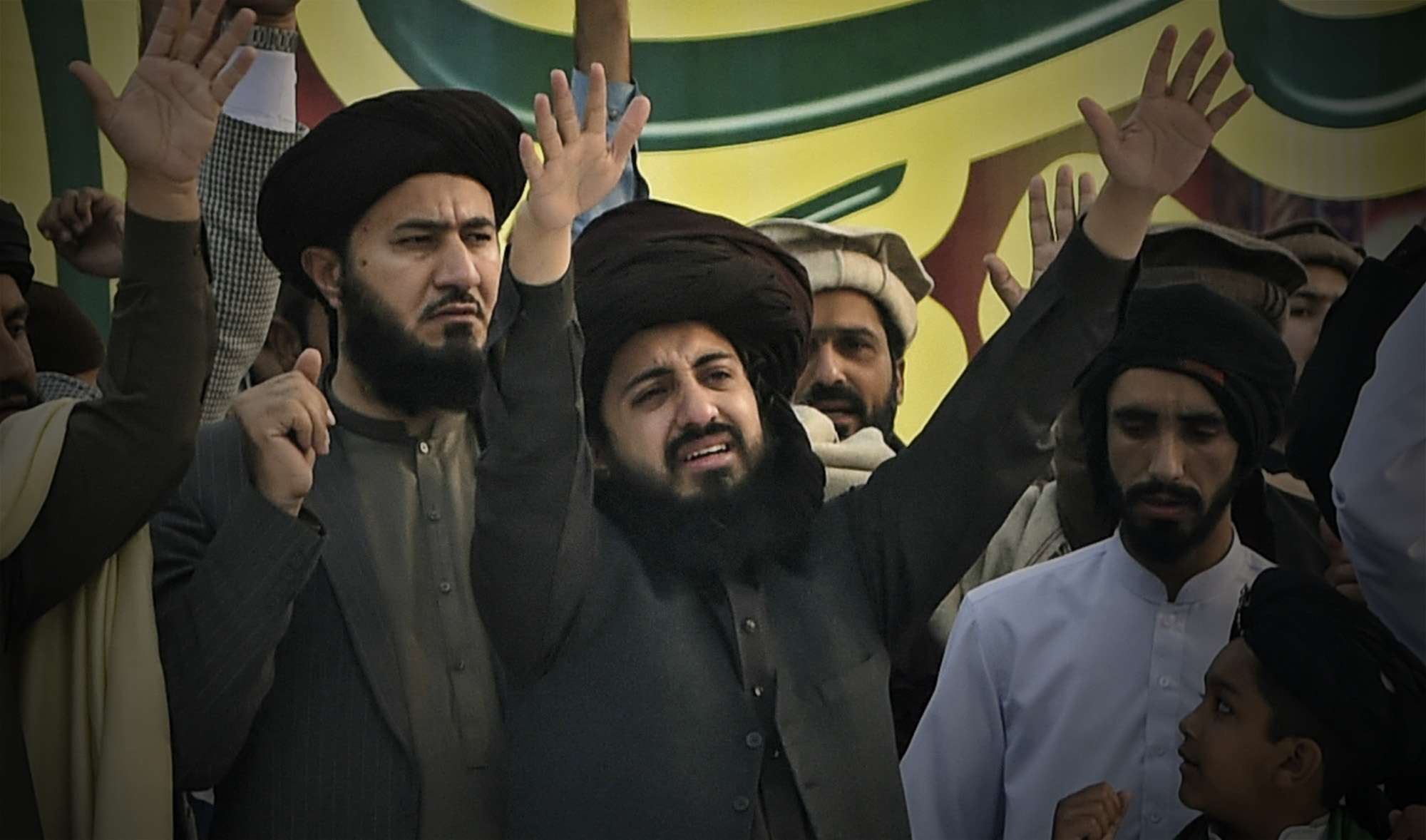


Hafiz Saad Hussain Rizvi, center, son of late Khadim Hussain Rizvi, founder of Tehreek-e-Labbaik party, gestures with party leaders during a gathering in Lahore on January 3, 2021. (AFP/File)

Rizvi called on the government to honor what he said was a commitment it made in February to his party to expel the French envoy before April 20 over the publication in France of depictions of the Prophet (pbuh).

The government of Prime Minister Imran Khan says it had only committed to debating the matter in Parliament.

“Protests broke out at numerous places in Karachi and other major cities following the development,” Pakistan’s Dawn newspaper reported.
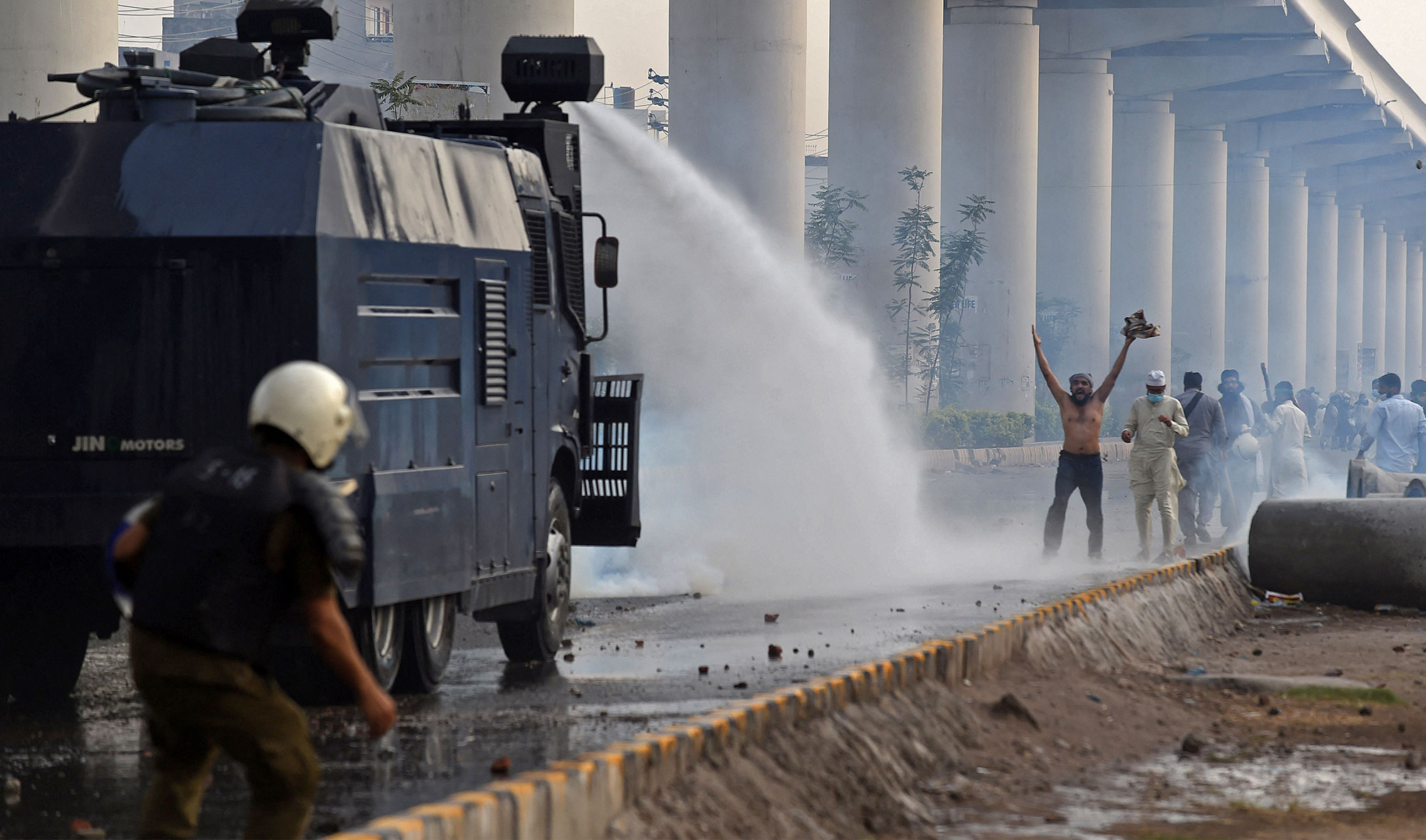


Police use water cannon to disperse supporters of Tehreek-e-Labbaik Pakistan (TLP) during a protest in Lahore on April 12, 2021, after the arrest of their leader, who has called for the expulsion of the French ambassador. (AFP)

In a video message, another TLP leader, Syed Zaheerul Hassan Shah, called on supporters to come out in the streets in protest, saying the government had "completely deviated from" the agreement it had reached with the TLP.

“Carry out protest demonstrations on roads and wherever you are, jam the entire country," Shah said. 

Rizvi became the leader of the Tehreek-e-Labiak Pakistan party in November after the sudden death of his father, Khadim Hussein Rizvi. 

Rizvi’s party wants the government to boycott French products and expel the French ambassador under an agreement signed by the government with Rizvi’s party in February.

Tehreek-e-Labiak and other religious parties denounced French President Emmanuel Macron since October last year, saying he tried to defend caricatures of the Prophet Muhammad (pbuh) as freedom of expression. Macron’s comments came after a young Muslim beheaded a French school teacher who had shown caricatures of the Prophet Muhammad (pbuh) in class. The images had been republished by the satirical magazine Charlie Hebdo to mark the opening of the trial over the deadly 2015 attack against the publication for the original caricatures. That enraged many Muslims in Pakistan and elsewhere who believe those depictions are blasphemous.

Rizvi’s party gained prominence in Pakistan’s 2018 federal elections, campaigning to defend the country’s blasphemy law, which calls for the death penalty for anyone who insults Islam.

It also has a history of staging protests and sit-ins to pressure the government to accept its demands.

In November 2017, Rizvi’s followers staged a 21-day protest and sit-in after a reference to the sanctity of the Prophet Muhammad (pbuh) was removed from the text of a government form.


Pakistan joins 22 Muslim states, OIC to condemn Israeli FM’s visit to Somaliland

Updated 5 sec ago
Follow

Pakistan joins 22 Muslim states, OIC to condemn Israeli FM’s visit to Somaliland

  • Israeli Foreign Minister Gideon Saar visited breakaway African region of Somaliland on January 6
  • Muslim states urge Israel to withdraw Somaliland recognition, respect Somalia’s sovereignty

ISLAMABAD: A joint statement by Pakistan, 22 other Muslim states and the Organization of Islamic Cooperation (OIC) on Thursday condemned Israeli Foreign Minister Gideon Saar’s recent visit to Somaliland as a violation of the African nation’s territorial integrity and sovereignty.

Saar’s visit to Somaliland capital Hargeisa on Jan. 6 followed Israel’s move last month to recognize Somaliland, a breakaway region from Somalia, as an independent country. The move drew a sharp reaction from Muslim states, including Pakistan, who said it was in contravention of the UN Charter and international norms. 

Several international news outlets months earlier reported that Israel had contacted Somaliland over the potential resettlement of Palestinians forcibly removed from Gaza. Muslim countries fear Israel’s recognition of the breakaway region could be part of its plan to forcibly relocate Palestinians from Gaza to the region. 

“The said visit constitutes a clear violation of the sovereignty and territorial integrity of the Federal Republic of Somalia, and undermines established international norms and the United Nations Charter,” the joint statement shared by Pakistan’s foreign office, read. 

The joint statement was issued on behalf of 23 Muslim states, including Saudi Arabia, Bangladesh, Pakistan, Egypt, Iraq, Iran, Palestine, Jordan, Kuwait, Türkiye, Oman and others. 

It reaffirmed support for Somalia’s territorial integrity and sovereignty, pointing out that respect for international law and non-interference in the internal affairs of sovereign states was necessary for regional stability. 

“Encouraging secessionist agendas are unacceptable and risk exacerbating tensions in an already fragile region,” the statement said. 

The joint statement urged Israel to revoke its recognition of the breakaway region. 

“Israel should fully respect Somalia’s sovereignty, national unity and territorial integrity and honor its obligations in compliance with international law, and demand immediate revocation of the recognition issued by Israel,” the statement read.

Somaliland broke away from Somalia unilaterally in 1991 as a civil war raged in the country. Somaliland has its own constitution, parliament and currency, a move that has infuriated Somalia over the years as it insists the region is part of its territory.