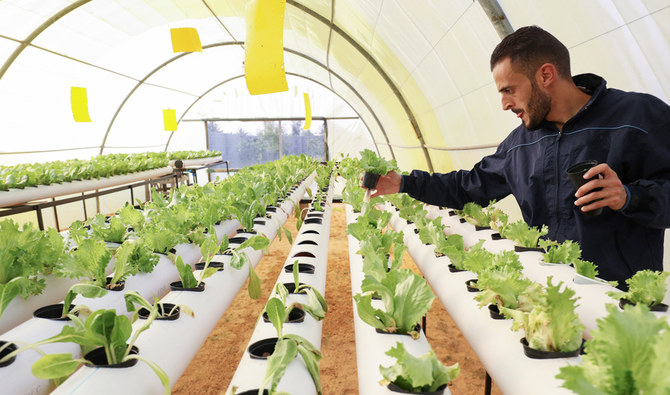
TRIPOLI: Under a yellow tarpaulin stretched over an arched metal frame, Siraj Bechiya and his partner inspect their hydroponically grown lettuce, pioneers of the method in mostly desert Libya where conventional agriculture struggles.
Zip ties, punctured plastic cups as pots and PVC tubing bought in DIY shops hold the precious crops at “Green Paradise” — so dubbed by the two young Libyan entrepreneurs spearheading the project.
But the ad hoc nature of the materials hasn’t stopped the plants from thriving, their long white roots nourished by water rich with nutrients and oxygen.
Bechiya and his partner, Mounir, have been working tirelessly on their project for months in the small town of Qouwea, 40 km east of the capital Tripoli, erecting a tunnel-shaped greenhouse surrounded by breeze-block walls on a semi-arid site.
Their hope is to demystify hydroponic farming, which “guarantees a good yield in small spaces,” uses little water and doesn’t need pesticides, 20-year-old Bechiya told AFP.
Soilless farming has gained ground in many countries but is still in its infancy in Libya.
But in a country whose territory is 90 percent arid desert, the method could offer a path toward more food self-sufficiency, Bechiya believes.
Agriculture remains a marginal sector in Libya, where the economy is dominated by hydrocarbons, the country boasting the most abundant oil reserves in Africa.
Arable land barely makes up three percent of Libya’s territory and is under threat, as rapid urbanization eats up the fertile strip along the Mediterranean coast.
Another major challenge to farming in Libya is the lack of water where agriculture needs it most.
The Great Man-Made River — a pharaonic project realized by former ruler Muammar Qaddafi more than 30 years ago — carries drinking water pumped from groundwater tables in the south to the northern cities where most Libyans live.
But this resource is not infinite, and the GMMR’s network has been heavily damaged in the decade of conflict that has ravaged Libya since Qaddafi’s ouster in a 2011 NATO-backed uprising.
In the face of these challenges, Bechiya and Mounir set out to train in hydroponics two years ago in neighboring Tunisia.
“When we came back, it was imperative that we move from theory to practice,” Bechiya said.
“We started with some vegetables in the house and we were surprised by people’s enthusiasm.”
In theory, hydroponics can guarantee higher yields and profits than conventional farming, which is at risk from weather, water shortages and pollution from unregulated pesticide use.
“With more space in the greenhouse, the idea was able to take off. We will continue to develop it ... and improve quality,” said Bechiya, as he measured the acidity of the water feeding his young lettuce.
“Libyan consumers don’t want produce full of pesticides anymore, but organic produce,” he added.


![]()

‘Green Paradise’ brings hydroponics to Libya
Short Url
https://arab.news/reske
‘Green Paradise’ brings hydroponics to Libya


Latest updates


© 2026 SAUDI RESEARCH & PUBLISHING COMPANY, All Rights Reserved And subject to Terms of Use Agreement.