Bahrain’s Arcapita buys FedEx distribution center in Texas

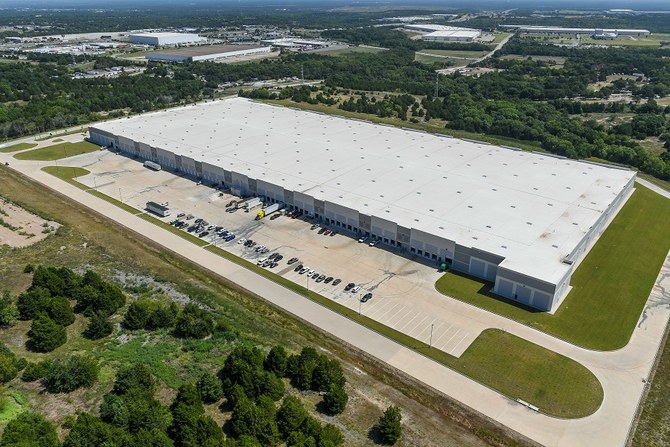
The center was built in 2018 and is located in Dallas-Fort Worth. (Supplied)
Short Url
Updated 13 April 2021
Follow

Bahrain’s Arcapita buys FedEx distribution center in Texas

  • Arcapita said the latest acquisition was part of the company’s investment in the fast-growing e-commerce sector

DUBAI: Bahrain-based investment firm Arcapita Group Holdings on Sunday announced it had bought a Texan distribution facility used by FedEx, bringing the total value of its US industrial real estate portfolio to over $200 million.

The latest acquisition of the Cedardale Distribution Center in Dallas brings to 16 the number of industrial facilities it has bought in Cleveland, Ohio and Indianapolis, Indiana.

The center was built in 2018 and is located in Dallas-Fort Worth, America’s fourth-largest metropolitan area, with a population of over 7.5 million people. It serves as a vital cog in FedEx’s distribution network in the southern US.

“The logistics sector is a key focus area for Arcapita. We have recently completed several acquisitions in the sector and as part of our broader strategy, we are focused on acquiring highly functional properties leased to investment grade tenants on a 10-15-year basis. We look forward to working with our partners to acquire additional assets in the months to come,” Brian Hebb, head of US Real Estate at Arcapita, said in a press statement.

Martin Tan, chief investment officer of Arcapita, said the latest acquisition was part of the company’s investment in the fast-growing e-commerce sector and the necessary supply chain to service it. Arcapita has offices in Atlanta, London and Singapore and an affiliated office in Bahrain. Over the last 24 years, it has recorded over 90 investments with a total transaction value in excess of $30 billion.

Lebanese social entrepreneur Omar Itani recognized by Schwab Foundation

Updated 23 January 2026
Follow

Lebanese social entrepreneur Omar Itani recognized by Schwab Foundation

  • FabricAID co-founder among 21 global recipients recognized for social innovation

DAVOS: Lebanon’s Omar Itani is one of 21 recipients of the Social Entrepreneurs and Innovators of the Year Award by the Schwab Foundation for Social Entrepreneurship.

Itani is the co-founder of social enterprise FabricAID, which aims to “eradicate symptoms of poverty” by collecting and sanitizing secondhand clothing before placing items in stores in “extremely marginalized areas,” he told Arab News on the sidelines of the World Economic Forum in Davos, Switzerland.

With prices ranging from $0.25 to $4, the goal is for people to have a “dignified shopping experience” at affordable prices, he added.

FabricAID operates a network of clothing collection bins across key locations in Lebanon and Jordan, allowing people to donate pre-loved items. The garments are cleaned and sorted before being sold through the organization’s stores, while items that cannot be resold due to damage or heavy wear are repurposed for other uses, including corporate merchandise.

Since its launch, FabricAID has sold more than 1 million items, reached 200,000 beneficiaries and is preparing to expand into the Egyptian market.

Amid uncertainty in the Middle East, Itani advised young entrepreneurs to reframe challenges as opportunities.

“In Lebanon and the Arab world, we complain a lot,” he said. Understandably so, as “there are a lot of issues” in the region, resulting in people feeling frustrated and wanting to move away. But, he added, “a good portion of the challenges” facing the Middle East are “great economic and commercial opportunities.”

Over the past year, social innovators raised a combined $970 million in funding and secured a further $89 million in non-cash contributions, according to the Schwab Foundation’s recent report, “Built to Last: Social Innovation in Transition.”

This is particularly significant in an environment of geopolitical uncertainty and at a time when 82 percent report being affected by shrinking resources, triggering delays in program rollout (70 percent) and disruptions to scaling plans (72 percent).

Francois Bonnici, director of the Schwab Foundation for Social Entrepreneurship and a member of the World Economic Forum’s Executive Committee, said: “The next decade must move the models of social innovation decisively from the margins to the mainstream, transforming not only markets but mindsets.”

Award recipients take part in a structured three-year engagement with the Schwab Foundation, after which they join its global network as lifelong members. The program connects social entrepreneurs with international peers, collaborative initiatives, and capacity-building support aimed at strengthening and scaling their work.