

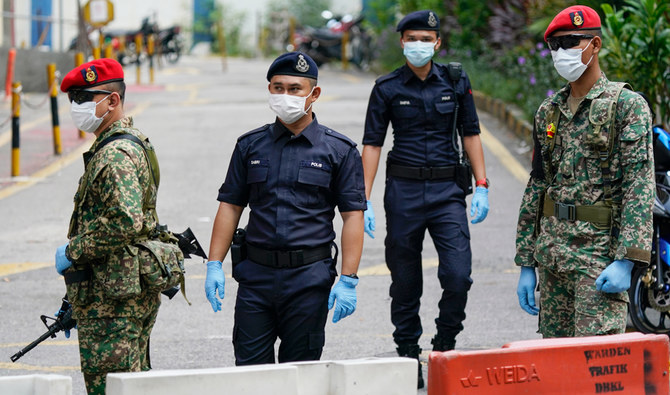
How close Saudi-Malaysian cooperation led to a drug bust

The drug bust was the result of a joint investigation by Malaysian police and the Saudi General Directorate of Narcotics Control. (AP)
Short Url
Updated 09 April 2021
Follow

How close Saudi-Malaysian cooperation led to a drug bust

  • Close cooperation with Saudi authorities comes as syndicates in the Middle East are shifting their routes to smuggle amphetamine pills, known as Captagon tablets, to the Arabian Peninsula through southeast Asia

KUALA LUMPUR: Close cooperation with Saudi Arabia authorities has helped Malaysia foil two major drug trafficking attempts in the past month, a top Royal Malaysia Police official said on Friday.

In the most recent operation, nearly 3.9 million amphetamine pills hidden inside a shipment container of aluminum floor springs were seized on Monday.

The drug bust was the result of a joint investigation by Malaysian police and the Saudi General Directorate of Narcotics Control (GDNC).

“It was the cooperation between the GDNC and Malaysia’s Ministry of Home Affairs that resulted in this drug seizure,” Malaysia's Narcotics Crime Investigation Department (NCID) director Razarudin Husain told Arab News.

The estimated worth of the drugs, he added, was about SR202.5 million ($54 million).

“The GDNC is one of NCID’s closest counterparts,” Husain said.

On March 15, with the help of GDNC, Malaysia seized 94.8 million Captagon pills worth $1.3 billion. According to Royal Malaysian Customs Department director general Abdul Latif Abdul Kadir, the drug bust was one of the largest in the country's history.

Close cooperation with Saudi authorities comes as syndicates in the Middle East are shifting their routes to smuggle amphetamine pills, known as Captagon tablets, to the Arabian Peninsula through southeast Asia.  

“Malaysia is being used as a transit before the drugs are distributed to the destination countries in the Middle East,” Husain said.

He also lauded the GDNC for its help in cracking down on drug trafficking in the region.

“It is important that drug enforcement agencies cooperate closely to take out drug syndicates that operate with no respect for our borders,” Husain said. “Through close and timely cooperation, we can take the fight to the drug syndicates.”


Greek police detain 313 in raid at university after mob attacked police

Updated 07 February 2026
Follow

Greek police detain 313 in raid at university after mob attacked police

  • Such attacks against riot police near the university campus are not uncommon
  • Riot police used tear gas and stun grenades to beat back the attackers

THESSALONIKI, Greece: Authorities in Greece on Saturday detained 313 people in a raid on the university campus of the country’s second-largest city, Thessaloniki, after riot police were attacked by mobs of people hurling more than 100 Molotov cocktails.
Greek police said roving groups of people wearing hoods emerged from the campus of the Aristotle University of Thessaloniki in the predawn hours Saturday to attack a squad of riot police. The unit is usually deployed some distance from the campus to quell any disturbances after all-night parties that take place on university grounds.
Police said all 313 people were released without being charged.
Such attacks against riot police near the university campus are not uncommon but it’s the first time that so many people were detained after such a clash during which an unusually high number of firebombs was used.
Riot police used tear gas and stun grenades to beat back the attackers. One officer was taken to a military hospital for burns to his face and leg while a 21-year-old civilian was treated for respiratory problems, police said.
The university said in a statement that off-campus “extremists” in conjunction with some individuals from within university grounds had committed the attacks. They said an investigation is underway to determine if any students had taken part. They added that no permission had been granted for any party to take place on university grounds.